
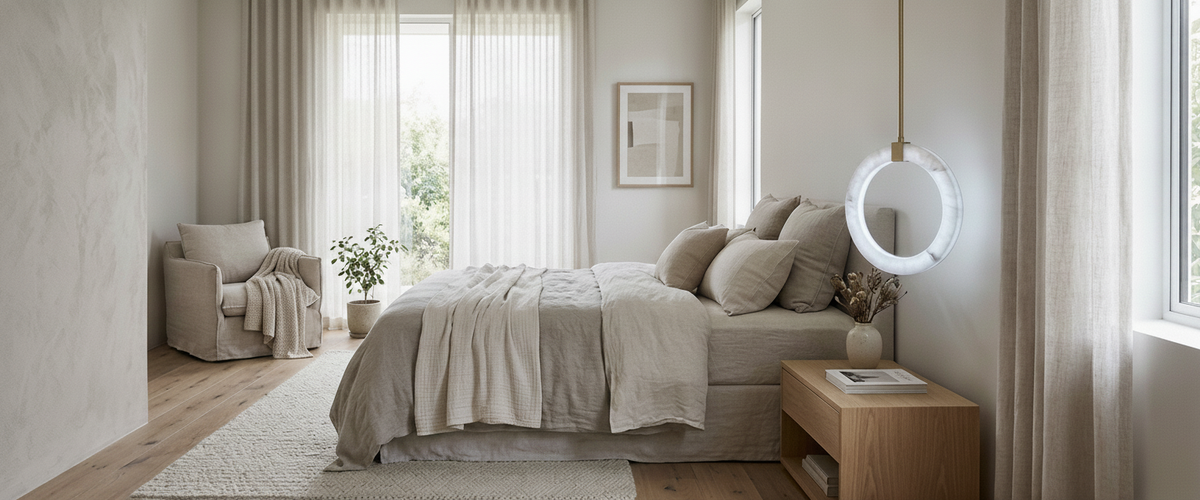

A single fitting hanging dead center in the ceiling is the fastest way to make a bedroom feel like a waiting room. Bright, flat, shadowless, and completely wrong for the one space in the house built for winding down. Good bedroom lighting works in layers, and the bedroom lights you pick change how the whole room reads at night. Alabaster and natural stone matter here more than almost anywhere else in the home, because a bedroom is where you look directly at your light sources from a lying-down position, and glare becomes very personal very quickly.
The fix is not complicated, but it does ask you to stop thinking about one big light and start thinking about three or four smaller pools of it. Good bedroom lighting is really just that: several modest sources doing quiet work instead of one loud one.
Layered bedroom lighting reads calm rather than clinical.

Key Takeaways for Bedroom Lighting
Never rely on one overhead fitting; layer ambient, bedside, and accent light.
Warm color temperature (around 2200K to 2700K) suits the wind-down hour far better than cool white.
Put every bedside light on a dimmer, ideally a separate one per side.
Alabaster and stone diffuse light so the source glows softly instead of glaring.
Balance the bed visually rather than matching every fixture on both sides.

Why One Overhead Fitting Flattens a Bedroom Every Time
Overhead light travels straight down. It sits behind you when you read, casts hard shadows under the eyes, and lights the floor more than the parts of the room you actually use. This is the single most common bedroom lighting mistake. Ceiling lights for a bedroom can still earn their place, but only as the gentlest layer, not the workhorse. When you shop for ceiling lights for the bedroom, look for shades that diffuse rather than beam, because the best ceiling lights for a bedroom soften their output before it reaches your eyes. This is where a translucent shade does real work. An alabaster pendant or ceiling light spreads a low, even wash across the room because the stone itself becomes the light source, softening the beam before it reaches you. You can browse the range of translucent fittings across our alabaster lighting collection to see how differently carved stone behaves compared with a bare bulb.
If your bedroom already has a downlight or spotlights, treat them as fill light on the lowest dimmer setting. They are useful for finding a lost earring in the morning. They are terrible for the last hour before sleep.
Bedside Decisions: Sconce, Table Lamp, or Both
The most important bedroom lights are the ones within arm's reach. Bedside pieces do most of the daily work in your bedroom lighting scheme, so this is where care pays off. Here you have three sensible routes, and the right one depends on how you use the bed and how much surface you have.
A sconce light fixture for the bedroom frees up the whole surface of your nightstand and throws light exactly where a reader needs it. A wall-mounted sconce light fixture in the bedroom is a favorite in the studio for smaller rooms and for clients who like a clear, uncluttered bedside. When choosing a sconce light fixture for a bedroom, mount the center of the fitting roughly 30 to 36 inches (75 to 90 cm) above the mattress, and angle or position it so the glow falls onto the page, not into your partner's eyes.
A table lamp is the flexible choice. You can move it, swap it, and it adds a decorative object to the room even when it is off. An alabaster or marble base table lamp gives you two lighting effects at once: task light through the top, and a soft ambient halo through the stone body. For anyone who reads sitting up, a lamp with a shade that sits at shoulder height when you are propped on pillows is the sweet spot.
Both is not overkill in a larger room. A low sconce for reading plus a table lamp for ambient glow lets you run the room at two different moods without touching the overhead fitting. This kind of flexible bedroom lighting suits master suites especially; with tall headboards, we often specify a sconce mounted high for a clean look and a small stone lamp below for warmth.
A stone sconce clears the nightstand and aims a soft glow onto the page.
Warm Color Temperature and Dimming for the Wind-Down Hour
Color temperature is the single setting most people get wrong in their bedroom lighting. Kitchens and bathrooms often run cool, around 4000K, which is fine for tasks and awful for rest. For bedrooms, aim for warm light between 2200K and 2700K. That lower range mimics candlelight and firelight, and it flatters both skin and stone. Alabaster in particular looks its best under warm light; the honey and cream tones in the veining come alive, whereas cool white can make natural stone look gray and lifeless.
Warm light in the evening is more than an aesthetic preference. Research from bodies such as the Sleep Foundation links exposure to bright, blue-heavy light close to bedtime with disrupted sleep, which is a strong argument for keeping your final hour dim and warm.
Put every fitting you can on a dimmer. A dimmed alabaster lamp at low output is one of the loveliest things you can do to a bedroom at night; the stone glows like an ember rather than a bulb. Use LED bulbs rated as dimmable, and pair them with a trailing-edge dimmer designed for LED loads. Mismatched dimmers are the usual cause of flicker and buzz. If you are changing switches or adding wiring for a hardwired sconce, use a qualified electrician; guidance from Electrical Safety First is a sensible starting point before any work begins.
What Watt Bulb for a Bedroom, and How Bright Is Enough
Forget old wattage habits from the incandescent era. With LED, wattage tells you energy use, not brightness; lumens tell you brightness. Good bedroom lighting starts with the right lumen count. For bedside reading you want roughly 400 to 800 lumens per lamp, which in LED terms is usually a bulb drawing 5 to 9 watts. For central ceiling lights for a bedroom used as ambient light, a bulb in the region of 800 to 1100 lumens on a dimmer covers most rooms. When the light passes through stone, some output is absorbed, so err slightly brighter than you would for a bare fitting and dim it down to taste.
Placing an Alabaster Fitting So Stone Glows Without Glare
The whole point of alabaster is that it hides the bulb. A raw LED filament is a hard, painful point of light; the same bulb behind a slab of carved stone becomes a soft, warm surface, which is exactly what good bedroom lighting wants. To keep it that way, position matters:
Keep bright sources below or above your natural sightline when lying down, not level with your eyes.
Choose thicker-walled stone shades where a fitting sits close to the bed, since thicker stone diffuses more and glares less.
Avoid placing a clear-glass or open-bottomed fitting directly over the pillows, where you will stare straight up into it.
One client in a low-ceilinged coastal cottage wanted an alabaster pendant over the bed. We shifted it to hang over the foot of the bed instead, so the glow washed back across the room without ever sitting in their line of sight from the pillows. Small move, completely different room. You can compare pendant, sconce, and ceiling options across the broader lighting range when you are working out what suits your ceiling height.
Balancing the Bed Without Matching Every Fixture
Symmetry feels safe, but a bedroom where both sides are identical can look staged. The trick is visual balance, not literal matching. A tall table lamp on one side can be balanced by a sconce plus a stack of books on the other, as long as the two sides carry similar visual weight and the light output is roughly even. Where you do want a pair, matching stone bedside lamps still reads calm because the veining in natural stone is never truly identical anyway; each piece has its own pattern, so a matched pair has quiet variation built in.
Keep the light heights close, though. A big difference in the height of the light source on each side is one of the few asymmetries the eye finds genuinely unsettling in a bedroom.
The Mistakes New Buyers Repeat, and the Quick Fixes
One central light, no layers. Fix: add at least one bedside source and put the overhead on a dimmer so the bedroom lighting has depth.
Cool white bulbs. Fix: swap for 2700K or warmer; the room will feel instantly calmer.
Non-dimmable bulbs. Fix: buy dimmable LEDs and a compatible trailing-edge dimmer.
Sconce mounted too high or too low. Fix: aim for the center around 30 to 36 inches above the mattress and test with someone in the bed before final fixing.
Lamp shade too small for the base. Fix: a stone base carries visual weight, so give it a shade with presence rather than a token one.
Forgetting the switch reach. Fix: make sure at least one light can be turned off without getting out of bed.
Caring for Stone Bedroom Lighting
Alabaster and marble are porous and softer than granite, so treat your bedroom lighting gently. Dust with a dry, soft cloth. For marks, use a barely damp cloth and dry immediately; skip household sprays, which can etch or stain the stone over time. Keep fittings away from radiators and steamy en-suite doorways where possible. Cared for simply, a stone fitting outlasts almost every trend you will put it next to.
Get the layers right and a bedroom stops feeling lit and starts feeling composed. That is the whole aim of considered bedroom lighting: warm, low, and glare-free, with stone doing the softening for you.