
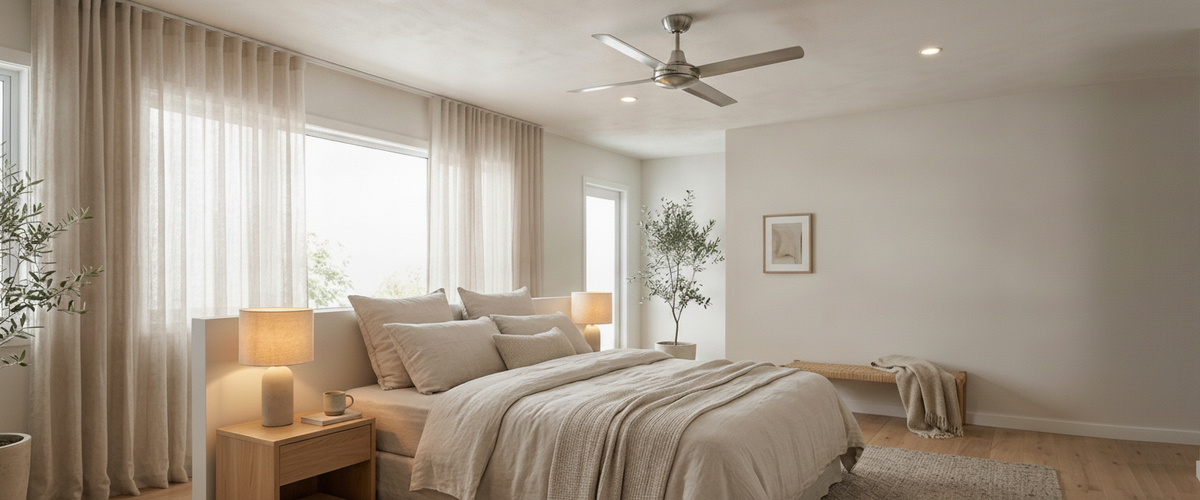

Bedroom ceiling fans lights get bought for a simple reason: one fixture that cools the room and lights it too. Tidy on paper. The trouble shows up the first night you lie back and stare straight into a bright disc of cold white light, with the whole room lit from a single point overhead. Bedroom ceiling fans lights earn their keep for airflow and general brightness, but as the only source in a bedroom they flatten the space and do nothing for the mood you actually want at 10pm.
That does not mean skip it. It means plan around it. Below is how bedroom ceiling fans lights behave, where they let you down, and how warm bulbs, diffusers, and a couple of well-placed bedside pieces turn them into part of a proper scheme rather than a compromise.

Key Takeaways
Bedroom ceiling fans lights handle airflow and broad ambient light, but they make poor task or mood lighting on their own.
Downlight blades push glare toward the bed; consider uplight or a shaded diffuser to soften what falls on you.
Warm bulbs (2700K, not 4000K) and a good diffuser kill the cold ceiling-fan glare most people complain about.
Add bedside sconces or lamps so you can read, wind down, and leave the fan light off entirely most evenings.
Match blade span to room size and keep the blades a safe height above the floor.

The Honest Limits of a Fan Light as Your Only Bedroom Source
Bedroom ceiling fans lights sit dead center, high up, and throw their brightness downward and outward in one flat wash. That is exactly what you do not want in a bedroom. Good bedroom lights work in layers: something soft overhead, something at bedside height for reading, and a low warm glow for the last hour before sleep. A single fan light collapses all three into one switch, and the result usually reads as either off or floodlit, with nothing in between.
There is also the glare problem. Because the light housing sits below the blades and often points straight down, you catch the source in your eyeline the moment you lie back. Bright, cool light in the evening suppresses melatonin and delays sleep onset, which is the opposite of what a bedroom fixture should do (the Sleep Foundation covers this well). So bedroom ceiling fans lights are genuinely useful for cleaning the room, changing the sheets, or a bright morning start. For the actual business of relaxing in bed, they need help.
Downlight Versus Uplight Blades and How Each Falls on the Bed
Bedroom ceiling fans lights come in two broad arrangements, and the difference matters more in a bedroom than anywhere else in the house.
Downlight fixtures mount the light below the motor and point the glow at the floor. They give you the most usable brightness and are the most common design. The catch is glare: lie flat, look up, and you are staring at the source. If you go this route, you want a deep opal diffuser or a shade that hides the bulb entirely.
Uplight or indirect fixtures bounce light off the ceiling instead. The room gets a softer, more even wash with almost no glare from the bed, which suits a bedroom far better. You lose a little raw brightness, but you gain comfort, and that trade is usually worth it in a room you use to sleep.
A halfway option we see in a lot of design projects is skipping the integrated fan light and running a separate ambient fixture nearby. Where you want the ceiling to carry a soft, even wash rather than a single hot spot beside the fan, a shallow diffused piece such as the Gemini Flush Ceiling Light 42.5cm in White reads far closer to the right language, sitting off to one side while the fan handles air. If you want to compare flush and semi-flush options more broadly, our lighting collection shows the range of diffusion you can get.
Warm Bulbs and Diffusers That Kill the Cold, Ceiling-Fan Glare
Most complaints about bedroom ceiling fans lights come down to the bulb, not the fan. Factory fittings often ship with a cool 4000K lamp, which reads clinical the second the sun goes down. Swap it for something warmer and the whole room changes character.
Color temperature: aim for 2700K in a bedroom. It is the warm, slightly amber tone that flatters skin, timber, and textiles. Save 4000K and above for kitchens and workshops.
Wattage equivalent: for general bedroom lighting most people are comfortable with an LED around 8 to 10 watts (roughly a 60 to 75 watt old-style equivalent) per bulb. If the fan takes multiple lamps, err lower per bulb so the total does not overpower the room.
Dimming: put the fan light on a dimmer if the fixture and bulbs allow it. Being able to drop the level for the evening is the single biggest upgrade you can make to bedroom ceiling fans lights. Check the bulbs are marked dimmable first.
Diffuser: a frosted or opal cover spreads the light and hides the bright filament point. Bare or clear-glass fan lights are the worst offenders for glare.
This is where a natural material earns its place. Alabaster and onyx do more than cover a bulb; the stone lets light pass through it, so the glow comes from the whole surface rather than a single hot spot. That diffused quality is exactly what bright, flat bedroom ceiling fans lights lack, which is why so many buyers pair a fan for air with a stone fixture for atmosphere.
Bringing in Bedside Sconces and Lamps So the Fan Stops Overworking
The moment you add light at bedside height, the fan light stops being the star and becomes the backup. That is the goal. A pair of table lamps or a sconce light fixture in the bedroom, one each side, gives you readable, directional light without lighting the whole ceiling.
Sconces free up the bedside table and keep the surface clear for a book and a glass of water. Mount them roughly at seated shoulder height when you are propped up in bed, usually somewhere around 55 to 65 inches (140 to 165 cm) from the floor, adjusting for headboard height. An alabaster wall light throws a soft pool downward for reading and a gentle glow upward, so it reads as decorative even when it is off.
Table lamps are the flexible choice if you rearrange furniture or move house often. A carved alabaster or marble base gives weight and a warm internal glow when the shade or stone is lit. For couples, a lamp each means one person can read while the other sleeps, which no single fan light will ever manage.
For the last layer, a small floor lamp or a low-output table lamp in a corner gives you that pre-sleep glow that keeps the overhead off entirely. This is the layer that lets you switch bedroom ceiling fans lights off for good most nights. The stone pieces in our alabaster lighting collection were chosen partly because they hold a low, warm light beautifully, which is precisely the register a bedroom wants after dark.
Blade Span and Mounting Height for the Fixture You Stare Up At
Get the physical fit right or bedroom ceiling fans lights will annoy you regardless of how good the bulbs are.
Blade span to room size: a small bedroom up to about 12 by 12 feet (roughly 3.7 by 3.7 m) suits a 42 to 44 inch (107 to 112 cm) span. Larger rooms take 52 inches (132 cm) or more. Too big a fan in a small room looks heavy overhead; too small and the air barely moves.
Ceiling clearance: keep the blades at least 7 feet (about 2.1 m) above the floor, and ideally 8 to 9 feet (2.4 to 2.7 m) for good airflow. On a standard ceiling use a flush or low-profile mount; on a high or vaulted ceiling a downrod brings the fan into the useful zone.
Bed position: center the fan over the open floor or the foot of the bed rather than directly over the pillows if you can. It cuts the sensation of light and air blowing straight down onto your face.
Weight and fixings: fans are heavier and create vibration, so they need a proper fan-rated ceiling box. This is not a job to improvise. Always have a qualified electrician fit any hard-wired ceiling fixture; the guidance from Electrical Safety First is worth reading before you start.
Scale matters just as much for the separate ambient fixture as it does for the fan itself. In a larger bedroom a wider flush piece keeps the ceiling from looking under-lit next to a 52 inch fan; something like the Gemini Flush Ceiling Light 61cm in Brushed Brass holds its proportion in a bigger room where a 42cm fitting would read as an afterthought. One lesson from the studio: buyers who treat bedroom ceiling fans lights as their only fixture almost always come back for a wall light or table lamp within a year. The ones who plan the fan as the air-and-backup layer from the start, and put the mood into alabaster or glass, are far happier with the room. Decide that split before you buy, not after.
A Quick Buyer's Checklist
Do you actually need the fan's light, or just its air? If air is the point, keep the light minimal and let other fixtures do the work.
Downlight or uplight? Uplight is kinder in a bedroom, and it is a big part of why the best ceiling lights for bedroom use point their glow upward.
Bulbs at 2700K, dimmable, with a real diffuser.
At least one bedside layer: sconce or lamp, ideally a pair.
Blade span matched to the room and blades at a safe height.
Fan-rated box and a qualified electrician for the install. Get that right and bedroom ceiling fans lights sit happily inside a scheme instead of running it.