
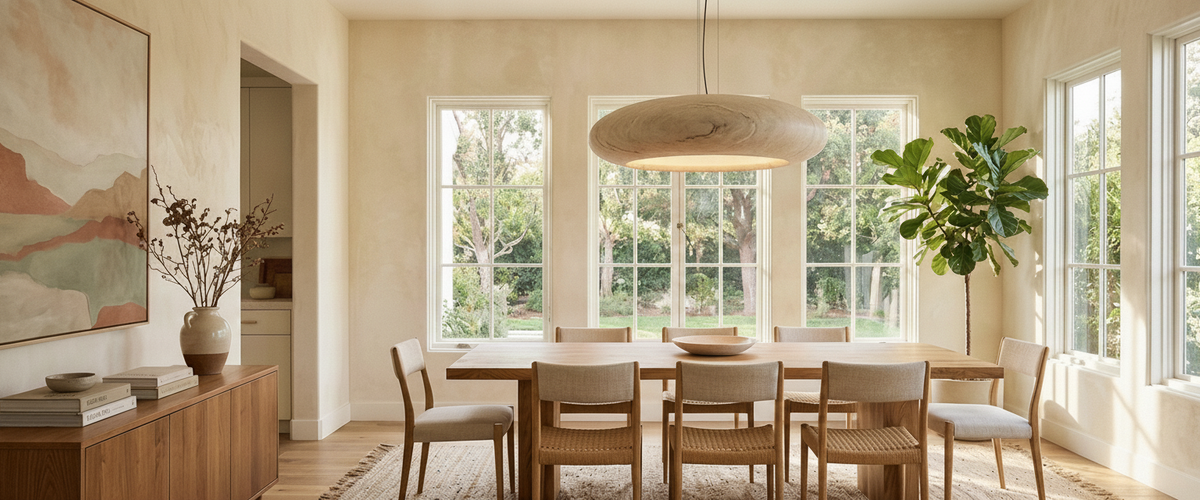

Walk into a room where the lighting has been done properly and you rarely notice the fittings first. You notice the wall glowing along its length, the shadow deepening in a corner, the warmth pooling under a pendant. That is the kind of architectural lighting modern interiors depend on: light treated as part of the structure rather than a set of objects bolted on afterwards. The trick is knowing when to hide the source and when to let one piece step forward and carry the whole scheme.
At Niori we build the visible end of that idea in alabaster and natural stone, so we spend a lot of time talking buyers through the balance between what should disappear and what should be seen. Good modern architectural lighting gets the ratio right; get it wrong and even a considered room reads flat.
A quiet base of concealed light with one alabaster pendant as the focus.

Key Takeaways
Modern architectural lighting layers hidden light (recessed, coved, grazed) with a small number of deliberate focal fixtures.
Alabaster and stone earn their place as the seen element: they diffuse light into a warm, even glow rather than a hard point.
One statement fixture over an integrated base beats several competing pieces.
Over-lighting is the most common mistake; a pared-back room needs restraint, not more lumens.
Wall lighting should reveal texture while the fitting itself recedes.

What Architectural Lighting Really Means Once Stone Does the Work
Architectural lighting is light designed alongside the building, not chosen at the end like a cushion. It follows lines, grazes surfaces, and defines volume. In a modern home that usually means recessed downlights, linear coves, and concealed strips doing the structural work, with a handful of decorative pieces adding character. That mix is the backbone of any modern architectural lighting plan.
Stone changes what the decorative layer can do. A bare bulb or a metal shade throws a hard, directional beam. Alabaster reads light differently. The stone is faintly translucent, so light travels a short way into the material and comes back out softened and warmed, carrying the veining with it. That is why a single alabaster pendant can feel like it is lighting a room from within rather than pointing at it. When people say modern architectural lighting feels calm, this diffusion is usually part of the reason.
Recessed, Coved and Grazed Light Against Decorative Statement Pieces
Think of your scheme in two registers. The hidden register sets the mood and does the practical work. The visible register gives the room its face. Most modern architectural lighting lives or dies on how well those two registers talk to each other.
Recessed downlights handle general and task light. Kept tight to walls and worktops rather than dotted across the ceiling in a grid, they stay quiet. Coved lighting tucked into a ceiling perimeter or a shelf reveal lifts the whole volume with soft, indirect light and no visible fitting. Grazing places a light close to a wall and skims it at a shallow angle, which pulls out texture: plaster, timber, stone cladding, brick.
Against that quiet base you place the statement. This is where a carved alabaster chandelier, a marble table lamp, or an onyx wall light does its job. Because the background is already lit, the focal piece does not have to work hard as a light source. It can be sculptural. You will find the range of pendants, chandeliers, wall and table lights across our lighting collection if you want to see how the seen and unseen layers of a modern architectural lighting scheme pair up.
Grazed light skims the wall to reveal texture while the fitting stays hidden.
Lighting a Wall So the Texture Shows and the Fitting Disappears
The best wall light design for modern homes usually hides its own presence. You want the effect, not the object announcing itself. That means fittings with a low profile, a warm output, and a diffuser that spreads light up and down the wall rather than blasting a bright disc at eye level.
Alabaster wall lights suit this well because the stone itself becomes the diffuser. Light comes through the material as a gentle wash instead of a hard edge, and the veining gives the fitting quiet interest even when it is switched off. Mount a pair either side of a bed or a fireplace and the wall reads as a soft vertical band of light with a stone object floating on it. This is modern architectural lighting at its most understated.
A few practical rules keep wall lighting architectural rather than decorative for its own sake:
Mount at a height that throws light onto the wall plane, not into people's eyes. Around 60 to 66 inches (150 to 168 cm) to the fitting centre suits most sightlines.
Choose fittings that emit both up and down for the widest, softest wash.
Keep the wall finish in mind. A matte plaster or lime wash catches grazed light beautifully; high gloss can hot-spot.
Space evenly and symmetrically. Modern rooms punish a fitting that sits slightly off-centre.
Where Alabaster and Stone Earn a Place in an Integrated Scheme
Not every point in a scheme wants stone. The concealed layer should stay anonymous. Stone earns its place at the moments where the eye naturally rests: over a dining table, beside a bed, on a console in an entrance hall, at the turn of a staircase. That placement is what separates thoughtful modern architectural lighting from a room full of fittings.
Alabaster has been prized for exactly this warmth for centuries. Medieval and Renaissance carvers used it for window screens and lamps precisely because it lets light through as a soft glow; the Metropolitan Museum of Art holds carved alabaster pieces that show how long makers have understood the material's translucency. That history is worth knowing because it tells you what the stone does best: it is a light-shaper, not a spotlight.
Each stone behaves a little differently. Alabaster gives the softest, most milky diffusion. Marble reads more solid and sculptural, often used where you want mass and presence rather than glow. Onyx carries dramatic banded veining and can look almost lit from within when a warm source sits behind it. Brass detailing ties any of these to a modern metal palette without stealing focus. Our alabaster lighting collection is the place to compare how those materials handle a warm bulb in a modern architectural lighting scheme.
On the question buyers ask us most: yes, high-quality wall lights for modern decor do exist at the point where the stone, the metalwork, and the electrical build are all considered together. Quality shows in even wall thickness (so the stone glows uniformly rather than blotchily), solid brass or steel fixings rather than plated pot metal, and a driver or lamp holder rated for the fitting. A cheap stone light betrays itself the moment you switch it on and see uneven dark patches.
One Deliberate Focal Fixture Layered Over Hidden Light
Restraint is the whole game. A modern architectural lighting scheme wants one piece that the room is organized around, sitting on top of the quiet architectural base. In a dining room that is almost always the pendant or chandelier over the table. In a living room it might be a floor lamp reading against a wall of concealed cove light, or a single sculptural table lamp on a low console.
We shipped a pair of alabaster pendants to a project in a converted warehouse where the client had already installed recessed strips along the ceiling beams. The builder wanted to add four more downlights over the island. We talked them out of it. With the coves carrying the ambient level, two low-hung alabaster pendants over the island were enough, and the room finally looked designed rather than lit. That is the layering principle in one job: the hidden light does the volume, the stone does the focus.
To choose your focal piece, work through a short decision list:
Sightline: where does the eye land first when you enter? Put the statement there.
Scale: a focal fixture should feel generous. Undersized pieces read timid over a dining table or in a double-height hall.
Height: hang pendants so the base sits roughly 30 to 36 inches (76 to 91 cm) above a table surface.
Material match: pick the stone that matches the mood. Milky alabaster for calm, banded onyx for drama.
One, not four: resist adding a second competing statement in the same room.
The Over-Lighting Mistakes That Flatten a Pared-Back Interior
The fastest way to ruin a considered modern room is to add more light. Over-lighting kills contrast, and contrast is what gives a space depth. A wall of even, shadowless brightness looks like an office, not a home, and it undoes the point of modern architectural lighting.
Common errors we see:
The downlight grid. Ceilings peppered with evenly spaced spots flatten everything. Place downlights with purpose, near the surfaces that need them.
No dimming. Every layer should dim independently. Fit trailing-edge LED dimmers matched to your drivers and check compatibility before install; poor pairing causes flicker and buzz. The guidance from Electrical Safety First is worth a read, and any hard wiring should be signed off by a qualified electrician.
Cold color temperature. Stone wants warmth. Aim for around 2700K so alabaster glows amber-honey rather than looking gray and clinical.
Competing statements. Two loud fixtures in one room cancel each other out.
Care keeps stone lighting looking right over years. Dust alabaster and marble with a dry, soft cloth; skip household sprays, which can etch or stain the stone. Keep fittings away from steam and standing water. Warm, low-wattage LED lamps run cooler and are kinder to the stone than old halogens ever were.
Do the quiet layer well, choose one honest piece of stone to carry the room, and dim it all. That is the sort of modern architectural lighting real homes actually want, and it is the approach we build for at Niori.