
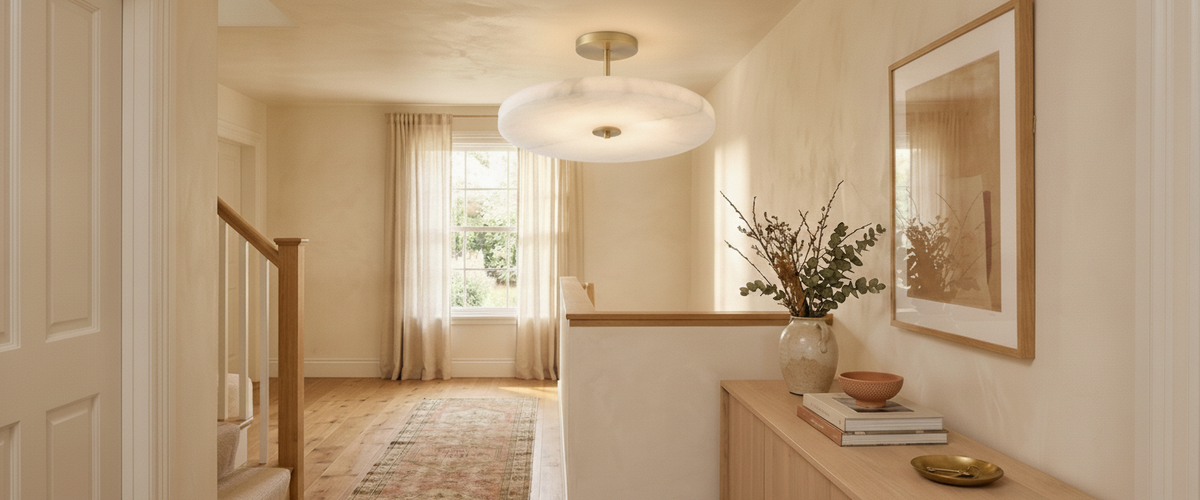

Some ceilings simply refuse a pendant. Too low, too busy overhead, a walkway where a hanging fixture would clip someone's head at every pass. That is exactly where an alabaster semi flush earns its keep. It sits close to the ceiling but drops just far enough for the stone to catch and soften the light, so you get warmth and presence without the swing and sightline problems of a suspended piece.
The stone is the point. Alabaster is mildly translucent, so an alabaster semi flush glows from within rather than throwing a hard cone downward. In a hallway or a low-ceilinged bedroom, that difference is the whole reason to spend on stone rather than a plain glass dome.
An alabaster semi flush lifts a low hallway without dropping into head height.

Key Takeaways
A semi flush hangs closer to the ceiling than a pendant but stands off it more than a flush mount, giving the stone room to glow.
Mounting height and viewing angle decide whether the veining reads as depth or as a flat gray disc.
Kitchens, landings, and stairwells are the rooms where an alabaster semi flush usually beats a pendant.
Warm bulbs (around 2700K) on a dimmer keep alabaster looking honey-lit, not cold.
Both contemporary and antique-style alabaster ceiling lights suit this format; the frame metal does most of the talking.

How a Semi Flush Sits Between a Pendant and a Flush Mount
Think of ceiling lights as a spectrum. A flush mount presses tight to the plaster and disappears; a pendant drops on a rod or cord and becomes a focal object. An alabaster semi flush lives in the middle, standing off the ceiling by a few inches (roughly 3 to 12 inches, or 8 to 30cm, depending on the design) on a short stem or spacer.
That small gap matters more than it sounds. It lets light spill up onto the ceiling as well as down, which lifts the whole room and stops the fixture reading as a dark lump. With alabaster, the gap also lets the top edge of the stone catch a little glow, so the piece looks lit through rather than lit at. That is the effect people are really buying when they choose stone over opaque materials.
Mounting Height and Sightlines That Decide How the Stone Reads
Alabaster only shows its veining when light passes through it at the right angle. Mount an alabaster semi flush too high and tight, and from below you see a flat, evenly lit face; the movement in the stone gets lost. Give it a touch of drop and you start to read the shoulders of the piece, where the stone thins and glows brighter.
As a rough working rule, most homes want at least 7 feet (about 2.1m) of clear head height below any ceiling fixture in a walkway. In a room where people sit rather than pass, you have more freedom. We had a client in a converted barn with 9-foot ceilings who wanted a pendant over a landing; the drop would have loomed over the stairs. A wide alabaster semi flush solved it, sitting high enough to clear every head while still glowing across the full width of the space. On a broad landing like that, a larger-diameter fitting such as the Gemini Flush Ceiling Light 81cm in Brushed Brass covers the span without needing to drop deep into the stairwell.
One habit worth borrowing from lighting engineers: look at the fixture from where you will actually stand or sit, not from directly beneath it. The Chartered Institution of Building Services Engineers publishes guidance on lighting design and visual comfort that is worth a skim if you are planning several rooms at once.
A pair of stone fittings gives a galley kitchen soft ambient light without pendant glare.
Room by Room: Kitchens, Landings, and the Ceilings That Fight Back
Kitchens are the obvious home for an alabaster semi flush. Cabinets, extractor runs, and downlights already crowd the ceiling, and a pendant over a walkway just gets in the way. A pair of stone fittings down the center of a galley kitchen gives soft ambient light that flatters worktops without the glare of bare spots.
Landings and stair returns are the second big win. These are transit spaces with awkward ceiling heights and, often, no natural light. A single alabaster semi flush here does quiet, generous work; the warm glow reads as welcoming rather than utilitarian. If you are lighting a run of connected spaces, browse the full lighting range to keep frame finishes consistent from hall to landing.
Bedrooms with low or sloped ceilings are the third. A pendant over a bed can feel oppressive; a close-mounted alabaster semi flush keeps the ceiling calm while the stone throws a soft, sleep-friendly wash. In a compact bedroom where you want presence without bulk, a mid-size fitting such as the Gemini Flush Ceiling Light 42.5cm in White sits quietly against a pale ceiling. Bathrooms and utility rooms can take one too, provided the fitting carries the right ingress-protection rating for the zone; ask before you assume, since not every decorative piece is bathroom-rated.
Contemporary Versus Antique Semi Flush in the Same Doorway
The stone stays roughly the same; the metalwork sets the mood. An alabaster contemporary ceiling light tends toward clean geometry, slim spacers, and matte or brushed metal. An alabaster modern ceiling light often leans on a single bold disc or drum of stone with minimal hardware, letting the material dominate. An antique alabaster ceiling lights brings warmer brass, softer edges, and sometimes a fluted or scalloped stone profile that nods to older schemes.
An alabaster transitional ceiling light is the diplomat of the group. It borrows a little from both camps, which is why an alabaster semi flush in this style slots into so many British homes that are neither strictly period nor strictly minimal. If you have a Victorian terrace with a modern kitchen extension, a transitional fitting in the hall lets the two halves talk to each other. Where the frame metal needs to carry the period warmth, a brass finish like the Gemini Flush Ceiling Light 61cm in Brushed Brass reads closer to that antique language than a black or white frame would.
A practical test we use in the studio: stand two candidate fixtures in the same doorway and squint. The one whose frame disappears and whose stone stays legible is usually the right call for that room. You can compare framing styles across our alabaster lighting pieces before you commit.
Bulb and Dimming Choices That Make the Alabaster Glow, Not Gray
This is where most alabaster ceiling lights are won or lost. Alabaster is a warm, cream-and-honey stone. Put a cool white bulb behind it and the whole piece turns flat and slightly gray, like a cloud on a dull day. Put a warm bulb behind it and the veining comes alive.
Color temperature: aim for around 2700K for living spaces and bedrooms. If a fixture is sold at 4000K, treat that as a neutral-white spec better suited to task areas than to showing off stone, and check whether a warmer lamp option is available.
Dimming: put every alabaster semi flush on a dimmer. The stone looks its best at 40 to 70 percent output in the evening, where it reads as a lit object rather than a bright source. Make sure the driver or bulb is genuinely dimmable and matched to your dimmer type.
Even fill: multiple lower-output lamps inside a wide fitting light the stone more evenly than a single bright bulb, which can create a hot spot that bleaches out the veining.
Color rendering: a high CRI lamp (90 or above) keeps skin tones and worktop colors honest under the warm glow.
Always have a qualified electrician handle the wiring and confirm the driver is compatible. The charity Electrical Safety First keeps clear guidance on safe installation that is worth reading before any ceiling work.
Placement Mistakes We Keep Fixing on Client Projects
The same handful of errors come up again and again with an alabaster semi flush.
Under-scaling. A small fitting on a broad ceiling looks like an afterthought. Measure the room and let the stone carry some weight; a wider piece grounds the space.
Centring on the room instead of the furniture. Over a kitchen island or a bed, align the fixture to the object people use, not the geometric center of the ceiling.
Fighting downlights. If you already have a grid of cool recessed spots, a warm stone fitting can look confused. Dim or zone the downlights so the stone becomes the evening layer.
Ignoring the top view. On a stair or split level, people see the fitting from above as well as below. Choose a piece whose top finish is tidy, since the spacer and fixings will be on show.
Skipping the dimmer. Full-output alabaster in a small hall is harsh. The dimmer is not a luxury here; it is how the material was meant to be seen.
Get the height, the bulb, and the scale right and an alabaster semi flush does something a flat ceiling light never can. It reads as a piece of stone that happens to hold light, which is the whole reason Niori works with alabaster and natural stone in the first place.