
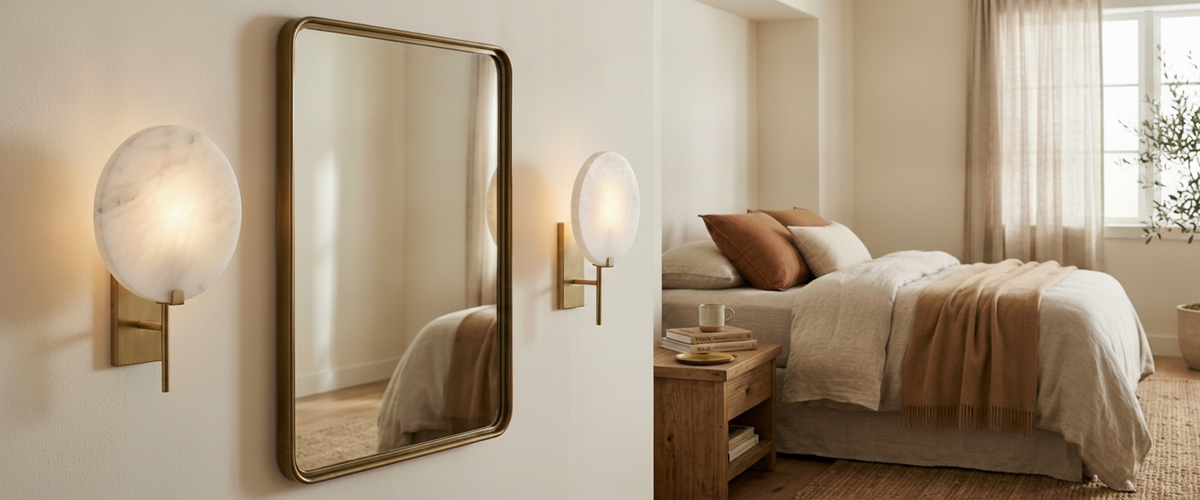

The wall light is the fitting most people leave until last, and it's the one that decides whether a room reads finished or flat. This buyer's guide sorts the family (sconces, uplighters, picture lights and exterior fittings), compares indoor and outdoor builds, and matches output, finish and scale to the job. Skip the right wall light and everything hangs from the ceiling, with nothing working at eye level. A well-placed fitting washes a surface, frames a doorway or throws a soft pool of light exactly where you stand, sit or read. Choosing well comes down to type first, then rating and scale, so we start there.
Get it right and the room gains depth. Get it wrong (an indoor rating on an exposed porch, a wall light three sizes too small for the wall) and it reads like an afterthought. Alabaster and natural stone earn their keep here. The material is thick enough to soften a bulb into a warm, low-glare glow, which is precisely what you want at head height. Below is how to sort the family, compare the builds, and match output, finish and scale to the job.

Key Takeaways
Sort the type first: sconce, uplighter, picture light and exterior fittings each solve a different problem.
Indoor and outdoor builds are not interchangeable. Check the IP rating on any wall light before anything else.
Decide the job: accent, task or pure atmosphere. That dictates output and beam direction.
Scale to the wall, not the box. An undersized fitting is the most common mistake.
Use a qualified electrician for any hard-wired install.

Sorting the Wall-Light Family
The term "wall light" covers several jobs that behave very differently once they're switched on. Choosing the right one starts with knowing which of these you actually need.
A wall sconce lighting setup is the classic pairing: two either side of a bed, a mirror or a fireplace. Sconces can throw light up, down, or diffuse it in all directions. In alabaster, this style of fitting glows across its whole face rather than firing a hard beam, which is why it flatters skin and softens bathroom mirrors so well.
An uplighter pushes light toward the ceiling, bouncing it back down as indirect fill. It's the quiet workhorse of a calm living room, lifting the space without a single visible glare source. A picture light is the specialist wall light, angled to graze artwork or a stone panel. And exterior wall lights are their own category entirely, built to survive rain, frost and UV.
If you want to see how these forms translate into alabaster and natural stone, our alabaster lighting collection is the clearest place to compare faces, veining and scale on each wall light side by side.

Comparing Indoor and Outdoor Builds Before You Buy the Wrong One
This is where money gets wasted. An indoor fitting placed on an exposed wall will corrode, fog and fail. The dividing line is the IP rating, a two-digit code for how well a fitting resists dust and water, and it's worth respecting as the baseline for choosing by location. The IEC's IP rating system sets out exactly what each digit means, so you can match a wall light to how much weather it will face.
For a sheltered porch or covered entry, IP44 is usually the working minimum; it handles splashing water from any direction. A rated fitting such as the Outdoor Wall Light E27 IP44 in graphite is the kind of build that suits that job, where the seal matters more than the material. Move to an open wall with driving rain and you want more protection again. Outdoor wall lights also use sealed gaskets, corrosion-resistant fixings and finishes chosen to hold up outdoors: think graphite, powder-coated black, or warm coffee and grey tones that weather gracefully.
A few practical distinctions worth holding onto:
Indoor sconces prioritise light quality and material. Alabaster, marble, brass detailing.
Exterior wall lighting prioritises the seal, the fixing and the rating. Up/down beam shapes are popular for framing a front door or grazing a garden wall.
Bulb access matters outside; you want a wall light you can re-lamp without dismantling half of it.
Solid stone is generally an indoor material. For a wall with lighting outside, choose a purpose-built exterior wall light and save the alabaster piece for the hallway behind the door.
Matching Light Output to the Job
Before you look at a single finish, decide what the wall light is actually for.
Accent lighting shapes a room. A picture light grazing a canvas, or a pair of uplighters lifting an alcove, adds contrast and drama at low output. You don't need much lumen here; you need direction and restraint, so the fitting does the shaping and the room takes the credit.
Task lighting has to work. A reading sconce beside a bed, or a wall light flanking a bathroom mirror, needs enough output to see by without dazzling. Aim the light where the task happens and, ideally, put it on a dimmer so you can drop it to a whisper at night.
Atmosphere is where alabaster shines. Because the stone diffuses the source through its body, a single warm bulb in a wall light reads as a soft, even glow rather than a hotspot. That's the effect people remember in a hotel corridor or a quiet dining room. For colour temperature, sit in the warm band (roughly 2400K to 2700K) and choose bulbs with a high colour rendering index, ideally 90 or above, so the veining in the stone still looks like stone.
Finish and Scale Choices That Read Intentional
Two things separate a considered wall light from a random one: finish and size.
On finish, let the room's metalwork lead. Brass warms up alabaster and pairs with aged bronze taps and handles; a blackened or graphite finish suits a cooler, more architectural room. Natural stone gives you a second decision, the veining. A busy, dramatic marble wants a simpler form around it; a quiet, near-white alabaster can carry more sculptural detail on the same fitting.
On scale, err larger than instinct suggests. Buyers routinely pick a wall light that looks right in the hand and far too small once it's on a two-metre wall. Where a wall calls for real presence rather than a discreet accent, a tall fitting such as the Essence Round Wall Light 115cm in brass holds its own against a large mirror or headboard in a way a compact sconce cannot. As a rough starting point, a wall light beside a mirror should sit around 60 to 66 inches (152 to 168 cm) from the floor at its centre, and its width should feel proportional to the mirror or headboard beside it, not lost against it. When in doubt, hold a paper template to the wall for a day before you commit.
Where Each Type Earns Its Place
Entrance and hallway: a pair of sconces at consistent height turns a corridor from a pass-through into a room. An alabaster wall light gives a welcoming glow that a downlight never will.
Bedroom: swing-arm or fixed reading sconces free up the nightstand and put light where a book is. Wire each wall light on individual switches so one partner can read while the other sleeps.
Bathroom: a wall sconce light flanking the mirror beats lighting from above, which casts shadows under the eyes. Confirm the wall light is rated for the zone it sits in.
Living room: uplighters on either side of a chimney breast build symmetry and lift the ceiling. A picture light over the mantel art finishes it, and a matching wall light keeps the pair reading as one scheme.
Exterior: up/down fittings either side of a front door read as intentional and light the threshold safely. For that symmetrical framing, an outdoor wall light like the Rex Up Down Outdoor Wall Light in grey throws light in both directions and weathers to suit most door furniture. Space them evenly and match the finish to your door.
To browse across pendants, sconces and floor pieces in one place, the full niori lighting collection shows how a single wall light can echo the rest of a room's scheme.
The Specs That Separate a Lasting Fixture From a Landfill One
A wall light lives on the wall for years, so the boring details decide whether you're happy in year five.
Bulb standard: a common cap such as E27 keeps re-lamping simple and cheap.
Dimmability: check the driver and bulb are both dimmable, and pair them correctly.
IP rating: non-negotiable on any exterior wall light and in bathrooms.
Materials at the fixing: corrosion-resistant fixings on outdoor wall lights; solid backplates that sit flush.
Serviceability: can you open it, clean it and change the bulb without specialist tools?
For alabaster and stone, care is refreshingly low-effort: dust with a dry, soft cloth, avoid solvents and anything abrasive, and never soak the stone. Because each fitting is cut from natural material, veining and tone vary between pieces, which is the point.
Buy for the job, respect the rating, size up rather than down, and the wall light stops being decoration and starts doing real work. If you're weighing materials or scale for a specific room, ask us for a tailored recommendation on the right wall light; the right stone in the right place is worth getting right the first time.