
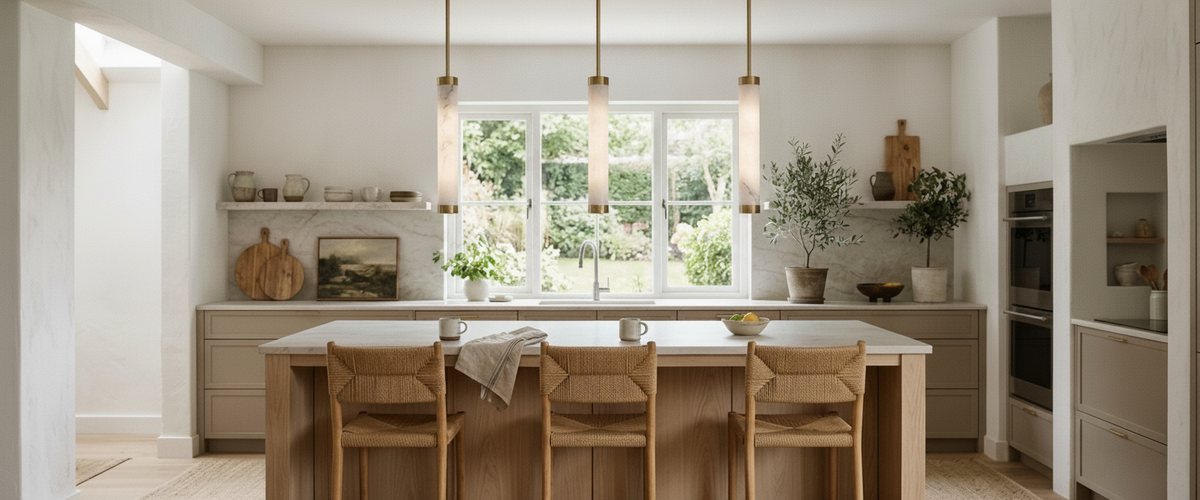

A kitchen island can carry the best joinery in the house and still look unfinished, and nine times out of ten the problem is the pendants. Either there is one lonely fixture stranded over a three-metre run, or three shades crammed together at a height that blinds anyone chopping onions. Good kitchen pendant lighting is mostly arithmetic and restraint, with a bit of material judgement on top; the best kitchen pendant lights only earn their keep once the spacing, height, and shade size are right, so the row reads as if it was always meant to be there.
This is the part of a kitchen where alabaster earns its place. Kitchens are full of reflective, unforgiving surfaces; stone shades give back a warm, diffused glow that takes the edge off all that hard geometry, which is why alabaster kitchen pendant lighting suits these rooms so well.
Alabaster pendant lights for a kitchen island soften the glare of hard, reflective surfaces.

Key Takeaways
Count: Most islands take two or three pendants; the island length and shade width decide which.
Height: Aim for the bottom of the shade roughly 30 to 36 inches (76 to 91 cm) above the worktop.
Spacing: Divide the island into equal sections and centre a pendant in each; do not just split the difference by eye.
Material: Alabaster and natural stone diffuse light and warm a room full of hard surfaces.
Control: Put pendants on their own dimmer so the same fittings work for prep and dinner.

How Many Pendants Your Island Actually Needs
Start with the island length, not a Pinterest board. As a working rule, a run up to about four feet (1.2 m) suits a single larger pendant or two small ones. Islands between four and seven feet (1.2 to 2.1 m) tend to look right with two medium shades or three smaller ones. Anything longer usually wants three, occasionally a run of four if the shades are slim. Choosing the right pendant lights for a kitchen is as much about proportion as it is about style, and good kitchen pendant lighting always starts from the measurements.
The mistake we see most often is odd spacing that looks accidental. Treat the island as a line to be divided into equal parts. For two pendants, split the length into three and hang each fixture on the first and second division. For three, divide into four and place one on each internal line. That keeps the gaps even and stops the row drifting toward one end. If you are choosing between two large shades and three small ones, ask whether the island is a quiet backdrop or the centre of the room. Fewer, larger shades read calmer; a trio of smaller ones feels more rhythmic. For a slim row of three, a compact fixture such as the Gemini Pendant Light 42.5cm keeps each shade small enough to repeat without crowding the run.
Cluster pendants sit slightly outside this maths. A tight cluster of small shades behaves as a single visual point, so you place it like one fixture and let the grouping do the work. It suits a squarer island better than a long galley run, and a piece like the Dynamite Square Cluster Pendant Light shows how the grouping reads as one deliberate focal point rather than several competing shades.
Even spacing is what makes kitchen island pendant lighting read as deliberate rather than accidental.
Hanging Height: Light the Food, Not the Cook
Hang too high and the light spreads thin and floods the ceiling. Hang too low and every guest across the island loses eye contact behind a shade. The reliable window for kitchen island pendant lighting is around 30 to 36 inches (76 to 91 cm) from the worktop to the bottom of the shade. Taller households sit at the upper end; if the cook is over six feet, add an inch or two so nobody ducks.
Ceiling height changes the sums. A standard eight-foot ceiling wants pendants at the lower end of the range so they do not crowd the head height of anyone standing. A tall or vaulted ceiling lets you drop them further and gives the drop cable room to look intentional rather than stubby. Alabaster helps here because the shade itself glows; even when it hangs a touch higher than a metal shade would, the stone keeps a soft presence at eye level instead of turning into a dark silhouette.
One practical note. If two people cook at the island at once, check the sightline between them before you sign off on height. A pendant that clears one person's eyeline can still block the person opposite. Cardboard mock-ups on string, taped to the ceiling, cost nothing and save a re-drill. This is the sort of check that separates good kitchen pendant lighting from a row that fights the room.
Why Alabaster and Stone Shades Soften a Hard Kitchen
Kitchens are built from reflective planes: quartz worktops, gloss cabinetry, steel appliances, glazed splashbacks. Bare bulbs and clear glass bounce off all of it and create glare exactly where you are working. Alabaster does the opposite. Light passes through the stone and scatters, so the source softens into a warm wash rather than a hard point, which is the whole case for stone kitchen pendant lighting.
The material also brings texture that a kitchen often lacks. Natural stone carries veining and slight colour shifts, and because every block is different, no two shades read identically. The Natural Stone Institute has good background on how these variations are inherent to genuine stone rather than a flaw (naturalstoneinstitute.org). That individuality is part of why alabaster reads as considered rather than off-the-shelf. You can see the range of forms this works across in the alabaster lighting collection, from slim island pendants to larger statement shades.
Onyx and marble detailing extend the same idea if you want more drama. Onyx tends to carry stronger colour and banding, which suits a kitchen where the island is deliberately the focal point. Marble accents on brass fittings pull the palette toward warmth without shouting, and either finish gives your pendant lights kitchen island scheme a bit more character.
Layering Pendants With Downlights and Under-Cabinet Strips
Pendants should never be the only light in a working kitchen. They set the mood and mark the island, but they are not built to light a chopping board on their own. The layers that do the real work are recessed downlights over the main circulation and prep zones, and under-cabinet strips that throw task light straight onto the worktop without casting your own shadow. Think of kitchen pendant lighting as one layer among several.
The trick is stopping the layers from competing. Keep the pendants on the warmer, lower-output setting for atmosphere and let the under-cabinet strips handle bright task lighting. If the downlights share the same warm colour temperature as the shades above, the room reads as one scheme rather than a patchwork. For colour temperature guidance in domestic spaces, the Chartered Institution of Building Services Engineers is a sound reference (cibse.org). In most homes, a warm white around 2700K to 3000K flatters both food and stone.
If you want to browse pendants alongside the ceiling and wall pieces that complete a layered scheme, the full lighting range is a useful place to compare forms and finishes.
Sizing Shades to the Island So the Row Reads Deliberate
Shade width matters as much as count when you plan kitchen pendant lighting. Kitchen pendant lights that are too small leave an island looking under-dressed; oversized shades that nearly touch make the run feel crowded. A rough guide: the combined width of the shades plus the gaps between them should sit comfortably within the island length, leaving clear margins at each end so the row does not run off the edge.
Keep the gap between shades a little larger than the shade width for slim pendants, and roughly equal for wider ones. Consistency is what sells it. Matched shades in a straight line always read more deliberate than a mixed set, unless you are deliberately staging a cluster. Depth counts too on a tall ceiling: a shallow disc can vanish, while a fuller alabaster form holds the eye. Over a long island where a single kitchen pendant light fixture has to anchor the whole run, a wider shade like the Gemini Pendant Light 105cm carries the scale that a cluster of small shades cannot. It is the same logic that makes any set of kitchen pendant light fixtures look planned rather than picked at random.
One Dimmer, Two Moods
The single upgrade that makes pendant lights for kitchen use feel expensive is a dedicated dimmer on the pendant circuit. During prep you want the shades brighter and the under-cabinet strips doing the heavy lifting. Come dinner, drop them low and switch the downlights off, and the island turns into a table. Same fittings, completely different room.
Match the dimmer to the driver. LED pendants need a compatible trailing-edge dimmer to avoid flicker or buzz at low levels, and this is worth confirming before installation rather than after. Any hardwiring should be signed off by a qualified electrician; UK guidance from Electrical Safety First is a sensible starting point (electricalsafetyfirst.org.uk).
A Quick Buyer's Checklist
Measure the island and decide count before you fall for a specific shade.
Confirm hanging height against your own eyeline and ceiling height.
Divide the island into equal sections and mark centres before drilling.
Check shade width and gaps read even, with clear end margins.
Put pendants on their own dimmer and confirm LED driver compatibility.
Keep colour temperature consistent across pendants, downlights, and strips.
Ask for a tailored quote; budget depends on material, scale, engineering, and finishing.
Where Niori Fits
Niori makes alabaster and natural-stone kitchen pendant lighting for people who want the island to carry real character rather than a stock fixture. Because the shades are cut from genuine stone, the light they give is warm and diffused, which is exactly what a hard-edged kitchen needs. Whether you land on two larger pendants or a slim row of three, the material does the heavy lifting once the spacing and height are right, and that is what makes kitchen pendant lighting worth getting right.