
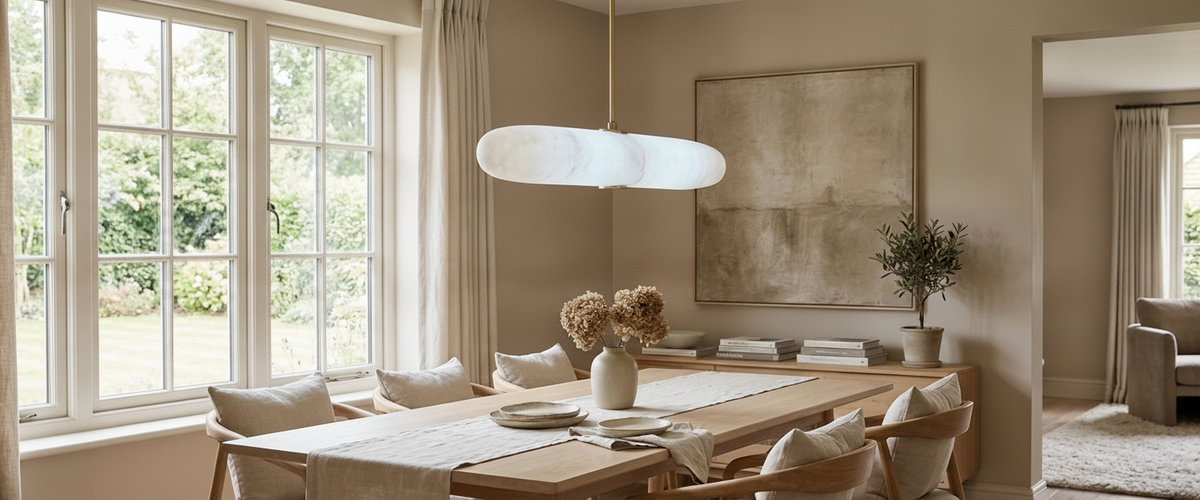

Learning how to install a pendant light fixture well starts with a decision most people skip: where it lives and how high it hangs. Hang the shade three inches too low over an island, or let it float in a bare stretch of ceiling, and even the best stone looks apologetic. When a pendant reads wrong, the mains are almost never to blame; placement is. This article walks the calls that decide the read: the drop over a table or island, centering on the surface below, sightlines, and pairing the shade with a warm dimmable bulb against a backdrop with enough contrast to make it show. Get those right and an alabaster shade becomes the warmest thing in the room.
We ship alabaster and natural-stone pendants to homes and hospitality projects worldwide, and the questions that come back are almost always about the same handful of placement decisions. Most people assume the wiring is the hard part; it rarely is. Measure the drop from the tabletop, not the ceiling, to keep the light useful and sightlines clear. That single habit does more to install a pendant light fixture well than any tool in the box.

Key Takeaways Before You Hang Anything
Height is the whole game. Over a dining table, the bottom of the shade usually sits around 30 to 36 inches (76 to 91 cm) above the surface. Over a kitchen island, closer to 30 to 34 inches (76 to 86 cm).
The same fixture reads differently in every location. When you install a pendant light fixture over a table, a stair landing and an island, each spot wants three different heights and often three different sizes.
Backdrop decides impact. A pale alabaster pendant against a pale ceiling can disappear. Contrast makes it read.
Dimming matters more than wattage. Warm, dimmable light is what makes stone glow rather than glare.
Always use a qualified electrician for the final connection. You can plan placement; leave the mains work to someone certified before you install a pendant light fixture.

The Same Fixture Over a Table, a Landing and an Island
Take one pendant and imagine it in three spots. Over a dining table it needs to light faces and food without blocking the line of sight across the table, so it hangs low and centered. Over a stair landing it becomes a sculptural object seen from below and from the floors above, so it hangs higher and is judged on its silhouette. Over a kitchen island it is a working light, spaced in a row and hung at a height that clears sightlines while people cook and talk. Before you install a pendant light fixture, decide which of these jobs it has to do.
Those are three genuinely different jobs. This is why we tell buyers to choose the location first, then the fixture, not the reverse. A single large alabaster orb can anchor a dining table beautifully and look lost over a narrow landing. A slim linear pendant that suits an island can feel mean over a generous round table. If you are still weighing formats, the full niori lighting collection lays the pendant, chandelier and wall light options side by side so you can see how scale changes the read before you install a pendant light fixture.

Mounting Height and Sightlines: The Choice That Makes or Breaks the Read
Most pendant regret traces back to height. The instinct is to hang high so nobody bumps their head, and the result is a fixture that hovers near the ceiling doing nothing for the room. When you install a pendant light fixture, trust the numbers instead.
Over a table, measure from the tabletop to the bottom of the shade, not from the ceiling. Around 30 to 36 inches (76 to 91 cm) keeps the light useful and the sightlines clear when seated. Rooms with tall ceilings can carry a little more drop, but resist hanging it at nose height for a standing adult crossing the room. For a kitchen island, aim slightly lower, roughly 30 to 34 inches (76 to 86 cm) above the counter, so task light lands where you chop and pour. These same ranges hold every time you install a pendant light fixture over a working surface.
Sightlines are the other half. Sit down at the table before you fix anything. Can you see the person opposite without the shade cutting across their face? Stand at the kitchen doorway. Does the pendant frame the island or block the view of the far wall? We ask clients to tape a paper template at the proposed height and live with it for a day before they install a pendant light fixture for real. It sounds fussy. It has saved more re-drilled ceilings than any spec sheet.
Over an island, space a run of pendants evenly and hang them at task height above the counter before you install a pendant light fixture.
Where the Pendant Earns Its Keep and Where It Fights the Ceiling
Pendants shine where there is a clear surface or zone underneath them to justify the drop: a table, an island, a bath (with the correct IP-rated fixture and a certified installer), a reading chair, a console in an entrance hall. Give a pendant a job and it looks intentional. Where a stairwell or double-height void needs a long vertical line rather than a broad shade, a slender drop such as the Look Round Pendant Light in brass reads as one clean gesture from every floor. Plan the location before you install a pendant light fixture and the piece almost always finds its place.
Where they struggle is open floor with nothing beneath. A pendant marooned in the center of a living room, with sofas pushed to the walls, tends to fight the ceiling rather than warm the space. In those rooms a pair of alabaster table lamps or a floor lamp usually does more. If you must install a pendant light fixture in an open zone, tie it to something: hang it over a coffee table, a bench, or a piece of furniture that reads as its anchor.
Bulb, Dimming and Backdrop: What Actually Decides Visual Impact
Alabaster and onyx are translucent, so the light source inside them is doing double duty: lighting the room and lighting the stone. Color temperature matters when you install a pendant light fixture in stone. We steer buyers toward warm output, roughly 2700K, which flatters the honey and cream veining rather than flattening it into a cold gray. The Illuminating Engineering Society treats warmer sources as a core part of comfortable residential lighting, and stone rewards that choice more than most materials do. See the Illuminating Engineering Society for the technical background on color temperature and glare.
Fit a dimmer. It is the single upgrade that changes how a stone pendant feels through the day: bright and functional at breakfast, low and amber for dinner. Match the dimmer to your LED driver, or you will hear it hum and watch it flicker. Before you install a pendant light fixture, ask your electrician to confirm compatibility so the final fit behaves.
Backdrop is the quiet decider. A cream alabaster pendant against a bright white ceiling can vanish; the same fixture against a deeper wall color, a timber ceiling or a darker island reads with real presence. Think about what sits behind and beneath the shade, not just the shade itself. Brass detailing helps here too, catching a glint that separates the fixture from a pale ground when you install a pendant light fixture in a bright room.
Contrast Games: Hang It So the Room Frames the Fixture
The pendants that photograph well and live well tend to have contrast working for them. A pale stone globe over a walnut table. A white marble shade against a soft charcoal wall. A row of amber onyx pendants above a pale stone island, where the glow reads against the cool worktop. When you install a pendant light fixture, you are not decorating the pendant; you are staging it. Over a long island or a dining table where several lights sit in a line, a compact multi-arm fixture like the CALLA three-light pendant in brushed chrome can do the work of a cluster from a single ceiling point.
One trick from the studio: when a client's ceiling is very light and they want an alabaster piece to feel substantial, we sometimes suggest a slightly larger shade than the math alone would call for. Scale reads as intent. A fixture that is a touch generous against a pale backdrop looks confident; one that is a touch small looks like a compromise. You can browse the alabaster lighting range to compare shade sizes before you install a pendant light fixture and commit to a drop.
The Placement Mistakes We Keep Fixing in Client Homes
Hung too high. The most common by far. The fixture ends up decorative rather than useful. Drop it to the numbers above whenever you install a pendant light fixture.
Off-center over the table. The pendant should center on the table, not the ceiling rose or the room. Tables rarely sit dead center.
Single small pendant over a long island. A run of two or three, evenly spaced, almost always beats one lonely fixture.
Cold bulb in warm stone. A 4000K or 5000K lamp turns honey alabaster gray. Keep it warm before you install a pendant light fixture.
No dimmer. A stone pendant at full output all evening is a glare source, not a mood.
Ignoring the flex length. Order the drop to suit your ceiling. Too much coiled cable at the rose looks unfinished, and it will nag at you every time you install a pendant light fixture in a low room.
A Simple Install and Placement Checklist
Confirm the ceiling can take the fixture weight, and check the manufacturer's mounting details before you install a pendant light fixture.
Decide the location's job: dining, task, sculptural, or accent.
Tape a paper template at the planned height and live with it for a day.
Set the drop from the surface below, not the ceiling, using the height ranges above.
Check sightlines seated and standing before you install a pendant light fixture and fix anything in place.
Choose a warm, dimmable bulb and confirm dimmer-driver compatibility.
Consider the backdrop; add contrast if the ceiling or wall is very pale.
Have a qualified electrician make the mains connection and test the dimming once you install a pendant light fixture.
Handled this way, when you install a pendant light fixture it stops being a guessing game. You place it where it has work to do, at a height that respects the people under it, with a warm bulb and a backdrop that lets the stone glow. That is the difference between a fixture that fills a hole in the ceiling and one that changes the room. Do the planning once and you will never install a pendant light fixture badly again. Browse the full Niori range when you are ready to match a piece to the spot you have in mind.