
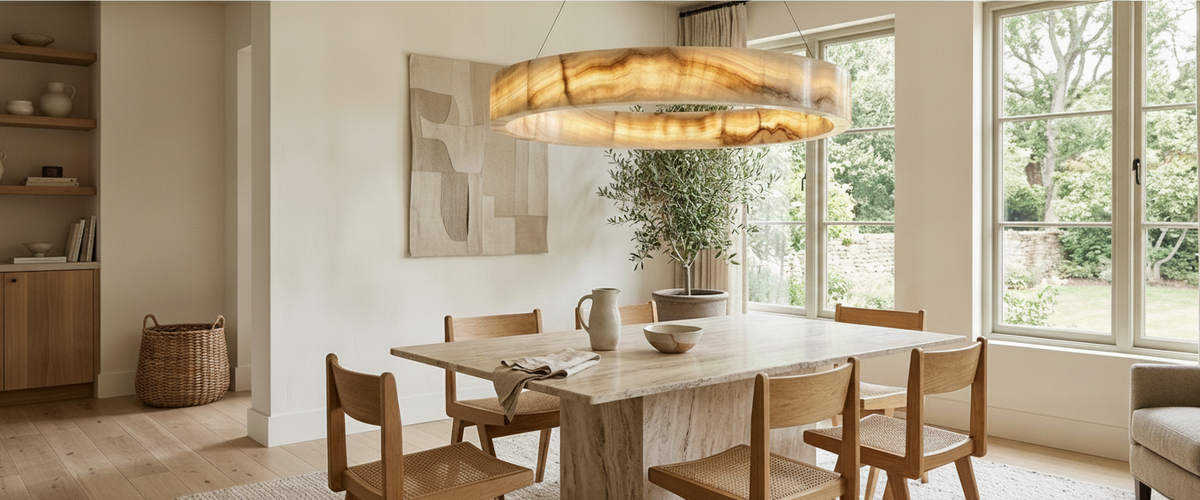

A natural stone table can carry a whole room, or quietly betray it within a year. The difference rarely shows in the photographs. It shows in the slab itself: how the veins run, how thick the stone is, what sits underneath it, and whether that milky surface was cut from the earth or poured from a bucket of filler. Once you know what to look at, a showroom stops being a wall of pretty surfaces and becomes a set of decisions you can actually make.
At Niori we spend most of our days working with alabaster and natural stone as lighting, so we look at every slab as something that either behaves well with light or fights it. That habit turns out to be useful when you are choosing a natural stone table too. Here is how we read one.
Follow the veining across the whole top: it should flow with the shape, not fight it.

Quick Answer: What to Check on Any Natural Stone Table
Veining and grain: no two slabs match, so buy the exact piece, not the display sample.
Stone type: marble, travertine, onyx and alabaster all behave differently as a surface and under light.
Backlighting: onyx and alabaster can glow; dense marble mostly cannot.
Weight and base: the engineering underneath decides whether the natural stone table survives daily life.
Finish: sealed, honed or polished changes how the stone ages and how much it forgives.
Honesty: filler, dye and resin-heavy 'stone' are the things a good showroom will let you inspect closely.

No Two Slabs Are Twins: Reading Veining and Grain
The stone in a natural stone table is a record of pressure and time, which is why every slab is a one-off. Marble veining tells you how minerals moved through limestone as it recrystallised; travertine's pitting and banding come from mineral springs. When you look at the surface, follow the veins across the whole top. Do they flow with the shape, or fight it? On a book-matched piece, the two halves should mirror each other cleanly at the seam. A sloppy match, veins that stop dead at the edge, or a grain that runs off at an odd angle usually means the fabricator cut for yield rather than for looks.
Grain also hints at durability. Tight, even grain tends to resist chipping better than loose, crumbly banding. Ask where the slab was quarried and whether the top and any matching pieces came from the same block. The US Geological Survey describes marble, travertine and onyx as varieties of metamorphosed or precipitated limestone, which is why their behaviour varies so much even under the same 'stone' label. That variation is exactly why a natural stone table never behaves like a printed lookalike.

Marble, Travertine, Onyx or Alabaster: How Each Stone Behaves
The name on the tag sets your expectations for the next ten years, so treat it as a spec, not a mood. It also tells you which kind of natural stone table you are really buying.
Marble is the workhorse. Dense, cool to the touch, and available in an enormous colour range. It takes a high polish but etches easily; anything acidic (lemon, wine, some cleaners) will leave a dull mark on a polished top. Marble is generally too dense to light through, which makes it a solid choice for a hard-working natural stone table.
Travertine reads warmer and more matte, with natural pits that can be left open or filled. It is softer than marble and more porous, so sealing matters more. Left open, those pits collect crumbs and grit; filled, the surface is calmer and easier to wipe.
Onyx is the showpiece. Translucent, dramatically banded, and the one true diva of the group. It scratches and stains more readily than marble, so it earns its keep on a console or accent piece rather than a hard-working dining top. Onyx is also the stone most likely to be backlit.
Alabaster sits closest to what we do every day. It is soft, fine-grained and beautifully translucent, which is exactly why it makes such warm, diffused light in a lamp. As a surface it is delicate; it dislikes water and abrasion, so it belongs on lamp bases, small tops and decorative pieces rather than anywhere that meets a wet glass. If you love the glow of alabaster and want it working hard, it usually earns its place as lighting first. Our alabaster lighting collection shows how that translucency reads when it is lit from within rather than wiped down after dinner.
Translucent onyx and alabaster carry an internal glow; dense marble stops the light dead.
Backlit and Beyond: When a Stone Table Is Meant to Glow
A backlit natural stone table is one of the most quietly theatrical things you can put in a room, and it only works with the right stone. Light has to travel through the slab, so translucency is everything. Thin-cut onyx and alabaster carry a warm internal glow that shows off their banding; dense marble stops the light dead and just looks lit from the edges.
If you want a table or console that glows, ask three questions. How thick is the lit panel? Thinner sections, often backed with a supporting layer, transmit more light but need careful engineering. What is the light source, and can it dim? A warm LED strip around 2700K flatters most stone; cool white makes onyx look clinical. And is the wiring done to standard? Any mains-powered furniture should be built and, where relevant, installed by a qualified electrician, in line with guidance from Electrical Safety First. This is the point where a decorative object becomes an electrical one, and it should be treated as such.
The same principle drives our whole range. Alabaster and stone reward light that comes through them, not just at them, which is why we design lamps and pendants around that translucency. A glowing natural stone table follows the same logic you can see across the wider lighting collection, where the material choice and the glow are the same decision.
Weight, Thickness and the Base Nobody Photographs
Stone is heavy, and a good natural stone table respects that. A generous console top can run well over 100 lbs (about 45 kg) before you add the base, and that load has to go somewhere. The part nobody photographs, the base and the fixings, is what keeps the piece safe and stable for years.
Check how the top meets the base. Is it resting on felt pads and gravity, mechanically fixed, or bonded? A wide, dramatic overhang looks elegant and puts real use on the join, so it needs a base engineered to match. Tap different areas of the top and listen; a consistent, solid note is reassuring, while a hollow patch can mean a thin slab over a substrate rather than solid stone. Ask the thickness of the actual stone, not the apparent edge, because a chunky-looking profile is sometimes a thin slab with a built-up rim.
Sealed, Honed or Polished: Finishes That Decide How the Stone Lives With You
The finish is where daily life meets geology, so choose it for how you actually live with a natural stone table.
Polished: reflective and rich in colour, but it shows etch marks and scratches most clearly. Best on lower-traffic pieces.
Honed: a smooth matte surface that hides wear far better and is more forgiving of a slid wine glass. A sensible default for anything that gets used.
Leathered or brushed: textured, forgiving, and good at disguising fingerprints on darker stone.
Sealing sits on top of all of these. Porous stones such as travertine and some marbles need a penetrating sealer, and it is not forever; expect to reapply periodically depending on use. Ask the showroom which sealer they recommend and how often. If the answer is vague, treat that as information.
Red Flags in the Showroom: Filler, Dye and 'Natural' Stone That Isn't
Most disappointments with a natural stone table trace back to one of a few tricks. Learn to spot them and you will buy better.
Heavy filler. Some pitting and repair is normal, especially in travertine and onyx. Large fields of resin filler that don't match the stone's tone are a sign of a poor slab dressed up.
Dye instead of colour. Suspiciously uniform, saturated colour can be dyed. Look at a cut edge; natural colour carries through the depth of the stone, while dye often sits shallow.
Reconstituted 'stone'. Agglomerate and resin-bound products are sold near the real thing. They can be perfectly good, but they are not solid stone and shouldn't be priced as if they were. Ask directly.
Bait and switch on the slab. The sample on the wall is not the piece you receive. Insist on approving the actual slab, or a photo of it, before it is cut.
Silence on the base. A seller who can describe the geology in loving detail but goes quiet on fixings and weight is telling you where the corners were cut.
One lesson from the studio: a client once fell for a pale onyx console in a lifestyle photo and was surprised on delivery that hers looked entirely different. It wasn't a fault. It was the stone being itself. We now walk every buyer through the exact slab before anything is finished, because the thing that makes a natural stone table worth having is the same thing that makes it unrepeatable.
Where a Stone Table Meets Stone Light
A natural stone table and a piece of alabaster or onyx lighting are two halves of the same instinct: you want material with depth, not a printed surface pretending. On a honed marble console where you want warmth catching the veins rather than a hard reflection, a low, softly rounded fixture such as the Essence Round Table Lamp sits more comfortably than a tall statement piece. Where the surface is more angular and you want the light to echo the geometry of the top, the Essence Square Table Lamp is closer to the right design language. Either way, the two read as a set, so plan the natural stone table and the light together rather than one at a time.
Prices for a solid natural stone table depend on the material, the size, the complexity of the cut, the engineering of the base and the finishing, so the honest answer to 'what will it cost' is to ask for a tailored quote once you know the piece. Get the slab, the base and the finish right, and a natural stone table stops being furniture you replace and becomes something you keep.