
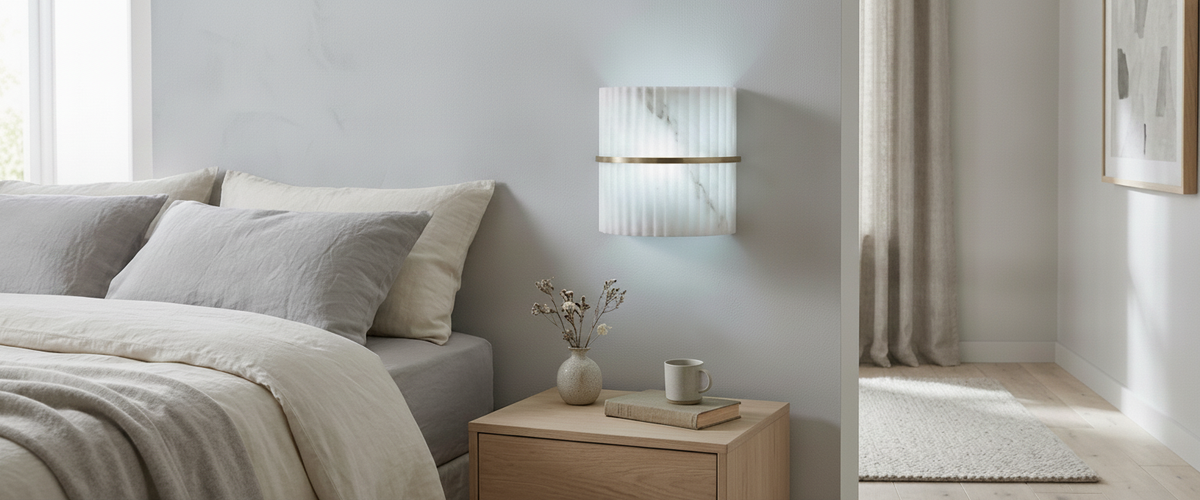

Hold a real alabaster sconce up to a cheap resin lookalike and the difference is obvious the moment you switch it on. The genuine stone glows from within, its veins catching the light like water under ice. The imitation just goes bright and flat. An alabaster traditional wall light earns its keep because of that living quality, and once you know what to look for, the fakes stop fooling you.
This is a buyer's guide for anyone weighing up a traditional sconce for a hallway, a dining room, or a pair either side of a bed. We ship these pieces to homes and hospitality projects across the UK and beyond, and the questions are always the same: how do I know an alabaster traditional wall light is real, how high do I mount it, and which bulb keeps the stone amber rather than gray?

Key Takeaways
Real alabaster is translucent and veined; it glows unevenly and warmly. Resin copies light up flat and uniform.
Mount most wall lights around 60 to 66 inches (152 to 168 cm) to the center, adjusted for ceiling height and use.
Warm bulbs at 2700K keep alabaster honey-toned. Cool white flattens the stone to gray.
Traditional forms sit happily in transitional and contemporary rooms if you keep the metalwork simple.
Budget depends on stone grade, scale, and metalwork, so ask for a tailored quote rather than trusting a fixed figure.

What Makes a Traditional Alabaster Sconce Feel Authentic
Authenticity in an alabaster traditional wall light comes down to the stone itself. Alabaster is a soft, naturally translucent form of gypsum that has been carved for lighting and sculpture for centuries. That translucency is the whole point. Light passes into the stone, scatters through the crystalline structure, and comes back out softened and warm.
Resin and acrylic imitations try to fake this with printed veining and a milky tint, but they betray themselves under power. The glow is even and slightly clinical, the veins sit on the surface instead of running through the body, and the material warms up under a bulb where real stone stays cool to the touch. A traditional carved form (a shell shape, a fluted half-round, a gently scalloped bracket) only looks right when the stone behind it is doing the work.
Look at the backplate and fittings too. A serious alabaster traditional wall light uses solid brass or bronze hardware, hand-finished, with the stone secured properly rather than glued into a thin frame. Where the metalwork is meant to complement the stone rather than hide it, a brass-framed fixture such as the Essence Round Wall Light 75cm, Brass shows how a restrained bracket lets the material carry the room. You can browse the difference across our alabaster lighting range.
Reading the Stone: Veining, Warmth and the Glow It Throws
No two alabaster panels are identical, and that is a feature, not a flaw. When you receive an alabaster traditional wall light from us, the veining pattern is unique to that block of stone. Some panels run with fine, feathered gray lines; others carry warmer honey and caramel streaks. Neither is better. What matters is how the veining reads once the light is behind it. Alabaster is a variety of gypsum prized since antiquity for exactly this quality, as the Encyclopaedia Britannica notes in its description of the stone's fine grain and translucency.
Switch a good sconce on in a dim room and watch the wall. A quality piece throws a soft halo above and below the fixture, with the veining visible as darker rivers inside the glow. That wall-wash is what makes alabaster feel expensive; the light does not stop at the shade, it spreads onto the plaster and gives the whole wall a warm cast. A flat imitation gives you a bright box on the wall and nothing else.
One lesson from the studio: we once had a designer client reject a panel because the veining looked "too busy" unlit. We asked her to wait until it was wired and dimmed. Lit at 30 percent, the same panel read as gentle, layered warmth, and she ordered three more. Alabaster has to be judged switched on, in the light it will actually live in.
Hallways, Dining Rooms and Bedsides: Where a Traditional Sconce Earns Its Place
An alabaster traditional wall light does its best work in rooms where you want atmosphere rather than raw output.
Hallways and staircases. Long corridors swallow light and feel like tunnels under a single ceiling fixture. A run of sconces at even spacing breaks the length into pools of warmth and guides you through. Traditional forms suit period hallways especially well, where a flush contemporary fitting would look out of place against panelling or cornicing.
Dining rooms. Wall lights either side of a sideboard or fireplace give a dining room a second, lower layer of light that a chandelier alone cannot. When the pendant over the table is dimmed for dinner, the sconces keep the edges of the room alive. Where a hallway or reception wall can carry a bolder statement, a larger fixture such as the Essence Round Wall Light 115cm, Brass holds its own beside tall panelling, while the 75cm version suits tighter dining walls. An alabaster traditional wall light is ideal in these rooms because the warm glow flatters both the food and the faces around the table.
Bedsides. A pair of wall-mounted sconces frees up the bedside table and puts a soft, low glow exactly where you want it for reading and winding down. Warm, diffused light in the evening supports the body's natural wind-down, so a dimmable alabaster sconce at low output is a genuinely practical bedside choice, not just a decorative one.
Mounting Height and Spacing So the Light Frames the Wall
Get the height wrong and even the best alabaster traditional wall light looks like an afterthought. Here is the practical checklist we give buyers:
General mounting height: aim for the center of the fixture around 60 to 66 inches (152 to 168 cm) from the floor. In rooms with high ceilings you can go a touch higher.
Bedside sconces: mount lower, roughly 30 to 36 inches (76 to 91 cm) above the mattress, so the light falls onto a book rather than into your eyes.
Dining and hallway runs: space fixtures 6 to 8 feet (1.8 to 2.4 m) apart for an even rhythm of light along the wall.
Flanking a mirror or fireplace: allow 28 to 40 inches (71 to 102 cm) between the pair so they frame the feature without crowding it.
Think about where the glow lands, not just where the socket sits. A sconce mounted too high throws its warmth onto the ceiling and leaves the wall below in shadow. Positioned correctly, the light frames the wall and pulls the eye to the stone. Always have wall lights wired and fitted by a qualified electrician; alabaster fixtures are heavier than they look and need secure fixing into a proper backing.
Pairing Traditional Alabaster With Transitional and Contemporary Rooms
Traditional does not mean it only belongs in period homes. The trick is the metalwork. Keep the brass or bronze bracket clean and restrained, and a carved alabaster traditional wall light slots into a transitional scheme without any clash.
An alabaster transitional wall light works because the stone carries the softness and history while the fitting stays quiet. Pair it with painted panelling, a mix of antique and modern furniture, and muted colors, and it reads as considered rather than fussy. For a fully alabaster contemporary wall light effect, choose a traditional stone panel on a slimmer, more geometric backplate; a squared frame such as the Essence Square Wall Light 75cm, Brass pushes the same stone toward a crisper, current language while the veining still does the emotional work.
We often steer clients away from over-matching. A single alabaster traditional wall light against a modern wall of flat plaster and concrete can be more striking than a whole set of matching contemporary fittings. If you want to compare forms across styles, the full lighting collection shows how the same stone reads differently depending on the metalwork around it.
Bulb and Dimming Choices That Keep Alabaster Amber
This is where most people undo an expensive fixture with a cheap bulb. Alabaster reflects the color temperature of whatever you put behind it. Get it wrong and the honey stone turns a sickly gray.
Color temperature: stick to 2700K for a warm, amber glow. Some traditional interiors go even warmer at 2400K. Avoid anything at 4000K or above; cool white drains the warmth straight out of the stone.
Bulb type: use a good-quality LED with a high color rendering index (CRI 90 or above) so the veining reads true. Low-CRI bulbs make the stone look muddy. The ENERGY STAR guide to light bulbs is a useful reference for reading color temperature and CRI on the box.
Dimming: fit a dimmer wherever you can. Alabaster is at its best at 20 to 40 percent output, where the glow is soft and the veining shows as gentle shadow. Match the dimmer to the driver so you avoid flicker at low levels.
Shape: choose a bulb small enough that it does not press against the stone or create a hot bright spot through a thin panel.
One practical note: if an alabaster traditional wall light takes a standard E27 or similar screw fitting, buy two or three bulbs of the same batch and brand. Mixing a slightly cooler bulb into a pair of matched sconces is the fastest way to spot that one has drifted gray while its twin stays amber.
Choose the stone for its glow, mount it so the light frames the wall, and feed it a warm, dimmable, high-CRI bulb. Do those three things and an alabaster traditional wall light will look right for decades, long after the resin copies have yellowed and cracked.