
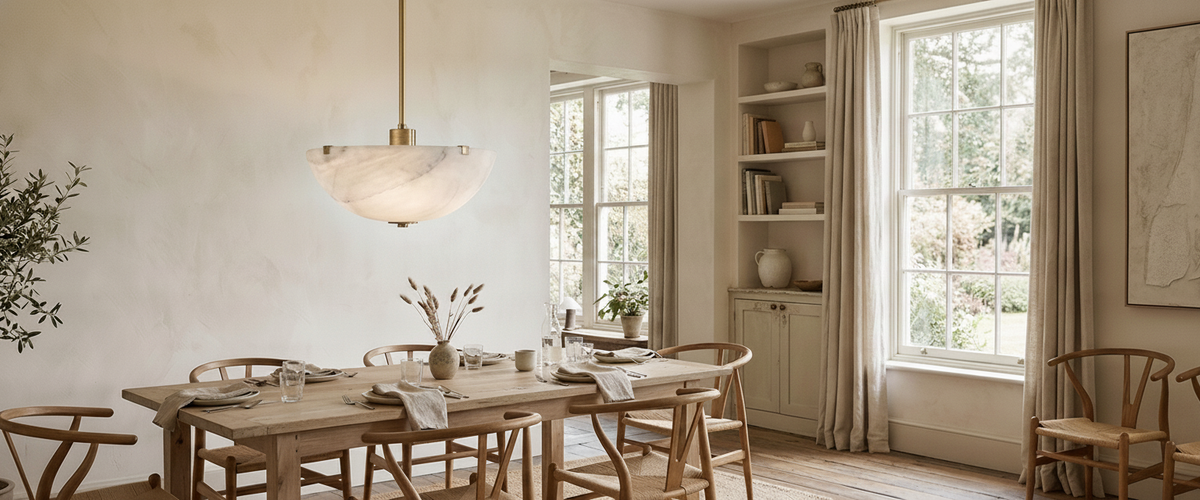

A genuine antique alabaster ceiling lights carries evidence you cannot buy new. Hand-tooled facets that catch the light unevenly, mounts that have softened at the edges, a bowl that has drunk decades of dust into its pores. Get close and the difference between real age and a clever copy is written all over the stone. Get it wrong and you pay antique money for something that came out of a factory last spring.
Alabaster has been carved for lighting since the material was first prized for the way it holds a candle flame and turns it into a low, honeyed glow. That same softness is why an antique alabaster ceiling light still feels right in a modern room. At Niori we work with alabaster and natural stone every day, and the questions buyers ask about vintage pieces come up again and again. This is what we tell them.
Uneven patina and hand-tooling are the first signs of genuine age.

Antique Alabaster Ceiling Light: Key Takeaways
Patina is your first tell. Real age dulls and warms the stone unevenly; reproductions look uniform under a torch.
Old mounts matter. Original brass or bronze fittings often carry casting marks, wear at contact points, and no modern thread standard.
Rewiring is non-negotiable. Any antique alabaster ceiling light needs new wiring by a qualified electrician before it goes up.
Bulb choice makes or breaks it. A warm LED around 2700K makes aged alabaster glow; cooler light turns it yellow and flat.
Weight is real. Solid stone bowls are heavy, so the ceiling fixing has to be right.

What Genuine Age Leaves Behind
Start with patina, because it is the hardest thing to fake and the easiest to read once you know what you are looking at. Alabaster is porous and slightly water-soluble, so decades of handling, heat from old lamps, and airborne dust settle into the surface and change how an antique alabaster ceiling light reads. The color shifts from bright white toward warm ivory or faint honey, and it does so unevenly. Rims that people gripped when cleaning wear smoother and lighter. Recessed carving holds more grime and reads darker.
Then look at the tooling. A hand-carved bowl from the late nineteenth or early twentieth century shows tiny inconsistencies: facets that are not quite parallel, a rim that varies by a millimeter or two, chisel or file marks inside the bowl where nobody bothered to polish because nobody would see. Traditional alabaster carving relied on files and abrasives worked by hand rather than machines, and that hand finishing is exactly what you feel. Run a finger inside an antique bowl and you feel that history.
Old mounts are the third witness. The ceiling fittings on an antique alabaster ceiling light were made in brass or bronze, often cast rather than pressed, and they carry casting seams, file marks where they were dressed by hand, and genuine wear where chain links or gallery arms rubbed for years. Threads rarely match modern metric or imperial standards, which is one reason rewiring a period fitting can be fiddly. If the metalwork looks crisp, machine-perfect and freshly plated, be suspicious.
How Antique, Transitional and Contemporary Stone Read From Below
Once a ceiling piece is up, you mostly see it lit and from below, so it helps to know how different eras read at a glance. A true antique bowl often has thicker walls and slightly irregular translucency, so the glow pools in patches and the veining looks organic and busy. The light feels lived-in.
Transitional pieces, made when factories began mixing hand and machine work, sit in between. The carving is cleaner, the walls more even, but you still find some hand finishing on the mounts. An alabaster contemporary ceiling lights, by contrast, reads calm and deliberate: even wall thickness, controlled veining, a glow that is smooth from edge to edge because modern makers select and cut stone for consistency. Neither is better. They simply speak different design languages, and knowing which one you want stops you overpaying for the age of an antique alabaster ceiling light you do not actually need.
If your heart is set on the aged look but the practicality of new engineering, an alabaster modern ceiling light with hand-selected stone can give you much of the character of an antique alabaster ceiling light without the rewiring lottery. You can compare current shapes and finishes across the alabaster lighting collection to see how contemporary makers handle veining and diffusion.
Rewiring a Period Fitting Without Gutting Its Character
Every antique alabaster ceiling light we have ever handled needed rewiring, and this is where character gets lost if you rush. Old rubber or cloth-covered flex perishes, and running current through it is a genuine fire risk. The guidance from Electrical Safety First is blunt about aged and deteriorated wiring, and any reputable restorer will insist on new internal cabling, a modern lampholder, and correct earthing on metal fittings.
A good restorer rewires through the original brass while protecting every aged part.
The trick is keeping the parts that carry the age. A good restorer rewires an antique alabaster ceiling light through the existing brass tube and gallery, reuses the original chain and ceiling rose where they are sound, and only replaces what is unsafe. What you protect:
The alabaster bowl itself, cleaned gently, never soaked.
Original mounts, chain and canopy where they are structurally fine.
Any maker's marks or casting detail on the metalwork.
What gets swapped without hesitation is the flex, the lampholder, and any corroded terminal block. Always have this work done by a qualified electrician, and ask them to confirm the fitting is earthed and that the ceiling fixing can carry the load. Stone is heavy; a bowl can run to several kilograms before you add the metal, so the backing needs a proper fixing into a joist or a suitable mounting plate, not a tired old hook.
The Warm LED That Makes Aged Stone Glow Instead of Yellow
The right bulb is the difference between an antique alabaster ceiling light that looks quietly beautiful and one that looks jaundiced. Aged stone already carries warm tones, so a cool or neutral LED fights the material and flattens it. We recommend a warm white around 2700K, which lets the honey in old alabaster read as depth rather than staining. Compare that with how much cooler modern fittings run: a contemporary flush light such as the Gemini Flush Ceiling Light in brushed brass is tuned to 4000K for crisp task light, which is exactly the register you want to avoid when the goal is a soft period glow.
Pay attention to color rendering too. A high CRI (90 or above) shows the veining and subtle color shifts properly, while cheap low-CRI lamps mute everything. Dimming matters more than people expect: an antique alabaster ceiling light was designed for candle and early filament light, both of which were low and flickering. A good dimmable warm LED, driven by a compatible dimmer, gives you that same soft evening register without the heat that damages stone over time. Test the bulb before final install, because some LED and dimmer pairings buzz or flicker in ways you will not tolerate at dinner.
Landing a Period Ceiling Piece in a Stripped-Back Modern Room
The most satisfying use of an antique alabaster ceiling light is not a period drawing room; it is a plain, contemporary space where the stone becomes the one soft, storied object. We shipped a rewired early-twentieth-century alabaster bowl to a client renovating a minimalist apartment, all pale plaster walls and oak floors, and the aged glow was the only warm thing overhead. It stopped the room feeling clinical.
Hang it where the eye lands first: over a dining table, in a stairwell you look up into, or centered in a hallway. Keep everything around it quiet so the stone does the talking. Scale is the part buyers misjudge most, and it helps to handle a proportion you can measure before committing to a heavy antique bowl. Where a hallway or kitchen calls for broad, even coverage rather than a pooled glow, a larger flush form like the Gemini Flush Ceiling Light 61cm in white shows how much ceiling a single fixture can cover, which is a useful yardstick for judging whether an antique alabaster ceiling light will read as too small overhead. The broader lighting range is a useful reference for scale and proportion before you commit.
The Red Flags That Give a Reproduction Away Every Time
Reproductions of the antique alabaster ceiling light are getting good, but they still trip on the same details. Watch for these:
Perfect uniformity. Even wall thickness and flawless symmetry usually mean machine work, not a hand-carved antique.
Fresh, crisp mounts. Brightly plated, machine-perfect metalwork with modern threads on a supposedly hundred-year-old fitting.
Resin, not stone. Tap it gently; real alabaster has a dense, dull ring and feels cold and heavy. Resin sounds hollow and warms fast in the hand.
Painted veining. Genuine veining runs through the stone and changes when backlit. Printed or surface-painted veining sits flat and stays the same lit or unlit.
No wear where wear belongs. A real fitting shows handling marks at rims and mount contact points. Uniformly pristine surfaces on an old piece are a warning.
Ask for close photographs lit and unlit, ask what was rewired and by whom, and ask for the fitting's history. An honest seller will tell you which parts of an antique alabaster ceiling light are original and which were replaced. Vague answers about a piece's age are a red flag of their own.
Buy for the material and the light first, the story second. A well-chosen antique alabaster ceiling light gives you a glow that no new fitting can quite copy, but only once the wiring is sound and the bulb is right. Get those two things wrong and the age counts for nothing.