
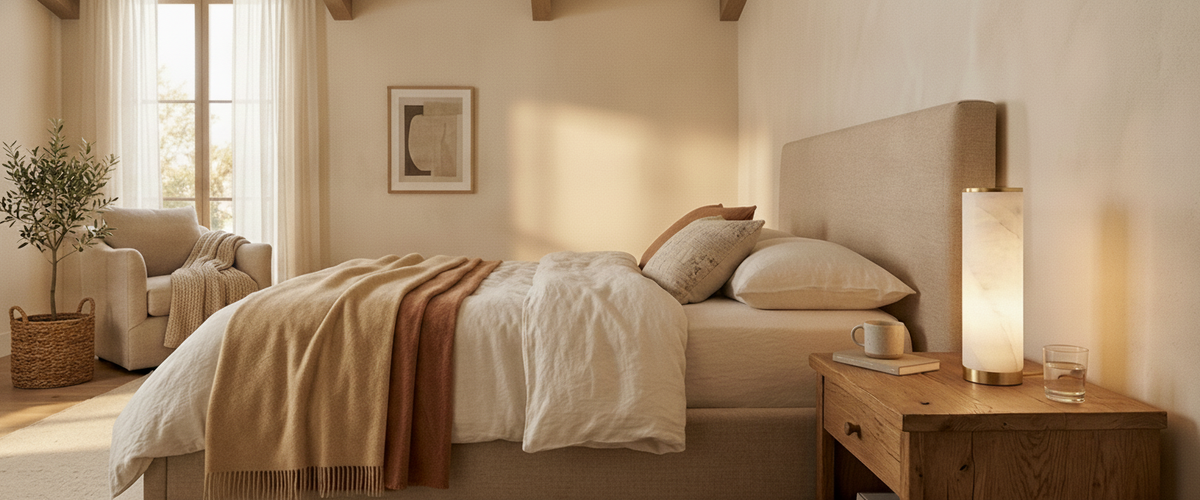

Most bedside lamps fail in one of two ways. Either the shade sits so high the bulb glares into your eyes, or it sits so low the light pools on the nightstand and never reaches your book. A good bedside table lamp bedroom setup is a precision object disguised as a soft one. This guide shows you how to size, place, and light a bedside table lamp bedroom pairing so it works the moment you lie down to read, not just how it looks switched off. Get the shade height, the bulb warmth, and the footprint right, and the rest follows.
The trick is to read the whole bedside as a system: mattress height, headboard, nightstand, and the person lying down. Once you measure those, the bedside table lamp bedroom choice almost makes itself. Reading the whole bedside as a system before you shop is the single habit that prevents most returns.
Quick Answer: Bedside Lamp Sizing at a Glance
Height: aim for the bottom of the shade to land near eye level when you are sitting up in bed, roughly 24 to 27 inches (61 to 69 cm) total for a standard bed.
Shade base: at or just above the eyes when reading, so the glow falls on the page, not into your face.
Footprint: the lamp should take up no more than a third of the nightstand surface.
Bulb: warm, dimmable, around 2700K for a bedroom.
Switch: reachable without sitting fully upright.

Read the Whole Bedside Before You Shop
Start with a tape measure, not a wishlist. Measure the height of your mattress from the floor, then the height of your nightstand surface. The gap between the two tells you how much lamp you actually have room for. A tall platform bed paired with a low nightstand needs a taller bedside table lamp bedroom setup than a low frame with a chunky bedside cabinet.
Headboards matter more than people expect. A high upholstered or panelled headboard can swallow a short lamp and leave the light trapped behind you. If your headboard rises well above the mattress, favor a slightly taller bedside table lamp bedroom pairing so the shade clears the top edge and the light can spread across the bed.
Here is the test I give clients: sit on the edge of the bed as you would to read, and note where your eyes fall. That line is where the bottom of the shade wants to be. It is a two-minute check that saves a return when you are picking a bedside table lamp for the bedroom.

Small, Skinny, or Modern: Which Shape Suits a Crowded Nightstand
Bedside real estate is usually tight. Between a book, a glass of water, reading glasses, and a phone charger, the lamp is competing for space. This is where shape does real work for a bedside table lamp bedroom setup.
Small bedside table lamps with a compact round base suit deep nightstands where you want a soft, contained pool of light. For a nightstand that needs warmth without glare, a compact form such as the Essence Round Table Lamp in black makes more sense than a tall statement piece. Skinny bedside table lamps, tall and narrow with a slim column, are the answer for shallow tables and floating shelves; they gain height without stealing surface. For pared-back rooms, bedside table modern lamps in clean geometric forms, a simple cylinder or a squared-off block, read as quiet and architectural rather than decorative. Where the room leans more graphic, the squared-off Essence Square Table Lamp in black is closer to that architectural language than a rounded silhouette.
This is where alabaster earns its place. A carved alabaster or natural-stone lamp glows through the material itself, so even a small footprint throws a warm, diffused light rather than a hard beam. The stone's veining catches the light differently on every piece, which means a modest bedside table lamp bedroom choice still has presence. You can see how that translates across forms in the Niori range of alabaster lighting, where the material does the softening for you.
Get the Shade at Pillow Level
The single most common bedroom lighting mistake is shade height. If the base of the shade sits below your eyeline when you read, you get glare. If it sits far above, the light throws downward and misses the page. Getting this right is what makes a bedside table lamp bedroom pairing work instead of annoy.
The target is simple: with you propped against the pillows in a reading position, the bottom edge of the shade should sit at roughly eye level. That angle drops the light onto your lap and book while shielding the bulb from view. Alabaster helps here because even if the bulb peeks slightly, the stone shade never produces the harsh point-source glare of clear glass or an open metal shade.
For couples who read at different times, this is worth solving per person. One partner sitting higher on more pillows may want a fractionally taller bedside table lamp for the bedroom on their side. Matching the pair on looks while allowing a small height difference is entirely fine.
One Lamp or a Matched Pair
Symmetry is restful, and a matched pair of bedside lamps is the classic move for a reason. It frames the bed, balances the visual weight, and gives each sleeper their own controllable light. For a double, queen, or king bed shared by two people, a pair for the bedroom is almost always the right call.
There are times a single bedside table lamp for the bedroom works better. A single bed against a wall, a nightstand on only one side, or a very narrow room where a second lamp would crowd the walkway all point to one well-chosen fixture, ideally balanced by another light source across the room.
Do bedside lamps have to match? No, and rigid matching can flatten a room. What must stay consistent is scale and light quality. Two lamps of similar height and similar warmth will read as a considered pair even if the bases differ. Mixing a stout stone lamp on one side with a tall skinny one on the other looks like an accident unless the rest of the room deliberately supports it.
Warm Bulbs and a Reachable Switch
Color temperature sets the mood of the whole room. For a bedroom, stay warm, around 2700K, which keeps the light restful rather than clinical. Cooler light suppresses the wind-down signal your body relies on before sleep; guidance from sleep researchers consistently links dimmer, warmer evening light to easier sleep onset (see the Sleep Foundation on light and sleep).
Fit a dimmable bulb and, ideally, a dimmable lamp. The ability to drop from reading brightness to a low glow for the last light of the night is what separates a bedside table lamp bedroom fixture from a desk lamp. Alabaster rewards dimming: as you lower the output, the stone keeps a gentle luminous quality instead of going dead and gray.
Put the switch where a half-asleep hand can find it. An inline switch on the cord, a base you can tap, or a rotary at the neck all beat a switch tucked behind the shade. If you are wiring in reading lights or switched sockets, use a qualified electrician; it is not a job to improvise near the bed.
Placement Mistakes That Leave One Side in Shadow
Pushing the lamp too far back. Set against the wall, the shade throws light behind the headboard. Bring your bedside table lamp for the bedroom forward so the light reaches your lap.
Ignoring the second sleeper. A single central pendant plus one bedside lamp leaves the other side dim. Match light on both sides for shared beds.
Buying for the tabletop, not the reader. A lamp that looks perfectly proportioned on the nightstand can still be the wrong height once you lie down.
Over-scaling on a small table. A heavy base on a slim nightstand looks top-heavy and leaves nowhere for a glass of water.
Forgetting the charger. Leave clear surface for a phone and cable so the lamp is not fighting for the same corner every night.
A Short Buyer's Checklist
Measure mattress height, nightstand height, and headboard height.
Do the sitting-up test to find your ideal shade base line.
Choose a small, skinny, or modern bedside table lamp bedroom form to suit the nightstand footprint.
Confirm the lamp is dimmable and takes a warm 2700K bulb.
Check the switch is reachable lying down.
Decide on one lamp or a matched pair based on bed size and room width.
If you want to compare forms and heights across the wider collection, the full Niori lighting range shows how table lamps sit alongside wall lights and pendants, which helps when you are balancing a bedside table lamp bedroom setup against the rest of the room. Niori works in alabaster and natural stone precisely because the material solves the bedroom's core problem: warm, even light with no glare, from a bedside table lamp bedroom pairing that still looks quiet by day.