
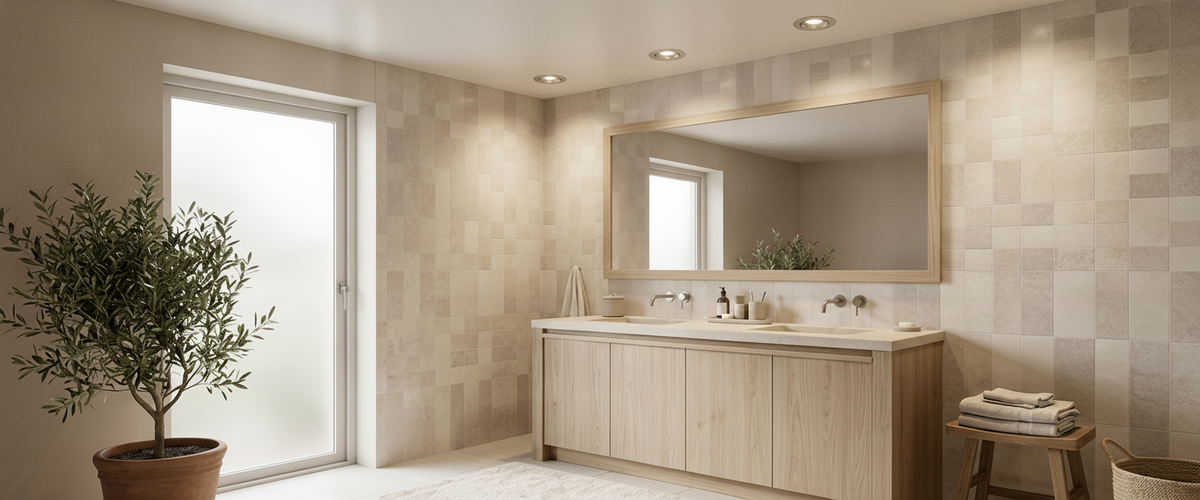

Walk into most newly refitted bathrooms in Britain and the ceiling gives the game away. Six identical cold-white pinpricks, punched in a grid, throwing hard circles onto the floor and leaving the walls in shadow. It looks like a changing room, not a place you want to soak on a dark February evening. Choosing bathroom LED downlights is less about wattage and more about warmth, aim, and the right IP rating for where each fitting actually sits. Get those three right and a small bathroom feels calm and expensive; get them wrong and no amount of tile can save it.
At Niori we are known for alabaster and natural-stone lighting, the pendants, wall lights and lamps that give a soft diffused glow. Bathroom LED downlights sit at the other end of the spectrum: precise, recessed, functional. The best bathrooms use both, and this guide covers how to specify the recessed layer so it flatters the room rather than flattening it.

Key Takeaways Before You Buy
Match the IP rating to the zone. Fittings over the shower and bath need higher protection than those by the door.
Choose warm output. Around 2700K to 3000K reads relaxed; 4000K and above reads clinical.
Fire-rated is standard for downlights cut into a ceiling with a room or loft above.
Plan spacing and beam angle so light reaches walls and mirrors, not just the floor.
Confirm the fitting dims on your chosen switch, and check how the LED is replaced years down the line.
Use a qualified electrician. Bathroom wiring falls under UK electrical regulations for good reason.

IP Zones Decoded: What Actually Needs Rating
Bathrooms here are split into zones based on how close a fitting is to water, and each zone sets a minimum IP (Ingress Protection) rating. Zone 0 is inside the bath or shower tray itself. Zone 1 sits directly above it, up to 2.25m. Zone 2 extends 0.6m beyond the bath edge and around a basin. Everything past that is outside the zones, though splashing still happens in real rooms.
As a working rule, a bathroom LED downlight over a shower or bath wants IP65. A fitting in Zone 2 near the basin should be at least IP44. Beyond the zones, a standard IP20 recessed downlight is technically fine, but in a compact bathroom where steam travels, many specifiers fit IP65 throughout for peace of mind and a consistent look. The guidance from Electrical Safety First is worth reading before you sign off a layout, and your electrician will confirm the zoning for your specific room.
Warm Versus Cool: Why Bathroom Downlights Read Clinical
Colour temperature is the single biggest reason bathroom lighting feels wrong. A lot of stock LED downlights ship at 4000K, a crisp neutral white that suits an office or a garage. In a small tiled room that light bounces off every hard surface and turns skin grey in the mirror.
For the main relaxing bathroom, specify 2700K to 3000K. That warmer tone flatters skin, softens grout lines, and pairs well with the amber glow of an alabaster wall light beside the mirror. Some households prefer a slightly cooler note in an ensuite used mainly for morning routines, where 3000K to 3500K helps you see clearly for shaving or make-up. Also check the CRI (colour rendering index). A bathroom LED downlight rated CRI 90 or above shows true colour, which matters at the mirror far more than most people expect.
This is where our two worlds meet. Recessed LEDs handle the task light; a piece from the alabaster lighting collection handles the mood, filling the room with warm scatter that no ceiling grid can replicate. The stone diffuses light through its natural veining, which is exactly the quality a bare downlight lacks.
Fire-Rated and Insulation-Covered Fittings: The UK Ceiling Reality
Cutting a hole in a ceiling makes a route for fire to spread between floors. Building practice here expects fire-rated downlights in most ceilings that separate storeys, and in the top-floor ceiling below a loft. A fire-rated bathroom LED downlight has an intumescent seal or backing that expands in heat and closes the gap, buying the 30, 60 or 90 minutes the ceiling is designed to hold.
If loft insulation sits above your bathroom ceiling, you also need fittings rated for insulation coverage, or you must maintain a clearance around each one. Modern LED recessed downlights sold across the UK usually state both fire rating and insulation contact clearly. Do not assume; check the spec sheet, and let your electrician confirm what your ceiling build-up demands.
Spacing and Beam Angle So You Light the Room, Not the Floor
The grid-of-spots look happens when fittings are dropped in evenly with no thought for what they hit. Better bathrooms treat their bathroom LED downlights as tools aimed at surfaces.
Wall washing. Place a row of recessed LED downlights roughly 200mm to 300mm off a feature wall so the beam grazes the tile and gives it depth.
Spacing. As a rough starting point, space downlights at a distance equal to the ceiling height for general cover, then adjust. A 2.4m ceiling suggests fittings around 1.2m apart, but a small room may need fewer than the showroom pushed on you.
Beam angle. A wider beam (around 60 degrees) blends into soft general light; a narrower beam (around 36 degrees) creates punchier pools for effect. Mix them with intent rather than fitting everything the same.
The mirror. Downlights directly in front of the face cast shadows under the eyes and chin. Light the mirror from the sides with wall lights, and let downlights handle the room.
Fixed Versus Adjustable: Aiming Light in a Small Bathroom
Fixed downlights point straight down. They are cheaper, cleaner-looking, and right over a shower where you just want cover. Adjustable (sometimes called tilt or gimbal) downlights swivel a few degrees, which is where a small bathroom quietly wins. Angle one toward a shelf of towels, another to graze a stone basin surround, and the room reads as designed rather than merely lit. Where you want that ability to redirect the beam across a compact space, a tilting bathroom LED downlight such as the Play Adjustable Recessed Downlight 7W gives you more control than a flush fixed head, and the lower output suits tighter rooms where a stronger fitting would overlight.
Bear in mind that most adjustable heads are IP20 or IP44 and belong outside the wet zones. Over the shower itself, stay with a fixed IP65 unit. If you prefer a replaceable lamp over an integrated diode, a fixed GU10 fitting like the GU10 Recessed Downlight in Chrome Matte lets you swap bulbs and change colour temperature later without touching the fitting. You can also browse recessed options across the wider lighting range to compare head styles and finishes, from matte chrome to copper and gold. When comparing the best LED downlights the UK market offers, look past the headline price to the trim quality, the driver and the warranty.
Comparing UK Options: Dimming, Glare and Long-Term LED Replacement
Three details separate a good bathroom LED downlight from a disappointing one, and none of them show up in a price comparison.
Dimming. Not every LED downlight dims, and not every dimmable one plays nicely with every switch. Confirm the fitting is dimmable and check the compatible dimmer list. Trailing-edge dimmers usually suit LED loads better than older leading-edge types. A bathroom that drops to a low warm glow for a late bath is worth the extra care at the wiring stage.
Glare. Cheap downlights sit flush with a visible bright chip. Better ones recess the LED behind a baffle or a slightly deeper anti-glare trim, so you see light on the surfaces rather than a dot burning in your eyeline from the bath.
Long-term replacement. Two camps exist. Integrated LED downlights have the diode sealed in; when it fails after years of service you replace the whole fitting. GU10-based downlights take a standard replaceable lamp, so you swap a bulb, not the unit. For a bathroom you plan to keep for a decade, a fire-rated GU10 bathroom LED downlight with a good IP rating gives you flexibility to change colour temperature or output later without a rewire.
12V Versus 240V Downlights
Older halogen setups often ran at 12V through transformers. Most modern LED downlights in the UK run at 240V mains, either as integrated units or GU10 lamps, which removes the transformer as a failure point. You will still see 12V LED downlights, usually MR16 lamps, in refits that kept the low-voltage wiring. If you are starting fresh, a 240V LED downlight, whether GU10 or a quality integrated fitting, keeps things simpler.
Swapping Halogen Downlights for LED
Replacing tired halogen spots with a modern bathroom LED downlight is one of the better upgrades in an older bathroom: less heat, far less energy, longer life. The simplest route is a like-for-like GU10 swap, popping in an LED lamp where a halogen sat, provided the fitting itself is sound and correctly IP-rated for its zone. Where the old fitting is a 12V MR16 on a transformer, the transformer may not drive a low-wattage LED reliably, so many electricians convert the point to 240V GU10 or fit a new integrated unit instead.
Anything involving the wiring, the transformer, or a non-fire-rated old fitting in a bathroom should go to a qualified electrician. Bathroom electrical work here is notifiable and needs to meet current regulations. It is a modest job for a professional and not one to improvise near water.
How Downlights and Alabaster Work Together
The bathrooms we admire most rarely rely on their bathroom LED downlights alone. We recently shipped an alabaster wall light for a Cotswolds ensuite where the owner had ripped out a cold six-spot grid and kept just two warm fire-rated downlights over the shower, letting the stone sconces carry the room. The result was softer, warmer, and used less light overall. That is the pattern to copy: bathroom LED downlights for precise task and safety cover, alabaster or natural stone for the warm diffused layer that makes a bathroom feel like part of the home rather than a utility.