
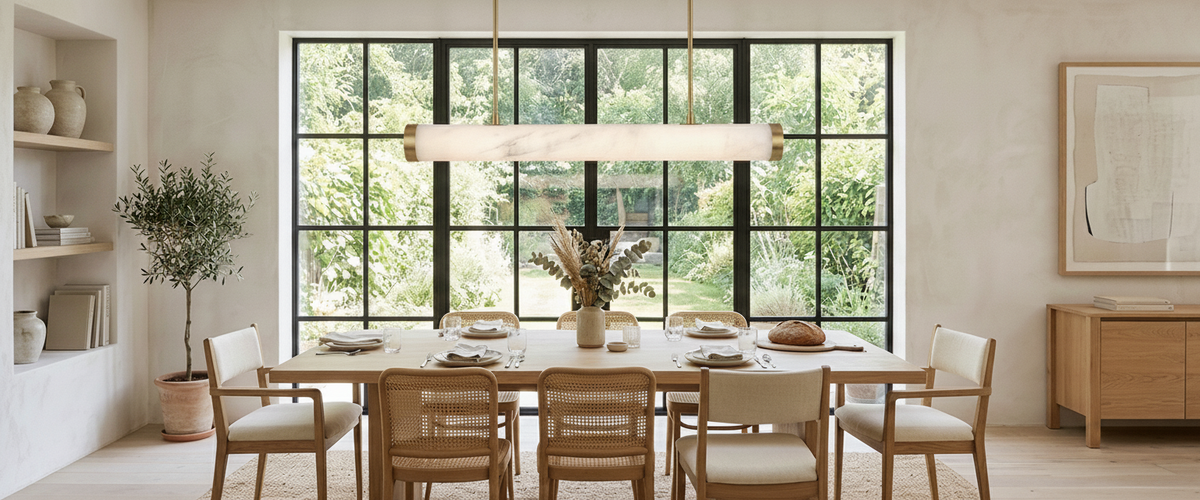

The quickest way to ruin an expensive alabaster pendant is to hang it too high and stuff it with a cold, over-bright bulb. Instead of the soft, honeyed glow the stone is famous for, you get a bright coin overhead and a fixture that looks like frosted plastic. Alabaster pendant lights reward a bit of planning, and most of the decisions that matter happen before the electrician arrives.
Alabaster is a soft, translucent stone. Light does not just bounce off it; it passes through the surface and scatters inside the material, which is why a well-lit piece looks lit from within rather than switched on. That single property drives every choice below, from bulb temperature to the paint color on the wall behind it. Good alabaster pendant lights lean into that quality instead of fighting it.
A warm, low-lumen bulb lets alabaster glow from within rather than showing a hot spot.

Key Takeaways for Alabaster Pendant Lights
Glow, not glare: use a warm, lower-lumen bulb so the stone lights evenly instead of showing a hot spot.
Height changes by room: a dining table, a kitchen island, and a stairwell each need a different drop.
Veined versus frosted: heavily veined stone throws pattern and shadow; near-white alabaster reads as a soft, even lantern.
Backdrop matters: a warm or mid-tone wall keeps pale stone looking like stone, not putty.
Dimming is essential: pair the alabaster pendant lights with a compatible dimmer to hold warmth as you drop the level.

The Glow-Versus-Glare Test Every Alabaster Pendant Has to Pass
Before you commit to a bulb, run a simple test in your head: when you stand under the pendant at normal head height, can you see a bright point through the stone, or does the whole shade look softly lit? A hot spot means the bulb is too powerful, too small, or sitting too close to the surface. An even wash means the light is doing what alabaster does best, and it is the mark of well-set alabaster pendant lights.
Warm color temperature carries most of the work. For living and dining spaces, aim for roughly 2700K, which reads as a soft, candle-adjacent white and flatters the natural cream and amber tones in the stone. A 4000K bulb, closer to daylight, tends to flatten alabaster and can make warm veining look gray. Output matters too: a translucent shade needs less raw brightness than an opaque one to feel useful, so start lower than you think and add a dimmer for control.
Color rendering is the detail most buyers skip. A bulb with a high CRI, ideally 90 or above, shows the subtle depth inside the stone instead of muddying it. The Illuminating Engineering Society treats color rendering as a core measure of light quality, and with alabaster pendant lights it is the difference between rich and flat.
Hanging Height Over a Table, an Island, and a Stairwell: Three Different Answers
There is no single correct drop for a pendant, because the job changes with the surface underneath.
Over a dining table, hang the base of the pendant roughly 30 to 36 inches (about 76 to 91 cm) above the tabletop. That keeps the glow at a flattering height without blocking the sightline across the table. With alabaster, a slightly lower hang works well because the stone will not dazzle anyone the way a bare bulb would.
Over a kitchen island, lift it a touch higher, closer to 32 to 40 inches (81 to 102 cm) above the counter, so it clears working sightlines and does not catch heads when you lean in. For a long island, a run of matched alabaster pendant lights looks calmer than one oversized fixture, spaced evenly with the end pieces set in from the counter edges. Where you want that even rhythm without competing with the stone, a compact fixture in a warm metal such as the Gemini Pendant Light 42.5cm in Brass shows how a smaller drop repeated across a run reads more intentional than a single large piece.
Two or three matched pendants light a long island more evenly than one oversized fixture.
In a stairwell or double-height hallway, the rules loosen. Here the pendant is sculpture as much as light source, and you judge it from several floors. Hang it so the lowest point sits comfortably above head height on the upper landing and reads well from below. A cascade of alabaster forms in a tall void is one of the most satisfying places to use the material, because you see the glow from every angle. If you are still weighing fixture types for a space like this, it is worth browsing the full alabaster lighting range to compare single alabaster pendant lights against multi-drop clusters.
Why a Veined Pendant and a Frosted One Behave Like Opposite Fixtures
Two alabaster pendant lights of identical shape can light a room completely differently, and the reason is the stone itself.
Heavily veined alabaster has bands of denser and more open material running through it. When lit, those veins glow at different intensities, so the fixture throws pattern, warmth, and a bit of drama. It reads as a natural object and pairs well with textured, layered interiors. The trade-off is that it is less predictable; every piece is genuinely one of a kind, which is part of the appeal and part of why photographs of it never quite match the piece in the room.
Near-white, lightly figured alabaster behaves more like a soft lantern. The glow is even and calm, closer to how a frosted glass shade performs but with more life and depth in the surface. If you want quiet and consistency, especially across a row of matched alabaster pendant lights over an island, lean toward the paler, more uniform stone. If you want each fixture to feel like a found object, choose the veining and let it lead.
Because alabaster is a natural material, the Natural Stone Institute notes that color and figure vary block to block, so treat any single image as a guide rather than a promise. When we ship matched pairs or runs from the studio, we hand-select pieces so they sit together, but perfect twins do not exist in natural stone, and you would not really want them to.
The Backdrop That Makes Stone Read as Stone, Not Putty
Pale alabaster against a stark, cool-white wall often looks washed out, almost like beige plastic. Give it a backdrop with some warmth or depth and the stone snaps back into focus. A mid-tone plaster, a warm off-white, a muted clay, a soft gray with a warm undertone; any of these lets the pendant's glow stand out instead of merging into the wall.
Contrast helps too. In a dining room with darker joinery or a deep-toned wall, a warm alabaster pendant becomes the obvious focal point. In an all-white kitchen, add warmth somewhere nearby, in the countertop, a timber shelf, or brass hardware, so the pendant reads as part of a considered scheme rather than a pale blob floating in bright space. Brass or bronze detailing on the fixture itself does a lot of this work, tying the warm stone to the metal finishes elsewhere in the room. Where a room already leans dark and moody, a fixture with a matte black frame such as the Gemini Pendant Light 61cm in Black shows how the metal can read as deliberate contrast rather than fighting a pale stone shade.
Dimming Alabaster: Keeping Warmth Without Dropping into Gloom
Alabaster pendant lights are at their best on a dimmer. The stone already softens light, so a full-power bulb can feel a touch clinical in the evening, while a dimmed warm LED settles into exactly the mood most people want after dark.
Two practical points. First, use a dimmer rated for your LED driver; a mismatched pairing causes flicker, buzz, or a dead zone at the low end where the light cuts out instead of fading. Ask for the driver spec and match it, or have your electrician confirm compatibility. Second, choose a bulb that warms slightly as it dims rather than one that just gets dimmer at the same cold tone. That gentle shift toward amber at low levels is what makes these fixtures feel candlelit rather than merely faint. Any hard-wired install should be signed off by a qualified electrician, in line with Electrical Safety First guidance.
Placement Mistakes We Keep Fixing in Client Homes
The same handful of problems come up again and again with alabaster pendant lights, and all of them are avoidable.
Hung too high. A dining pendant lifted to ceiling-hugging height loses intimacy and turns the stone into a distant smudge. Bring it down.
Wrong bulb temperature. A cool 4000K bulb in a warm alabaster shade fights the material. Switch to 2700K and the piece transforms.
One giant pendant over a long island. A single fixture rarely lights a long run evenly. Two or three smaller matched pendants look intentional and spread the glow.
No dimmer. Installing beautiful alabaster pendant lights on a plain on/off switch wastes half their range. Budget for a compatible dimmer from the start.
Cold, stark backdrop. Pale stone on bright white plaster looks lifeless. Warm the wall or add nearby warm materials.
Ignoring the off state. A pendant spends most of the day unlit. Choose a form and stone figure you like as a daytime object, not only when it glows.
Alabaster pendant lights reward restraint and a bit of forethought. Get the height, the bulb, the dimmer, and the backdrop right, and a single fixture does more for a room than a whole ceiling of downlights. If you are comparing options across pendants, wall lights, and larger fixtures for a project, the wider lighting collection is a useful place to see how the same warm stone behaves across different formats.