
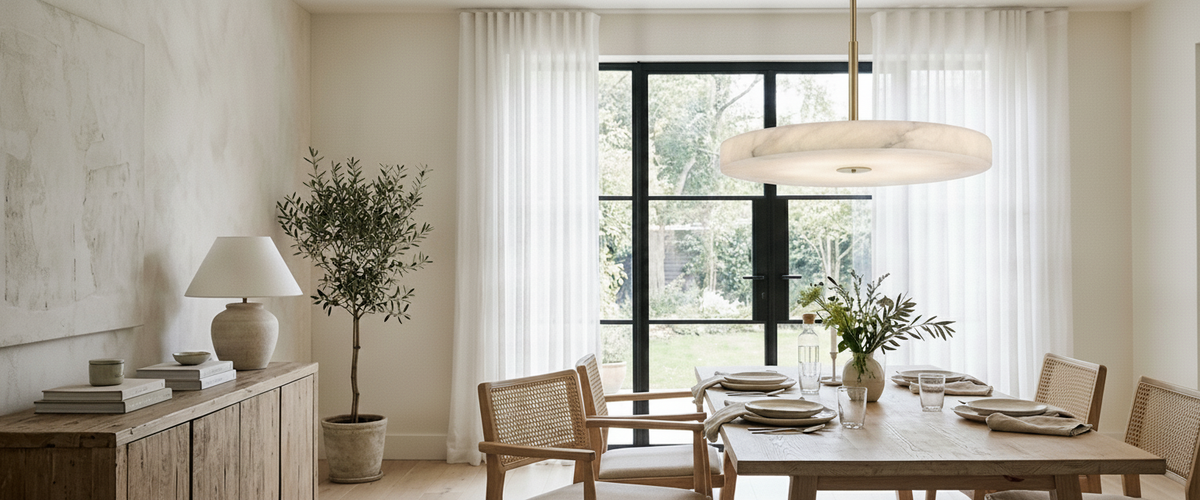

An alabaster contemporary ceiling lights lives or dies by how the stone handles light from behind. The same fitting that glows like a lantern in one room can read flat and grey in another, and the difference rarely comes down to the shape you chose from a thumbnail. It comes down to slab thickness, the run of the veining, how deep the fixture sits against the ceiling, and the bulb you slide inside. Get those right and the stone earns its place. Get them wrong and you have paid for marble to look like frosted plastic.
At Niori we make alabaster and natural-stone lighting, so the questions below are the ones we field most often from buyers and designers before an alabaster contemporary ceiling light ships. Here is what actually matters.
Even translucency is what separates a lantern-like glow from a flat, grey panel.

Key Takeaways Before You Buy
Contemporary and modern are not the same brief. Modern leans hard-edged and minimal; contemporary is looser and current. Both suit an alabaster contemporary ceiling light, but they ask for different silhouettes.
Slab thickness controls the glow. Too thick and the light chokes; too thin and hotspots show. Even translucency is the goal.
Veining is not decoration alone. It steers where light pools and where it darkens.
Mind the mounting gap. Flush fittings need room for drivers and hardware, or you get a bulky ceiling and a warm patch you did not want.
Warm-white and dimmable. Around 2700K keeps the stone honest; cooler light drags it toward cold grey.
Carved beats moulded. There are tells, and they are worth knowing before you spend.

Contemporary Versus Modern, and Why It Matters Overhead
People use the words as if they mean the same thing. In lighting they do not. An alabaster modern ceiling lights usually means clean geometry: a disc, a shallow dome, a rectilinear slab with almost no ornament. A contemporary reading is broader and more forgiving, taking in soft organic forms, mixed materials, and the odd sculptural flourish that would feel out of place in a strict modern scheme. That is why an alabaster contemporary ceiling light can carry a little more shape than its modern cousin.
Overhead, this distinction has real consequences. A pure disc reads best in a room that is already spare, where the ceiling is a plane and the fitting becomes a quiet full stop. Put that same disc in a busier, layered room and it can look like it wandered in from another house. When you browse the alabaster lighting collection, it helps to decide first whether you want the alabaster contemporary ceiling light to disappear into a minimal scheme or to sit as a soft focal point. That choice narrows the shortlist faster than any style label.
How Slab Thickness and Veining Decide Whether the Glow Lands Even
Alabaster is a translucent stone, which is the whole point of using it. Light passes through it and softens on the way, so the material itself becomes the diffuser. That translucency is also why thickness matters so much on an alabaster contemporary ceiling light. A slab cut too thick swallows the light and reads dull; cut too thin and it turns brittle in the hand and shows the bulb as a bright core. The sweet spot is a panel thick enough to glow evenly across its face without any single hot patch giving the game away.
Veining is the second variable. Alabaster is a form of gypsum, prized for centuries precisely because it lets light through where denser stones cannot; the British Museum notes its long use in translucent decorative work for exactly this reason (britishmuseum.org). Those veins are seams of slightly different density, so light pools where the stone is clearer and darkens where the vein runs thick. On a well-made alabaster contemporary ceiling light, that variation looks like the stone breathing. On a poorly matched one, a heavy vein sits right across the brightest zone and the whole piece looks smudged. This is why we photograph the actual slab going into a bespoke ceiling piece rather than a stock swatch. Two panels from the same block can read very differently once they are lit.
A shallow profile with room for the driver keeps light spreading across the stone rather than pooling.
The Mounting Gap Most Buyers Miss
Here is the detail that catches people out. A flush or semi-flush alabaster contemporary ceiling light needs somewhere to put its driver and hardware, and stone is not the material you want pressed hard against a heat source or a low ceiling with no breathing room. Skip that thinking and two problems appear: the fitting sits chunkier than the render suggested, and the light concentrates into a warm patch instead of spreading across the stone.
Ask three things before you commit. What is the overall drop or projection from the ceiling? Where does the driver live, inside the canopy or remote? And is the LED gear separated from the stone by an air gap or a diffuser layer? A good maker will answer without hesitating. It is also why the fixed engineering of a flush disc matters so much to how it reads: a piece like the Gemini Flush Ceiling Light 42.5cm in White shows how a shallow profile keeps the light spreading across the face rather than pooling in one spot. For rooms with low ceilings, common in older flats and converted spaces, a genuinely shallow semi-flush with a remote driver often beats a chunky flush unit that eats headroom. Any hardwired fitting should be installed by a qualified electrician; the guidance from Electrical Safety First is worth a read if you are project-managing a renovation.
Slotting a Pared-Back Fitting Into Modern and Transitional Rooms
A restrained alabaster contemporary ceiling light is a quiet workhorse across very different schemes, which is why it sells across our whole lighting range. In a strictly modern room, let it be the only soft, tactile thing on the ceiling and keep everything around it flat and matte. The contrast between the warm stone and the hard planes is the whole effect.
Transitional rooms, the ones mixing older bones with current furniture, are where an alabaster contemporary ceiling light really settles in. The stone reads as timeless rather than trend-led, so it bridges a period cornice and a low modern sofa without picking a side. Scale is what tends to make or break the placement here: over a hallway or a compact kitchen, a wider disc such as the Gemini Flush Ceiling Light 61cm in Brushed Brass gives an ambient wash without the visual weight of a pendant, which keeps sight lines clean. In a bedroom, the same soft overhead glow does the job that a harsh downlight never manages: light you can actually relax under. We shipped a pair of semi-flush alabaster fittings to a London townhouse landing last year where the client had spent months rejecting glass pendants for looking cold; the stone was the thing that finally felt right.
Warm-White Bulbs and Dimming That Stop the Stone Reading Cold Grey
Alabaster has a natural warmth, a faint honey or cream cast that flatters skin and timber. The wrong bulb kills it stone dead. Push a cool 4000K or higher lamp through the panel and the warmth flattens into a clinical grey; the stone looks like painted resin. Stick to warm-white, around 2700K, and an alabaster contemporary ceiling light does what you bought it for.
Colour rendering matters as much as colour temperature. Look for a high CRI lamp, ideally 90 or above, so the stone's subtle tones and the veining read true rather than washed out. Dimming is not optional on an overhead alabaster contemporary ceiling light; it is the difference between a bright daytime wash and a low evening glow that turns the whole panel into a lantern. Check the driver is genuinely dimmable and matched to your switch, because a mismatch shows up as flicker or a hard cut-off at the low end. If a fitting is sold as a fixed 4000K unit, factor that into your decision, because you cannot warm it up later.
The Tells That Separate a Carved Piece From a Moulded Lookalike
Real carved alabaster and a moulded composite can look close in a photograph and nothing alike in the room. Learn the tells and you will not overpay for the imitation when you shop for an alabaster contemporary ceiling light.
Veining that continues around edges. On carved stone the grain runs through the material and wraps the profile. Moulded pieces often carry a printed or surface pattern that stops dead at a seam.
Uniqueness. No two carved panels match. If every unit in a product photo shows identical markings, it is not natural stone.
Weight and cool touch. Real alabaster is dense and cool to the hand. Composite feels lighter and warms up quickly.
Edge finish. Hand-worked stone shows slight variation at the edges and a fine polished or honed surface. Moulded parts often have a giveaway mould line or a too-perfect uniform sheen.
How light sits in it. Genuine alabaster glows with depth, the light appearing to sit a little way inside the stone. Cheaper diffusers glow flatly on the surface.
Ask the seller straight out whether the panel is natural alabaster or a stone-effect composite, and whether they can show the specific slab. A specialist will happily talk you through the block it came from. Alabaster is a soft stone, so an alabaster contemporary ceiling light also needs sensible care once installed: keep it dry, dust with a soft dry cloth, and avoid household chemical sprays, which can etch the surface. The Natural Stone Institute publishes clear guidance on cleaning soft stones if you want the technical detail.
A Quick Buyer's Checklist
Decide modern (spare, geometric) or contemporary (softer, sculptural) before you shortlist your alabaster contemporary ceiling light.
Confirm the panel is natural alabaster, not composite, and ask to see the slab.
Check even translucency: no single hotspot, veining that flatters rather than smudges.
Ask about drop, driver location and the air gap between LED and stone.
Insist on warm-white (around 2700K), high CRI (90+) and a dimmable driver matched to your switch.
Book a qualified electrician for install, especially on low ceilings and older wiring.
A well-chosen alabaster contemporary ceiling light does something no glass or metal fitting quite manages: it turns the light source itself into a soft, warm object overhead. Whether you settle on a spare modern disc or a softer contemporary form, buy on the strength of the stone and the engineering behind it, not the thumbnail, and your alabaster contemporary ceiling light will still look right in a decade.