
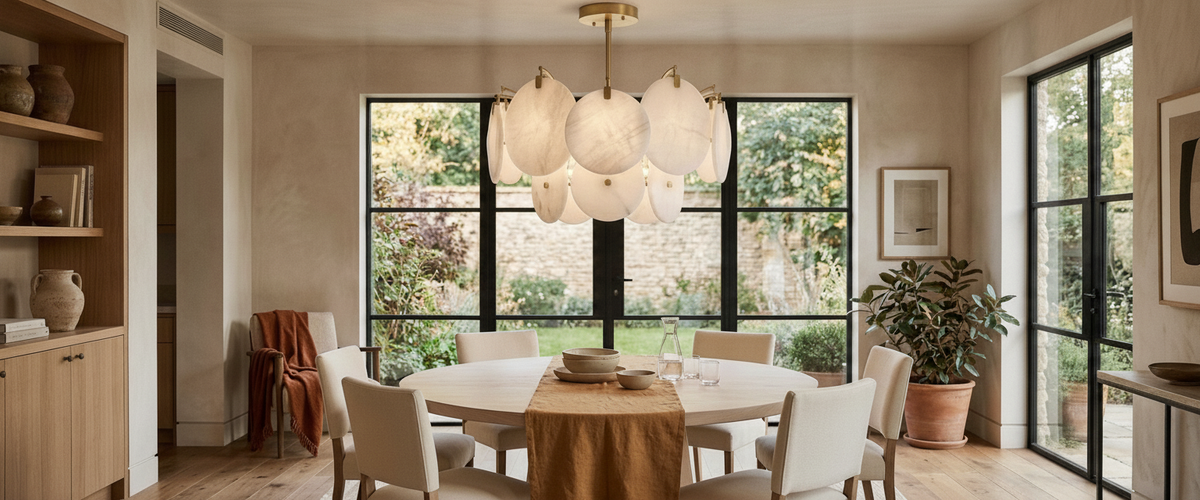

The shape of a chandelier decides where the light lands before the stone does anything at all. A round alabaster chandelier pushes a soft glow out in every direction, so it fills a space evenly rather than drawing a bright line down the centre of a table. That single fact should shape almost every decision you make about it, from the diameter you order to the room you hang it in.
We ship a lot of round pieces, and the questions that come back are always the same: how big, how bright, and how do you keep the veining from looking blotchy once it is lit. This guide answers those, alongside the trickier judgement calls that separate a round alabaster chandelier that sits beautifully from one that fights the room.

Key Takeaways
A round profile spreads stone-filtered light outward and downward, so it suits rooms used from more than one angle.
Size the circle to the table or the seating group beneath it, not to the ceiling void above.
Read the veining as a full circle before you buy; even banding keeps the lit glow consistent.
Dimming matters more than raw wattage. Warm LEDs on a compatible dimmer give you the controlled circle of light a round alabaster chandelier does best.
Antique alabaster carries age in its surface. Expect softened edges and colour shifts, and check the fitting before you rely on it.

How a Round Profile Throws Stone-Filtered Light
Alabaster is mildly translucent, so light does not bounce off it the way it does off metal or opaque glass. It passes through the outer layer, scatters inside the stone, and leaves as a warm, low-contrast glow. A linear fixture concentrates that effect along an axis, which is why long dining tables and kitchen islands suit a linear pendant. A round alabaster chandelier does the opposite. It gives you a ring or dome of light that radiates outward, so the brightness falls off gently in a circle rather than dropping sharply at the ends.
That makes the circular form the more forgiving choice in rooms you move around. Entrance halls, circular or square dining rooms, reading corners, and open-plan spaces where the seating is not lined up all read better under a round alabaster chandelier. The light has no obvious front or back, so it never looks as though it is aimed at one wall.
You can see the range of forms across our alabaster lighting collection, but the principle holds: match the geometry of the fixture to the way people actually use the floor beneath it.
Reading Veining Around a Curved Shade
Alabaster is a natural stone, and no two pieces are identical. On a flat panel that variation is easy to judge. On a curved or domed shade it is trickier, because the veining wraps and you only ever see part of it at once. Before you commit to a round alabaster chandelier, look at the shade as a whole circle rather than a single flattering photograph.
What you want is reasonably even banding all the way round. When the veins run in loose, consistent bands, the lit glow stays smooth and the stone looks like one continuous material. When a shade has one dense, dark seam and three pale panels, that contrast doubles under light: the dark seam reads almost opaque while the pale sections glow bright. A little variation is the point of natural stone. A hard, uneven split is a distraction.
The Natural Stone Institute notes that gypsum alabaster is a soft, banded mineral, which is exactly why hand selection matters so much for a curved piece. Ask the seller how they grade and orient the panels before assembly. A good workshop turns the stone so the strongest veining sits where it flatters the curve, not where it snags the eye.
Sizing the Circle to the Table, Not the Ceiling Void
The most common sizing mistake is choosing the diameter to fill the ceiling. The ceiling is not what the chandelier serves. The table, the island, or the seating group below it is.
For a round alabaster chandelier over a round or square dining table, aim for a diameter of roughly half to two-thirds the width of the table. Over a rectangular table you would usually reach for a linear piece, but if you want a circular design there, size it to the shorter dimension so it does not overhang the edges. In an entrance hall or an open room where the piece hangs free, a rough rule is to add the room's length and width in feet and treat that sum in inches as a sensible diameter. A 14 by 16 foot room lands around 30 inches (about 76 cm) as a starting point.
Hanging height follows the same logic. Over a table, leave around 30 to 36 inches (76 to 91 cm) between the tabletop and the bottom of the fixture so sightlines across the table stay open. In a hall with tall ceilings, hang it lower than instinct suggests; a chandelier stranded near a high ceiling looks lost. If you are unsure, ask for the weight before you plan the fixing, since a round alabaster piece carries real stone and needs a mount rated well above its load. We tell clients to size the electrical box and the ceiling support to the fixture, never the other way around.
Where a Round Piece Flatters, and Where It Modernises
A round alabaster chandelier does something quietly clever in a period room. The curved stone and warm glow sit comfortably against cornicing, panelling, and older joinery, because the material reads as classic while the clean circular geometry keeps it from looking fussy. In a Georgian or Victorian dining room, a simple alabaster ring or dome gives you the presence of a traditional fitting without the tiered crystal and visual noise.
Drop the same shape into a pared-back contemporary space and it changes role. Against flat plaster, oak, and concrete, the round profile becomes a soft sculptural moment, and the natural veining brings warmth that a machined glass or metal fixture cannot. We shipped a large domed alabaster chandelier to a client renovating a mid-century house, and it became the one warm, organic object in an otherwise crisp room, stopping the interior from feeling clinical.
If your scheme leans darker and more graphic, where the fitting is meant to register as a frame rather than a soft glow, a metal piece such as the Dynamite 6 Light Chandelier is closer to the right design language than translucent stone. Where the room is used from every angle and you want the light itself to be the event, the round alabaster chandelier stays the better answer. Geometry solves the practical problem. Finish and material solve the aesthetic one.
Antique Alabaster Chandeliers: What the Decades Leave Behind
An antique alabaster chandelier is a different proposition from a new one, and worth understanding before you buy. Alabaster is soft, so years of handling and cleaning round off carved edges and soften detail. The stone also shifts colour over time; older pieces often warm towards honey or amber tones, and some develop fine surface crazing that reads as character when lit and as damage when it is not.
Two things need checking on any older piece. First, the stone: hold it to the light and look for cracks that run rather than sit on the surface, because a running crack in a load-bearing shade is a structural worry, not a cosmetic one. Second, the wiring and fitting. Vintage fittings frequently need rewiring to meet current standards, and that is not a job to improvise. Have a qualified electrician inspect and, where needed, rewire an antique alabaster chandelier before it goes up. The guidance from Electrical Safety First sets out what safe practice looks like.
Buy an antique alabaster chandelier for the surface age gives the stone, not despite it. That soft, slightly uneven glow is the reward. Just price in the likelihood of a rewire and a clean before it earns its place.
Fitting and Dimming for a Controlled Circle of Light
A round alabaster chandelier rewards restraint on brightness. Push too much cool, high-output light through it and you lose the warm scatter that makes the stone worth having. Go warm and dimmable instead.
Colour temperature: stay in the 2700K to 3000K range. Warm light reads with the honey undertone of the stone; cooler light flattens it.
Bulbs: use LED for the low heat, which matters inside an enclosed stone shade. Confirm the fitting type and maximum wattage per lamp before ordering replacements.
Dimming: pair the fixture with a dimmer rated for LED. A round alabaster chandelier is often the main light in the room, so the ability to drop it to a low, even wash for evenings is the point.
Wiring: hardwired ceiling fixtures should be installed by a qualified electrician, and the ceiling support must be rated above the fixture weight.
How to Balance a Round Alabaster Chandelier
A round alabaster chandelier that hangs slightly off-level shows it instantly, because the eye reads the circle against the ceiling line. Most quality pieces have adjustment at the canopy or in the chain or rod links. Level it with a spirit level across two axes, tighten the fixing, then check again after a day or two, since a heavy stone piece can settle. If one section of the ring sits low, the load is usually uneven at the mount rather than a fault in the fixture; a good installer will correct it at the ceiling.
How to Clean an Alabaster Chandelier
Keep it simple and dry. Dust regularly with a soft, dry microfibre cloth or a clean soft brush. Alabaster is porous and reacts badly to water and household cleaners, so avoid sprays, soap, and anything acidic; moisture can stain or etch the surface permanently. For a mark that dust will not lift, use a barely damp cloth on that spot alone and dry it straight away. Never soak alabaster. Turn the power off and let bulbs cool before cleaning around them.
Cared for this way, a round alabaster chandelier holds its glow for decades, which is rather the point of buying stone in the first place. Because pricing depends on the diameter, the stone selection, the fitting complexity, and installation, we would always suggest requesting a tailored quote rather than working from a rough figure.