
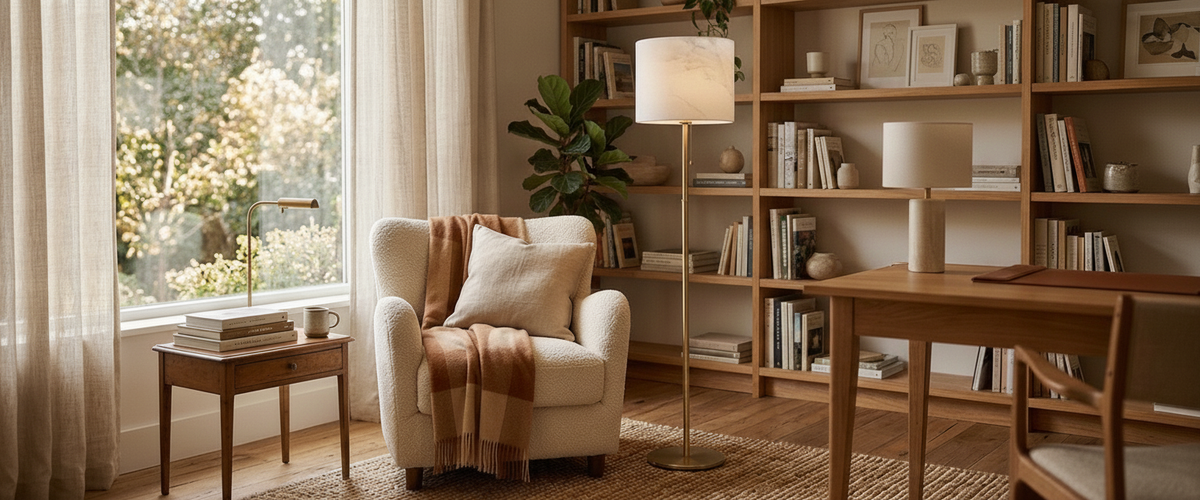

A floor lamp is the one piece of lighting you notice at eye level all day, switched on or off. Get it right and the corner reads as considered; get it wrong and you have spent good money on something that looks loud in a showroom and awkward at home. The best unique floor lamps do quiet, useful work: they carve out a pool of warm light, give a reading chair a reason to exist, and hold a sightline without crowding the floor. That is a harder brief than most lamps meet.
At Niori we design alabaster and natural-stone lighting, so we spend our days thinking about how a material behaves when the switch flips. The lesson we keep learning is simple. The unique floor lamps people live with for years are rarely the ones that shout loudest.

Key Takeaways
Distinctive means the lamp still looks good on a dull Tuesday, not just in the catalogue.
Stone, marble and onyx bases give weight and character without any visual noise.
Size the lamp to the corner it fills, not the photo that sold it to you.
The quality of light it throws matters more than the shape it strikes.
Honest construction shows in the base, the joints, the switch and the cable.

Distinctive Versus Attention-Seeking
There is a difference you feel rather than describe. A distinctive lamp holds its own in the room and lets everything else breathe. An attention-seeking one demands that the sofa, the rug and the art all step back and defer to it. The first ages well. The second starts to grate within a season.
When clients ask us for unique floor lamps, what they usually want is the first thing: a piece with clear character that still plays nicely with the rest of the room. Novelty for its own sake fades fast. The best unique floor lamps get their pull from a carved alabaster column or a honed marble base, presence that comes from the material itself, so they do not have to try so hard. That is the quiet route to standing out.
Stone, Marble and Onyx Bases as the Quiet Route to a Standout Lamp
Weight is the first tell. Pick up a lamp with a genuine stone base and it settles in the hand with a heft that plastic and thin metal simply cannot fake. That mass also does practical work: a low, dense base steadies a tall lamp so it does not wobble when a dog brushes past or a child leans on the shade. This is where unique floor lamps prove themselves before they are even switched on.
Then there is the surface. Marble runs in soft grey and cream veining that catches side light. Onyx can glow slightly when lit from within, its bands warming to amber and honey. Alabaster is the material we return to most, because it is translucent in a way stone rarely is; light passes through it and comes out softened, warm and even. A carved piece such as the Vellum LED Alabaster Column Floor Lamp shows how the column itself becomes the light source, with the stone diffusing the glow rather than a fabric shade doing the work. No two of these unique floor lamps read the same, since the veining is set by geology rather than a print run. You can see how that plays out across our alabaster lighting range, where the same design takes on a different character stone by stone.
Natural stone also grounds a room in a way glossy finishes do not. In a pale, modern living room a stone-based lamp adds a note of substance. In a warmer, more traditional space it feels quietly at home. That flexibility is why we keep specifying it for unique floor lamps.
Sizing a Sculptural Lamp to the Corner It Fills
The most common buying mistake we see is scale. A lamp looks perfect in a wide studio shot, arrives, and turns out to be a giant in a modest sitting room or a toy against a double-height wall. The photo is not lying; it is just shot to flatter.
Measure before you fall in love. As a working rule, a floor lamp for reading wants the lower edge of its shade somewhere around 40 to 50 inches (100 to 127 cm) from the floor, so the light falls onto the page rather than into your eyes when you are seated. For an ambient lamp meant to wash a corner, you have more freedom on height. Check the base footprint too. A generous stone base needs a clear patch of floor; wedge it against a skirting board and the proportions fight the wall. Most unique floor lamps live or die by this step.
Think about the volume of the corner, not just the floor space. A tall, slim column suits a narrow gap beside a bookcase, while for a compact reading nook a smaller footprint like the Atria Small LED Alabaster Floor Lamp keeps the proportions honest. A lower, wider sculptural form suits an open corner where it can be seen in the round.
Why the Light It Throws Matters More Than the Silhouette
A lamp is a light source first and an object second. Too many striking designs forget that. Before you commit, ask what the lamp actually does after dark.
Alabaster and opal glass shades diffuse light into a soft, glare-free glow, which is why these unique floor lamps suit living rooms and bedrooms where you want to relax rather than read a spreadsheet. Where the room needs that soft diffused wash rather than a hard directional beam, a globe form such as the Selvano Alabaster Globe Floor Lamp is closer to the right design language. A bare directional head throws a harder, more useful pool for a reading chair. Many of these sculptural designs use warm-white LED, and we would steer most buyers towards a colour temperature around 2700K for living spaces; the Illuminating Engineering Society treats warm-white ranges as the norm for comfortable residential settings, and it is a range that flatters both skin and stone. The IES publishes the technical background if you want the detail.
Dimming matters as much as brightness. A lamp you can take from a low evening glow up to a working level earns its place in more moments of the day. Confirm the lamp is dimmable and that it plays well with a trailing-edge dimmer before you buy, especially with integrated LED. The best unique floor lamps give you that range without a flicker.
Placing the Lamp So It Leads the Eye
Where you put a floor lamp changes how the whole room reads. A few placements do most of the work, and unique floor lamps reward careful positioning more than plain ones.
Beside a reading chair or the end of a sofa: the classic spot, giving directed light for reading and a soft anchor to the seating group.
In a corner behind a chair: bounces light off two walls and lifts the darkest part of the room, which is where living rooms usually fall flat.
Framing a console, fireplace or piece of art: the lamp becomes part of a composition rather than a stray object.
Beside a window: good after dark, since it replaces the daytime pull of the view with a warm focal point at night.
Keep it out of main walking routes. A sculptural base at ankle height in a doorway is a stubbed toe waiting to happen, and it drags the eye down instead of leading it across the room. You can compare forms and heights across our wider lighting collection to see how a floor lamp sits with pendants and wall lights in the same scheme.
Can you have two floor lamps in one living room? Yes, and in a larger space it often reads better than one. Use them to balance opposite corners or to bracket a sofa. Keep them from the same family or at least the same material language, so they feel deliberate rather than accidental. Two mismatched statement lamps end up competing, which is the opposite of what unique floor lamps are meant to do.
Build-Quality Tells That Separate Craft From Gimmick
A high price does not guarantee good making. Here is what we look at when we assess unique floor lamps, and what you can check yourself.
The base: real stone has weight and a cool touch. Tap it. A hollow ring often means a stone-effect resin over something lighter.
The joints: where the column meets the base and the head, look for clean, flush connections rather than glue lines or wobble.
The finish on metal: brushed brass and matt black should feel even, with no thin patches at the edges where plating gives out first.
The switch and cable: an inline switch that feels solid and a cable with a decent braided or well-finished sheath signal a maker who cared past the photograph.
The stone edges: hand-finished alabaster has softly worked edges and consistent translucency, not sharp machine chatter marks.
One more note on the material itself. Alabaster is a soft stone and it dislikes standing water, so a quick dust with a dry, soft cloth is the right routine, and any damp wipe should be followed by drying. The Natural Stone Institute keeps clear care guidance for gypsum-based stones if you want to read further before you buy. Treat the piece kindly and your unique floor lamp will outlast most trends.
Because these unique floor lamps vary so much in stone, scale, engineering and finishing, there is no single sensible price to quote. Budget depends on the size of the piece, the complexity of the carving and the metalwork, and the light engine inside. If you have a specific corner and a look in mind, ask us for a tailored quote rather than working from a headline figure.