
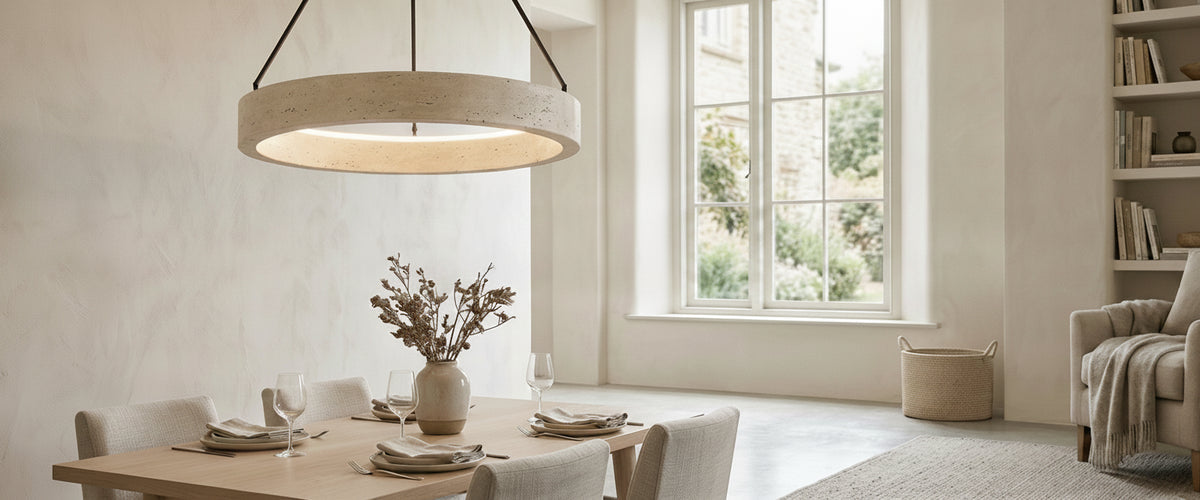

Polished marble throws light straight back at you. Travertine does something far more interesting: it catches the beam in its open pores and lets it crawl across the surface, so the stone looks lit from within even when the source is entirely hidden. That single behaviour is why a travertine stone pendant lights sits so comfortably over a dining table or an island, and why the same fixture can look dull and lumpen if the grain, the bulb, or the drop height is specified badly. Travertine is unforgiving of lazy decisions.

Key Takeaways
- Travertine's pitted grain scatters light sideways, giving a soft grazed surface rather than the mirror flash of polished marble or onyx.
- A travertine stone pendant light is markedly less translucent than alabaster, so it lights the room downwards while the body itself glows gently at the rim.
- Form drives character: cylinders are architectural, discs are quiet, a travertine linear pendant light is the workhorse for long tables and islands.
- Travertine reads visually heavier than it weighs, so drop height and scale need more care than with glass.
- Warm bulbs between roughly 2400K and 2700K flatter the ochre undertone; anything cooler turns the stone grey.
- Stone grade (filled or unfilled) and backplate finish are the two details buyers skip and later regret.

Why the Grain of a Travertine Stone Pendant Light Scatters the Beam
Travertine forms as mineral-rich water deposits calcium carbonate around springs, trapping gas bubbles as it sets. Those trapped voids become the pits, channels and linear striations that make the stone instantly recognisable, and they are the reason it handles light the way it does. You can read more about how these freshwater carbonate deposits build up in the geological summaries published by the British Geological Survey. A polished, dense stone reflects specularly, which is a technical way of saying it produces a hot spot and a glare edge. Travertine's surface breaks that reflection into hundreds of tiny shadowed cavities, so the light diffuses across the face of the shade instead of bouncing off it.
The practical effect: a travertine stone pendant light produces very little visual noise. There is no bright hot ring on the shade to distract you across a table, and the stone holds a low, even tonal glow along its lower edge. Where alabaster transmits light through the body and lights up like a lantern, travertine mostly works by surface. Thin-cut sections do transmit a faint warmth at the rim, but you should buy travertine for its texture and grounding weight, not expecting it to behave like a backlit alabaster shade. If you want that lit-from-within effect, our alabaster lighting range is the better starting point, and many projects run both materials in the same house.
Cylinder, Disc, or Linear: How Form Changes a Travertine Stone Pendant Light
Cylinders and Capsules
A vertical cylinder emphasises the stone's horizontal bedding lines, so the striations run across the form like strata in a cliff face. It is the most architectural travertine stone pendant light you can specify: a tight, controlled pool of light below, reading as a small piece of building rather than decoration. Cylinders suit hallways, stair voids and pairs over a breakfast bar. Where you want that discipline but still need the banding to carry some warmth, a form like the Corano Travertine Cylinder Pendant Light reads correctly, with the walnut band grounding the paler stone above it. Capsule and cone forms soften that severity slightly, widening the beam and letting a little more glow escape at the lower edge.
Discs and Domes
A disc pendant is the quietest option travertine offers. Because the eye reads a flat plane, the grain becomes the entire event, and the fixture recedes into the ceiling line when switched off. Domes sit between the two, spreading light more generously and giving a warmer, fuller wash. These are the shapes to choose in a room that already has a lot going on: patterned tiles, a strong worktop veining, open shelving.
Linear Bars
A travertine linear pendant lights is the specification that solves long-table problems. One continuous bar over a 2.4 metre (roughly 8 foot) dining table gives even coverage without the visual clutter of three separate pendants and three separate ceiling penetrations. It also lets the stone show its grain along its longest axis, which is where travertine is at its most convincing. Linear pieces do demand a level ceiling and a properly sited fixing point, so confirm the joist position before you commit.
Rooms Where a Travertine Pendant Pulls Focus, and Rooms Where It Disappears
A travertine stone pendant light performs best where its colour has something to answer to: oak, walnut, unlacquered brass, limewashed plaster, wool, rush matting. Over a kitchen island in a plaster-and-timber extension it becomes the warm anchor in the room. Over a dining table in a period house with dark joinery it holds its own without competing. In a stairwell, a single large travertine pendant light hung down a double-height void gives you sculptural presence in a space that usually gets nothing but a flush fitting.
The rooms where it struggles are cool, grey-toned, and high-contrast: a monochrome bathroom, a north-facing room painted in a blue-grey, a kitchen with white gloss units and cool LED task lighting. Travertine's ochre and biscuit tones need warm neighbours or they look muddy. It also disappears in rooms with very high ambient daylight and pale stone floors, where the shade blends into the background and the fixture stops earning its keep. We had exactly this on a project in a Cotswolds kitchen with a pale limestone floor and painted units: the client's first choice, a light cream travertine disc, vanished. A darker banded disc of the same form, along the lines of the Torvane Travertine Disc Pendant Light, gave the piece back its edge, and nothing else in the room changed.
Scale and Drop: Why Travertine Reads Heavier Than Its Weight Suggests
Stone carries visual mass, and a travertine stone pendant light carries more of it than the kilos on the spec sheet suggest. A stone shade of the same diameter as a glass one will feel roughly a third larger to the eye, which means the usual rules of thumb need adjusting downwards, not upwards. Over an island, size the pendant to around a third of the island width when using a single piece, and leave generous clear space between multiples rather than crowding them.
For drop height above a dining table or island, aim for roughly 75 to 90 cm (about 30 to 36 inches) from the tabletop to the base of the shade. Go lower with a narrow cylinder, higher with a wide disc, and always check sightlines across the table from a seated position. In rooms with ceilings above 2.7 metres (about 9 feet), add height to the drop rather than the fixture, otherwise the pendant floats.
Weight matters structurally too. Any travertine pendant light ceiling installation needs a fixing into a joist or a properly specified support, not a plasterboard anchor, and the electrical work should be signed off by a qualified electrician. Guidance published by CIBSE is a sound reference point for lighting design and installation standards on larger residential and hospitality schemes.
Bulb Temperature and the Warm Ochre Undertone Travertine Always Wants
Get this wrong and nothing else you specified will save the piece. Travertine's undertone sits in the ochre, buff and biscuit range, and cool light kills it stone dead. Stay between 2400K and 2700K. At 3000K the stone starts to look sandy and slightly flat; at 4000K it goes grey and clinical, and the pits that should look like texture start looking like damage.
Choose lamps with a colour rendering index of 90 or above so the mineral variation in the stone stays legible. Dimming is non-negotiable in dining rooms: a travertine stone pendant light at full output is a working light, and at 20 percent it becomes an entirely different fixture, all warm edge glow and low pooled light. Confirm the driver and dimmer are compatible before installation, because low-end flicker is more obvious under stone than under fabric.
Stone Grade and Backplate Finish: The Two Decisions Buyers Consistently Overlook
Travertine is sold filled or unfilled. Filled stone has its pores grouted and honed smooth, giving a more uniform, contemporary face that dusts easily and suits kitchens. Unfilled stone keeps its open pitting, which is far more expressive under raking light and far more likely to catch airborne grease over a hob. Neither is better; they are different fixtures. Before you order a travertine stone pendant light, ask which grade it uses and how the stone has been sealed, since travertine is porous and reactive to acids.
The second oversight is the backplate and hardware finish. A warm brass or bronze canopy carries the ochre through to the ceiling and makes the pendant look designed. Chrome or cool nickel against travertine creates a small, permanent clash you will notice every time you walk in. Where a room already has timber joinery to answer to, pairing the stone with a warm wood element rather than a cold metal one is the safer move, which is the logic behind a piece such as the Lunaro Travertine & Walnut Single Pendant Light. Consider the flex or rod colour too: black cable against cream stone is a strong graphic choice, while a warm braided flex disappears politely.
Buyer's Checklist Before You Order
- Measure the table or island and set the pendant width to roughly one third of it, sizing down slightly for stone.
- Confirm ceiling height, joist position and the exact fixing point, especially for a linear bar.
- Decide filled or unfilled travertine based on room use, not photographs alone.
- Match the metal finish to your existing ironmongery and taps.
- Specify 2400K to 2700K lamps, CRI 90 or higher, on a compatible dimmer.
- Hold a sample against your worktop and joinery in both daylight and evening light before committing.
- Book a qualified electrician and confirm the load rating of the fixing before any travertine stone pendant light goes up.
Living With Travertine
Dust with a dry, soft brush rather than a damp cloth, working into the pits rather than across them. Skip vinegar, lemon-based sprays and general bathroom cleaners entirely, as calcium carbonate etches on contact with acid. In a kitchen, wipe the underside occasionally with a barely damp microfibre cloth to lift cooking film before it sets. Re-sealing is a periodic job, not an annual one, and a good stone supplier will tell you which product suits the grade they used.
The budget for a travertine stone pendant light depends on stone grade, block yield, scale, the complexity of the metalwork, and the finishing and installation involved. Rather than working from a guessed figure, request a tailored quote with your dimensions and drop height. If you are still weighing materials, it is worth browsing the wider lighting collection at Niori, where alabaster, marble, onyx and travertine sit side by side and the differences in how each stone handles light become obvious very quickly.