
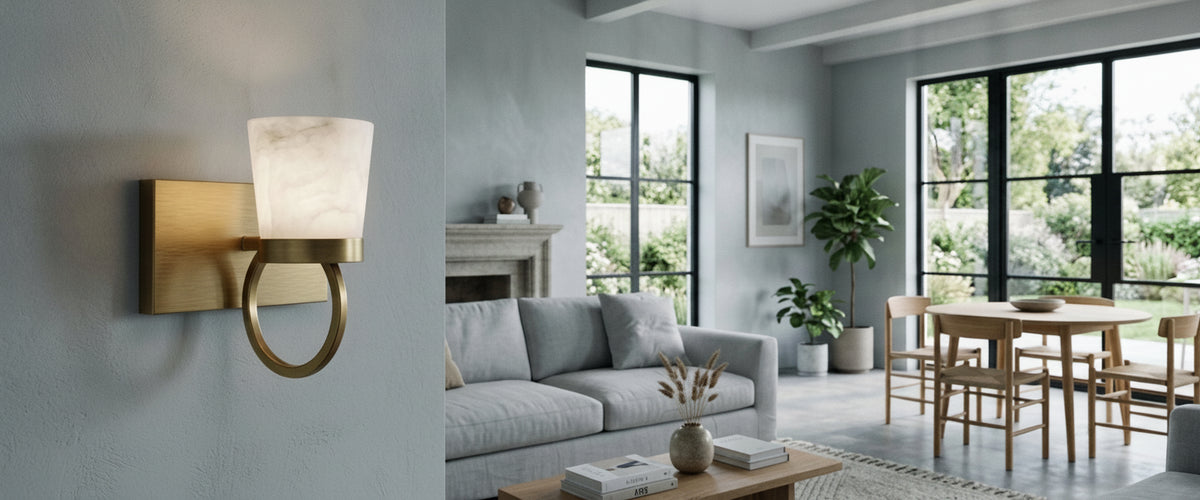

Brass has a reputation problem, and polished brass caused most of it. Mirror-bright fittings from the late eighties turned a genuinely good metal into shorthand for dated, and plenty of buyers still flinch at the word. A brushed brass lighting behaves nothing like that. The grain scatters reflection instead of throwing it back, so the metal reads as a warm, matte tone rather than a bright spot in the corner of your eye. Paired with alabaster or onyx, which already soften light on the way through, it is one of the calmest combinations you can put in a room.

Key Takeaways
- Brushed brass diffuses reflection. The fine directional grain kills the hotspots that make polished brass look restless under a spotlight.
- A brushed brass light works hardest where you look at the metal for a long time: wall fittings at eye level, floor lamp stems, table lamp bases, chandelier arms.
- 2700K is nearly always the correct bulb for a brushed brass light. Cooler light drains the warmth out of the alloy and turns it faintly green.
- Mixing metals is fine if one finish clearly leads and the others support it.
- Quality lives in the substrate and the coating, not the photograph. Solid brass or a properly applied PVD finish will outlast thin plating by years.

Brushed, Polished or Antique Brass: What the Surface Actually Does to Light
All three start from the same copper and zinc alloy. What changes is the last five minutes of finishing, and that is where the visual difference is decided.
Polished brass is buffed to a near-mirror. It reflects specularly, meaning light bounces off at a predictable angle in a concentrated beam, so the fitting picks up every lamp and window in the room and holds a bright glint. In a large hallway that can be lively. Above a dining table, under downlights, it becomes a nuisance.
Brushed brass is abraded with a fine directional grain, usually running along the length of a stem or around the circumference of a ring. That microscopic texture scatters incoming light across many angles, which is why a brushed brass light looks like a colour rather than a mirror. You see the tone of the metal, not the reflection of your kitchen island.
Antique brass is a chemically darkened surface, often with relief left brighter on the high points. It reads older and heavier, and it drops the contrast between metal and shade almost to nothing. That suits a period cottage; it can look muddy against a pale plastered wall where you actually want the fixture to register.
There is a practical consequence too: brushed surfaces hide fingerprints far better than polished ones. If a brushed brass light is going near a switch plate, a stair handrail or a bedside table, that finish saves you a cloth every week.
The Fixture Types Where Brushed Brass Earns Its Place
Metal finish matters in direct proportion to how long your eye rests on it, which is why a brushed brass light pays for itself most in the pieces you stand beside. Ceiling roses seen from six metres away could be almost any colour. A wall fitting at shoulder height, half a metre from you, is a different matter.
Wall lights
This is where brushed brass does its best work. Mounted at roughly 1.5 to 1.7 m (60 to 66 inches) from the floor, the backplate and arm sit squarely in your field of view, and the brushed grain keeps them quiet. Against an alabaster shade the warm metal picks up the honey in the stone's veining, and the two materials read as one object rather than a shade bolted to a bracket. For a fitting read from a metre away rather than across a room, the Aurelian LED Alabaster Wall Light, Brushed Brass shows the logic of the pairing: the backplate stays matte even with low sun on it, while the stone carries the glow.
Low afternoon sun is the real test, and it is the one most people skip. A polished sample that looks elegant under showroom downlights will throw a hard glint across the wall when western light catches it; a brushed sample in the same spot stays even all the way through. If the fittings are going to flank tall windows, hold the sample there before you commit.
Floor and table lamps
The stem of a brushed brass light is a vertical line you live with. Brushing keeps it as a soft warm stroke instead of a glare. It also survives contact with hands, sleeves and vacuum cleaners better than a mirror finish, which shows every micro-scratch. Scale is the real decision here: beside a low armchair, a contained piece such as the Atria Small LED Alabaster Floor Lamp, Brushed Brass holds the finish at seated eye level without dominating the corner, while the larger version of the same design suits taller ceilings and heavier furniture.
Chandeliers and pendants
Brushed brass arms work beautifully when they are structural and visible, holding alabaster discs or petals in a layered arrangement such as the Aurelian LED Layered Arms Alabaster Chandelier, Brushed Brass, where the metal is doing load-bearing work rather than decoration.
Where it quietly disappoints is on very small, very simple pendants suspended high in a double-height space. From that distance the brushed grain is invisible and the metal just reads as beige. If a brushed brass light will hang more than about 3 m (10 feet) above your head, spend the finish budget on the shade material instead. You can see how the metal and stone are balanced across different fixture types in our alabaster lighting collection.
Bathrooms and kitchens
A brushed brass light performs well in humid rooms provided the coating is right, and it hides limescale spotting better than chrome. Any hardwired fitting in a bathroom zone must be installed by a qualified electrician to the current wiring regulations; this is not a job to improvise.
How Wall Colour and Stone Surfaces Shift the Way Brushed Brass Reads
Brass is not a fixed colour. It is a warm mid-tone that borrows heavily from whatever sits behind it, and it changes noticeably between morning and evening light.
Against cool grey or blue-grey walls, brushed brass jumps forward. The complementary contrast makes it look more golden and more deliberate, which is useful if you want the brushed brass light to act as a punctuation mark. Against warm off-whites, clay and mushroom tones, it recedes into the wall and behaves like jewellery rather than a feature. Against deep green or oxblood, it glows, and this is the pairing that turns a dining room into somewhere you want to sit after the plates are cleared.
Stone surfaces complicate it further. Carrara marble, with its cool grey veining, throws brass into relief. Travertine and creamy limestone absorb it. Onyx, especially the amber and honey varieties, is the natural partner; the warm mineral banding and the brushed metal share the same register, and lit from within, onyx pushes exactly the tone that flatters the alloy. Hold a sample against your actual worktop at three points in the day before committing. Showroom lighting lies.
Mixing Metals Without a Fight
The rule that everything must match died a long time ago, but the replacement rule is not "anything goes". It is about hierarchy.
- Pick a lead finish and commit to it. If brushed brass is the lead, it should appear at least three times in the room: lighting, a door handle, a mirror frame.
- Brushed brass and matt black is the easiest pairing. Black reads as a graphic outline rather than a competing metal, so there is no clash of undertone.
- Brushed brass and brushed nickel works because the surface treatment matches even though the colour does not. Warm and cool sit together comfortably when both are matte.
- Brushed brass and polished chrome is the hardest combination. Chrome is cool, blue-shifted and highly specular; brass is warm and diffuse. If you inherit chrome taps you cannot change, keep every brushed brass light on the vertical plane (wall fittings, pendants) and let chrome stay horizontal at worktop level.
- Do not mix two golds. Brushed brass next to polished gold or rose gold looks like a mistake rather than a decision.
Why 2700K Is Almost Always the Right Bulb for a Brushed Brass Light
Colour temperature does more to a brass finish than any cleaning routine. At 2700K the source sits in the same warm register as the alloy, so the metal looks rich and the alabaster above it glows amber-white. Push to 3000K and the effect is acceptable but thinner. At 4000K, a brushed brass light turns faintly grey-green and alabaster loses its depth entirely, reading like frosted acrylic.
Three specification points worth insisting on when you buy a brushed brass light:
- 2700K, or 2400K for bedrooms and snugs where you want candle-adjacent warmth.
- CRI 90 or above. Colour rendering determines whether the veining in natural stone shows as subtle mineral variation or as dirty smudges. Cheap LEDs flatten stone badly.
- A properly matched dimmer. Trailing-edge dimmers suit most LED drivers; leading-edge units often buzz or flicker. Confirm compatibility with the specific driver rather than assuming, and have the circuit checked by an electrician if you are retrofitting.
Integrated LED fittings remove the guesswork because the temperature and rendering are engineered into the product. Where a fitting takes replaceable lamps, buy a full set at once so every bulb in the room ages at the same rate.
Three Quality Signals That Separate a Lasting Finish from One That Dulls
1. What is underneath the brass. Solid brass components have the colour all the way through, so a scratch shows as a bright line that patinates back over time. Brass-plated steel or zinc shows silver or grey when damaged, and there is no recovery. Weight is the quickest field test: pick up the backplate of a brushed brass light and you will know within a second.
2. How the finish is sealed. Brass naturally tarnishes as copper in the alloy reacts with oxygen and sulphur compounds in the air, which is why unlacquered pieces darken. The Copper Development Association sets out how alloy composition and surface treatment govern that behaviour. A good fitting is either honestly unlacquered and sold as a living finish, or properly protected with a durable lacquer or a physical vapour deposition (PVD) coating. Thin spray lacquer is the failure point: it flakes at handled edges within a year or two and leaves a patchy, half-tarnished surface that cannot be tidied.
3. Consistency at the joints. Look at where an arm meets a body, or where a stem enters a base. On well-made pieces the brushed grain runs in a deliberate direction and continues logically across the join. On poor pieces the grain changes direction randomly, or the seam is filled and sprayed. That detail tells you how the whole fitting was assembled.
A Short Buying and Care Checklist
- Request a physical finish sample and view it against your wall colour in daylight and after dark.
- Confirm whether the brass is solid, plated, or PVD coated, and whether it is lacquered or a living finish.
- Check the mounting height for wall fittings against furniture and door architraves before ordering.
- Specify 2700K and CRI 90+, and confirm dimmer compatibility with the driver.
- Dust with a dry, soft microfibre cloth, always following the direction of the brushed grain.
- Never use abrasive metal polish, vinegar or ammonia-based cleaners on a lacquered or PVD finish; the Canadian Conservation Institute is clear that abrasives permanently remove surface material.
- For adjoining alabaster or marble, keep water and solvents away from the stone entirely and use a dry cloth only.
- Budget realistically. Cost depends on alloy quality, stone selection, fixture scale, engineering and installation, so ask for a tailored quote rather than working from a headline figure.
Where to Start
If you are specifying a whole scheme, begin with the fitting you will stand closest to. Get that finish right, then work outward; the pieces you view from across a room are far more forgiving. Niori works almost exclusively in alabaster, onyx and natural stone with brass detailing, so if you want to compare how the same finish behaves on a wall fitting, a floor lamp and a layered chandelier, browse the full lighting range or start from the homepage and filter by fixture type. A brushed brass light chosen carefully will still look considered a decade from now, which is more than most finishes can promise.