
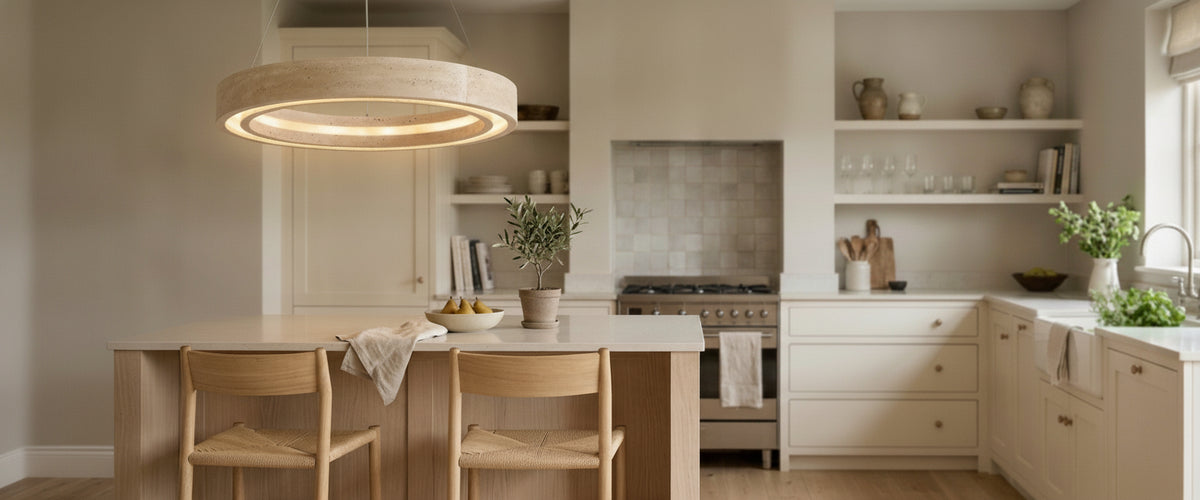

Most travertine pendant lights fail the same way. They get hung a foot too high, fitted with a bulb chosen for a garage rather than a kitchen, and floated over a countertop color that drags the stone toward gray. The fixture is fine. The scheme around it is doing the damage. A travertine pendant light is one of the few fixtures that genuinely rewards fussiness about numbers, because the stone is thick, porous and only semi-translucent, so every inch of drop and every degree of color temperature shows up on the surface of the shade.

At a Glance
Drop height: 30 to 36 inches (76 to 91 cm) from the countertop to the lowest point of the shade, measured to the stone, not the cable.
Spacing: 24 to 30 inches (61 to 76 cm) between pendant centers, with at least 6 inches (15 cm) of island left beyond the outer fixtures.
Bulb: 2700K for a warm evening kitchen, 3000K if your cabinets are cool gray or your stone is heavily walnut-toned.
Dimming: Non-negotiable. At full output a travertine pendant light reads as a bright fixture; at around 40 percent it reads as a glowing object.
Finish pairing: Warm brass, walnut and unlacquered metals sit better with travertine than chrome or nickel.
Care: Dry dust weekly, pH-neutral cleaner occasionally, never anything acidic.

Travertine Scatters Light Differently From Alabaster
Alabaster is a gypsum stone with a fine, even crystal structure. Backlight it and the whole shade blooms; the glow travels through the body of the stone and the veining reads like smoke suspended in honey. Travertine behaves differently. It is a calcium carbonate rock formed at mineral springs, and it carries the evidence of that formation in its structure: linear bedding planes, tiny voids, and a denser, more granular body. Light does not flood through travertine the way it does through alabaster. It creeps, and that single difference explains how a travertine pendant light behaves once the switch is on.
The practical result is that a travertine pendant light throws most of its output down and lets only a soft halo through the walls of the shade. That makes it excellent task lighting over a work surface and much less useful as ambient fill for the room. On the studio bench we sometimes put an alabaster sample and a travertine sample against the same lamp; alabaster lights up edge to edge, while travertine glows around the rim and holds a warm, matte density through the middle. Neither is better. They are different tools.
What this means for your kitchen: if you want the pendants to also brighten the room, plan for perimeter lighting to do that job. A travertine pendant light kitchen scheme works best when the pendants own the island and the downlights or wall lights carry the rest. If you want a clean pool of light on the island with a warm object hanging above it, a travertine pendant light is exactly right. Get that straight before you buy and you stop over-specifying wattage.
Veining Density and Stone Color Shift How Warm Your Kitchen Feels After Dark
Travertine is not one color. Light cream stone with tight, fine veining reads almost neutral in daylight and turns a soft biscuit tone under a warm bulb. Walnut-toned travertine, with heavier banding and deeper ochre, absorbs more light and reads noticeably richer, closer to caramel, once the sun goes down. Two identical travertine pendant lights cut from those two stones will change the mood of a kitchen entirely.
Denser veining also means more visible internal texture when lit. That can be gorgeous over a plain island and busy over a heavily patterned quartzite. A useful rule: let one surface do the drama. If your countertop has bold movement, choose a travertine pendant light in light cream stone with quiet banding. If your worktop is a flat honed surface, a walnut and beige shade with strong bedding lines gives the room the character it is missing.
Form matters here too. A cylinder shows veining as continuous horizontal bands and reads architectural, which is why a shade like the Corano Travertine Cylinder Pendant Light sits comfortably above a plain slab worktop. Where you want more light pushed straight down onto the prep zone and the stone read as a graded wash rather than a band, a cone such as the Alvero Travertine Cone Pendant Light is closer to the right design language. Domes give the softest edge to the light pool. Ribbed and square-block shapes are the most sculptural of all, and they read as objects during the day rather than just fixtures at night. Browsing travertine pendant light forms side by side across the wider natural stone lighting range is the quickest way to work out which silhouette suits your ceiling height and cabinet style.
Hanging Height: The Number Most Buyers Get Wrong
The standard advice is 30 to 36 inches (76 to 91 cm) between the countertop and the bottom of the shade. In practice, pendants tend to end up at 40 or 42 inches (102 to 107 cm) because higher feels safer, and that is where a travertine pendant light stops working. Too high and the light pool spreads thin, the stone loses its glow against the ceiling, and the fixture floats in no man's land instead of anchoring the island.
Three details change the number. First, sightlines: if the island faces a kitchen table or a view, drop toward 34 to 36 inches (86 to 91 cm) so the shade sits above eye level for seated diners. Second, ceiling height: on 8-foot (2.4 m) ceilings, favor the shorter end and choose slimmer forms; above 10 feet (3 m) you can hang lower and go larger without crowding. Third, the mass of the stone itself. Travertine shades are visually heavy, so a travertine pendant light that looks correct in a rendering can feel oppressive at 30 inches if the shade is wide. Cut a paper template, tape it at the intended height, and stand at the sink. Ten minutes of that saves a re-drill.
One more point that gets skipped: measure to the stone, not to the cable clamp or the canopy. Overall drop figures are sometimes quoted to the fitting rather than to the bottom of the shade, which is how a travertine pendant light ends up hanging several inches lower than the drawing suggested. Confirm what the drop dimension is measured to before your electrician cuts anything.
Spacing Pendants Over a Long Island Without the Corridor Effect
Evenly spaced travertine pendant lights in a long row can turn an island into a runway. The corridor effect happens when identical fixtures are spread too far apart along a narrow axis, creating a marching rhythm rather than a centered composition.
For a 7-foot (2.1 m) island, two pendants usually beat three. For 8 to 10 feet (2.4 to 3 m), three travertine pendant lights work well, but pull them in: 24 to 30 inches (61 to 76 cm) between centers keeps the group reading as one lighting event. Leave at least 6 inches (15 cm) of island beyond the outer fixtures so nothing looks like it is sliding off the end. Then check the alignment against the island's true center, not the ceiling joists, because those two rarely agree.
An alternative that suits the material particularly well: one larger single travertine pendant light, or a linear arrangement with two generous shades rather than three small ones. On a shorter island, a single well-proportioned fixture such as the Lunaro Travertine & Walnut Single Pendant Light anchors the center far more convincingly than a trio of small shades strung out along the length. Because the stone is visually substantial, fewer and bigger almost always looks more considered than more and smaller.
Cabinet and Wall Colors That Keep Travertine Reading Warm
Travertine has a beige-to-ochre base, which means a travertine pendant light can go muddy fast against the wrong backdrop. Cool gray cabinetry, blue-leaning whites and stark bright whites all push the stone toward dull sand.
What works: warm off-whites, clay and putty tones, olive and sage greens, deep bronze and oak or walnut cabinetry. Against a warm-toned wall the same shade reads creamy and lit-from-within. Hardware follows the same logic; brass and aged bronze bring out the ochre, while polished chrome flattens it. If you already live with cool gray cabinets and are not repainting, compensate with the bulb rather than the stone, which is where the next decision comes in. If you are still deciding between materials, setting a travertine pendant light beside the softer, more translucent pieces in our alabaster lighting collection shows how differently each one behaves once your existing color scheme is in the frame.
2700K or 3000K Inside a Stone Shade
This single decision changes the whole scheme around a travertine pendant light. At 2700K, warm-white light amplifies travertine's natural ochre and gives the kitchen an evening mood. At 3000K, the light is slightly crisper, food colors on the counter read more accurately, and heavily banded walnut travertine looks less orange. Cool white above 3500K should be avoided entirely; it turns warm stone gray and makes the veining look dirty.
Guidance from the US Department of Energy on LED lighting is worth reading if you are choosing between lamp types, but for stone shades the priorities are simple: 2700K to 3000K, a color rendering index of 90 or above, and genuine dimmability. High CRI matters more with travertine than most people expect, because low-CRI LEDs strip the subtle red and yellow tones that make the veining sing.
Dimming deserves its own note. Stone diffuses, but it does not tame glare from an over-bright source at the aperture. Run a travertine pendant light at full output for task work and dim to roughly 40 percent for dinner, and the shade shifts from bright fixture to glowing object. Check that your dimmer is compatible with the driver, and have a qualified electrician handle wiring, mounting and load checks rather than treating it as a weekend job.
Choosing a Travertine Pendant Light: A Buyer's Checklist
Match the stone to the countertop, not the floor. Bold worktop, quiet stone. Quiet worktop, characterful stone.
Confirm what the quoted drop is measured to and whether the cable or rod can be shortened on site.
Check the fixing weight. Stone shades are heavier than glass; plasterboard alone is not a mounting solution, and a ceiling box or timber noggin is often needed.
Ask about veining variation. Natural stone differs piece to piece, so travertine pendant lights bought as a pair should ideally be selected together.
Specify the bulb before install so you are not switching lamps at ceiling height later.
Plan perimeter lighting to carry the ambient load, since a travertine pendant light sends most of its output downward.
Budget realistically. Cost depends on the stone block, the shade size, wall thickness, metalwork and finishing, so request a tailored quote rather than assuming a figure.
Living With Travertine Above a Kitchen Island
Travertine is porous by nature, which is exactly why a travertine pendant light in a kitchen needs a care plan. Airborne grease settles on the upward-facing surfaces of a shade and, over months, can darken open pores. Dry dust weekly with a soft microfiber cloth. Every few months, wipe with a barely damp cloth and a pH-neutral stone cleaner, then dry immediately. Never use vinegar, lemon, or general bathroom sprays; acids etch calcium carbonate and the damage is permanent. The Natural Stone Institute's care guidance covers sealing and cleaning principles in more detail, and the same logic applies to a lit shade as to a countertop.
Handled properly, a travertine pendant light ages well. The stone develops a softer patina, the brass warms, and the fixture starts to look like it was always part of the room. That is the point of choosing natural stone in the first place, and it is why Niori works with alabaster, travertine, marble and onyx rather than fabricating a look in resin. If you want to see how different stones behave under light before committing, start with the full range on our homepage and judge each material on translucency rather than on daylight photos alone.