
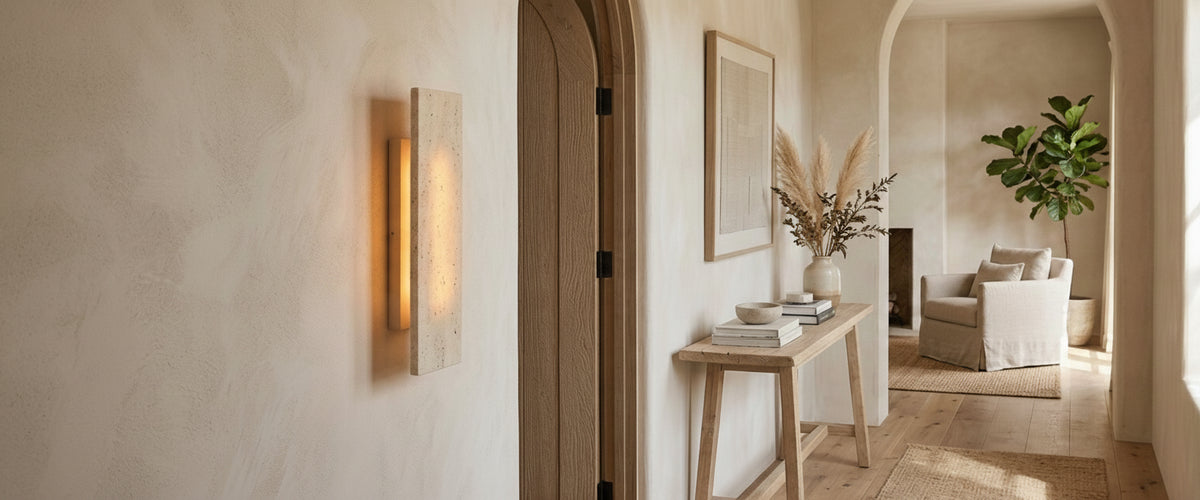

Fit a travertine wall light next to a cool downlight and the stone dies. It goes flat, chalky, faintly gray, like a sample board left in a north-facing office. Get the color temperature and the mounting height right and the same travertine wall light reads like a slice of quarry face with a fire behind it. Travertine is one of the most rewarding stones we work with at Niori, and one of the least forgiving of lazy specification, so it pays to understand what the material is doing before you pick a shape.

At a Glance: Travertine Wall Light Essentials
Warm light only. 2700K is the sweet spot. Anything at 3500K or above drains the honey out of the stone.
Travertine is porous and pitted. Light travels a shorter distance through it than through alabaster and scatters as it goes, which is exactly the appeal.
Wall tone matters as much as the fixture. Limewash, clay plaster, oak and warm off-whites let it breathe; cold brilliant white fights it.
Outdoors, check the IP rating first. A sheltered porch and an exposed garden wall are not the same brief.
Mount lower than you think. Most travertine wall lights sit best at roughly 5ft to 5ft 7in (1.5m to 1.7m) to the center in corridors and living spaces.
A duo earns its place where architecture is already symmetrical: a bed, a chimney breast, a pair of doors.

Travertine Versus Alabaster: Porosity, Veining and a Deeper Glow
Before you commit to a travertine wall light, know how the stone differs from alabaster. Alabaster is a fine-grained gypsum stone. It transmits light almost like frosted honey, with soft cloudy movement and very few interruptions. Travertine is a different animal: a terrestrial limestone laid down by mineral-rich springs, full of tiny voids and banded layers formed as calcium carbonate precipitated out of the water. Historic England's guidance on building materials is a useful primer on how porous stones handle moisture and cleaning, and it is worth a read before you specify travertine anywhere damp (Historic England, building materials advice).
What that means for lighting is simple. A travertine wall light throws a shorter, denser, earthier glow. Light travels a little way into the stone, hits the pitting and the sedimentary bands, and stops. You get warm beige and biscuit tones rather than the milky luminosity of alabaster, and you get texture: those characteristic pits catch shadow across the face of the fixture even when the lamp is off. Filled and honed travertine looks calm and architectural. Unfilled travertine looks quarried and rough at close range. Neither is better, but they suit different rooms.
Thickness changes everything for a travertine wall light too. On a thicker disc or cube, the stone reads as a solid, sculptural mass with a halo of light escaping around it. On a thinner slab or a shade-style panel, more light passes through and the banding becomes visible from across the room. A deep stone disc like the Caldera Large Disc Travertine Wall Light plays the first game, holding its mass and letting the glow escape at the edges. Where you want the light carried by glass and the stone left to do the structural, textural work, the Arvella Travertine & Glass Wall Light is closer to the second approach. If you are comparing translucency across materials, look at the full alabaster lighting range alongside the stone pieces, because the difference in glow is obvious once you see them side by side.
Why 2700K Flatters Travertine and Cooler Light Makes It Look Dusty
Travertine sits in the warm end of the color spectrum: cream, oatmeal, walnut brown, rust in the iron-rich seams. Warm white light at around 2700K sits in the same family, so a travertine wall light amplifies the stone's own pigment. Push up to 4000K and the blue content in the light cancels that pigment out. The result reads dusty, like an unfinished plaster wall.
Two more specifications matter on any travertine wall light. Choose lamps with a color rendering index of 90 or above, because travertine's appeal is subtlety of tone and low-CRI LEDs flatten exactly those tones. And insist on dimmability. The stone glows most convincingly at 30 to 60 percent output, where the light is escaping through the material rather than blasting out of it. Above that, on some thinner sections, you start to see the lamp itself as a hot spot behind the stone.
Where a travertine wall light has an integrated LED module, check that the driver is compatible with your dimming system before the electrician arrives. Trailing-edge dimmers generally behave better with LED drivers than older leading-edge plates. All mains wiring should be done by a qualified electrician; that matters, because it is the difference between a fixture that dims smoothly and one that flickers for the next decade.
Indoor Siting: Wall Surfaces and Room Tones That Let Travertine Breathe
The wall behind a travertine wall light is half the design. Travertine is at its best against surfaces with some texture and warmth: limewash, clay plaster, tadelakt, brushed oak paneling, warm putty and mushroom paints. Against a cold brilliant white, the stone looks yellowed rather than warm. Against a very dark charcoal, you lose the material entirely and see only the light.
Hallways are the obvious home. A run of two or three travertine wall lights down a corridor at even spacing gives you a rhythm of warm pools and, crucially, gives the stone a reason to exist at eye level where people can see the pitting. Bedrooms are the second natural fit, either flanking the bed or set on the return wall so the light washes down rather than into your eyes. Bathrooms need more care: travertine is porous, so keep the fixture well clear of shower zones and make sure extraction is doing its job.
One from the studio. We supplied a pair of rectangular travertine wall lights with walnut detailing to a converted stone barn in the Peak District, where the client had specified them against a bright white gallery wall. They came back frustrated. A repaint in a warm limewash and one swap from 3000K to 2700K lamps, and nothing else changed, but the fixtures finally looked like part of the building. The stone had been right all along.
Travertine Outdoor Wall Lights: Where the Material Holds and Where It Does Not
A travertine outdoor wall light can be beautiful under a covered porch, a loggia, a deep overhang or a courtyard wall that stays sheltered. In those positions the stone weathers slowly and gracefully, picking up a soft patina. Fully exposed to hard rain and repeated frost, unsealed travertine is a different proposition: water enters the pores, freezes, expands and eventually causes surface loss. Sealing helps, and needs repeating.
Check two things before you buy a travertine wall light for an external position. First, the IP rating. The two-digit IP code, defined in IEC 60529, tells you the level of protection against solids and moisture (IEC). IP44 is broadly suitable for sheltered external positions; IP65 is what you want on anything genuinely exposed to driving rain and hosing. Second, the fixings and internal fittings. Stainless steel or properly coated brass, and no ferrous components that can bleed rust stains down the face of a pale stone.
If your wall is exposed, consider keeping the travertine wall light indoors and choosing a properly rated external fixture in a metal or glass body outside, then linking the two schemes with matching color temperature. Consistency of light does more for a facade than consistency of material. You can browse the wider lighting collection to see how the same warm register carries across different bodies and finishes.
Mounting Height and Sightlines Change the Stone's Drama
Height is where most travertine wall light schemes go wrong. Standard practice pushes sconces up to 5ft 11in (1.8m) or higher, which was sensible when they were bright uplighters. A stone fixture wants to be seen. Mount it at 5ft to 5ft 7in (1.5m to 1.7m) to the center in a hallway or living room and the texture reads at eye level, the glow lands on the wall in a defined pool, and the fixture becomes furniture rather than an appliance.
Flanking a bed, drop the travertine wall light lower still: around 4ft to 4ft 7in (1.2m to 1.4m) from the floor works for reading, measured to the light source rather than the top of the backplate. Above a chimney breast, take your cue from artwork rather than convention, keeping the sconce clear of any heat rising from the fire. In a stairwell, set the height from the landing, not the treads, or you will end up with a fixture that looks correct on the drawing and floats oddly in the flesh.
Sightlines matter as much as numbers. Stand where people actually stand. If a globe design sits at the exact height where a seated guest looks straight into it, move it or dim it. In tight spaces where the eye meets the fixture head on, a downward-facing dome such as the Corvella Dome Travertine Wall Light is more forgiving, because it pushes light onto the wall and floor rather than towards the eye.
Single Sconce or a Travertine Duo Wall Light?
A travertine duo wall light, meaning a matched pair either side of a feature, works when the architecture is already symmetrical. Beds, chimney breasts, mirrors, a pair of French doors, an archway. Symmetry there reinforces something that exists. Pair them off-center in a room with no axis and they simply look like two lights that could not agree.
Go single where the wall itself is the composition: a long corridor with a rhythm of sconces, a stair half-landing, a niche, a bar back. A single fixture also suits heavily veined or unfilled stone, where each piece is visibly individual and a matched pair will never truly match. That is worth saying plainly. Natural stone varies, and two travertine wall lights from the same batch will differ in banding and pit density. Most clients find that charming. A few do not, in which case honed and filled travertine with quieter figuring is the safer choice.
Buyer's Checklist Before You Order
Confirm the light source. Replaceable lamp or integrated LED, and whether the driver suits your dimmer.
Specify 2700K and CRI 90+ across every fixture in the room, not only the travertine wall light.
Test the wall color with a lit sample before committing to paint.
Check backplate size against the wall, especially on narrow returns and around door architraves.
For external use, match the IP rating to real exposure, then plan for periodic resealing.
Book the electrician early so cable positions are set before plastering.
Ask for a tailored quote. Cost on stone lighting depends on the block, the scale, the machining, the metalwork and the finishing, so a considered quote beats a guess.
Living With Travertine: Care That Actually Works
Dust a travertine wall light with a dry microfiber cloth, and do it more often than you would with glass, because the pits hold dust. Skip anything acidic. Vinegar, lemon-based sprays and standard bathroom cleaners will etch calcium carbonate and leave dull patches that no polish will bring back. A pH-neutral stone cleaner, used sparingly on a barely damp cloth, is all that is needed indoors.
Isolate the circuit before cleaning near a fitting, and let the stone dry fully before switching back on. Outdoors, expect to reseal on a cycle set by exposure rather than the calendar, and watch for organic growth in shaded corners; a soft brush and clean water deals with it early. Handled properly, a travertine wall light ages the way good stone should, keeping its color and gaining a quiet surface depth. If you want to see how the material sits alongside alabaster, marble and onyx across pendants, chandeliers, wall lights and floor lamps, start at the Niori homepage and work through the ranges from there.