
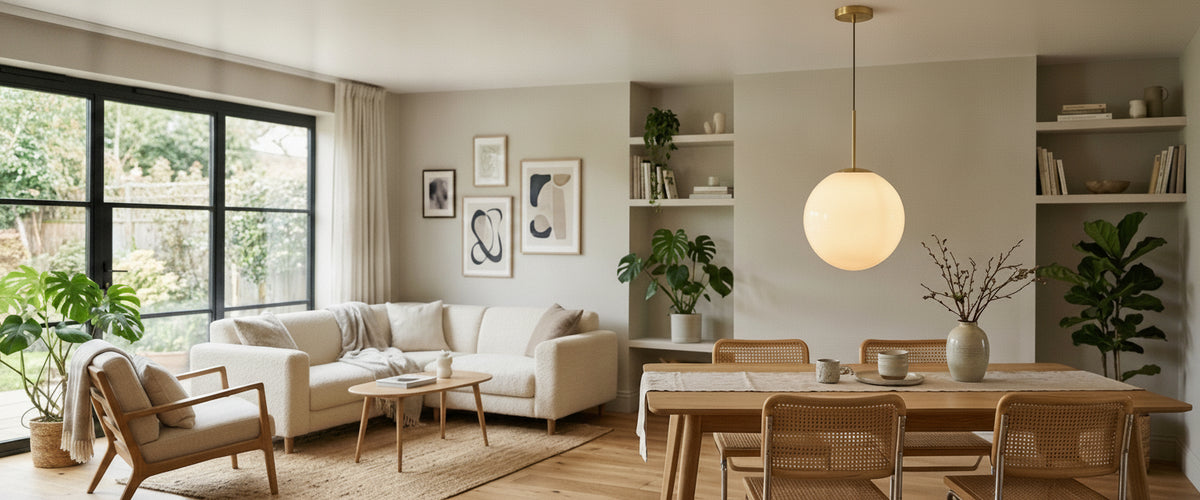

A sphere is the least forgiving shape in lighting. A cone, a dome or a fluted shade can be a few centimetres too small and most people will never notice, because the eye reads the silhouette rather than the volume. A globe pendant lights gives you no such cover. Hang one that is slightly undersized over a dining table and it looks like a beach ball on a string; hang one too low and it splits the table in half. The shape is honest, which is exactly why designers keep specifying it and why so many buyers get it wrong on the first attempt.
At Niori we work mainly in alabaster and natural stone, so we spend a lot of time talking clients through how a translucent material behaves inside a closed form. The advice below applies whether you are looking at hand-blown opal glass, a solid stone sphere, or a mixed piece with brass detailing.

At a Glance: Getting a Globe Pendant Light Right
- Diameter matters more than style. Over a dining table, aim for roughly one third of the table's width for a single globe.
- Hang the bottom of the sphere 75 to 85 cm (about 30 to 34 inches) above a dining table, a little higher over a kitchen island where people stand.
- Material decides where the light lands. Opal glass throws light everywhere; alabaster and stone push more of it down and glow rather than glare.
- Clusters need a reason. Odd numbers and varied drops create rhythm; evenly spaced identical globes at one height usually read as clutter.
- Bulb choice is visible. Inside a translucent sphere there is nowhere to hide a cold or unevenly lit lamp. Stay between 2400K and 2700K and insist on dimmable.
- Check the seam, the lampholder access and the cleaning route before you commit. These are the three things buyers regret ignoring.

Why a Sphere Makes Proportion Errors Visible
Every other pendant shape has a taper. The eye follows the line down to a point, which gives it something to do besides measure. A globe presents a single continuous curve, so your brain compares it directly against the surfaces around it: the table edge, the worktop, the width of the window behind it. That comparison is instant and unkind.
There is a second issue. A sphere occupies real visual volume at head height. A flat disc pendant of the same width feels lighter because it has almost no depth. So when you scale up a globe pendant light to get enough presence over a long table, you also scale up the mass sitting in the sightline between two people at dinner. That tension between presence and obstruction is solved with drop height rather than by shrinking the fixture.
A practical test before ordering: cut a circle of card to the diameter you are considering, tape it to a length of string and hang it. Sit down at the table. Stand at the worktop. You will know within thirty seconds whether the size is right, and it costs nothing.
Glass, Alabaster, Resin and Metal: How Material Decides Where the Light Goes
Opal glass is the default for a reason. Hand-blown opal diffuses evenly in all directions, so a single sphere lights a room rather than just a surface. The trade-off is that it is a bright object even at low output, and the quality of the diffusion depends entirely on how well the glass was made. The Corning Museum of Glass has a useful body of work on how blown glass is formed, and it explains why thickness varies slightly across a hand-made piece. Cheap opal shows this as bright and dull patches when lit. Where a room needs that soft, all-directional diffusion with a warm metal detail at the neck rather than the hard sparkle of clear glass, something like the Pallo Pendant Light in white opal glass with brass detail is closer to the right design language.
Alabaster and natural stone behave differently. Stone is translucent rather than transparent, so light enters the material, scatters through the crystalline structure and leaves as a soft, warm glow with visible veining. A stone globe pendant light sends less light sideways and more of it downward, which makes it flattering over a table and much less tiring in a room where people sit for hours. It is also heavier, which affects fixings and ceiling structure. Our alabaster lighting collection is the place to start if you want that quality of glow rather than the sharper brightness of glass.
Resin and acrylic globes can look convincing when unlit. Switched on, they tend to go flat and slightly yellow-grey, they scratch, and they age badly near heat.
Metal half-globes with an open underside are a different animal. They give directional task light and no ambient spill, which suits a bar or a reading corner but leaves a dining room feeling like a stage set unless you layer in wall lights.
Diameter and Drop: The Numbers That Separate Deliberate From Accidental
Start with the surface, not the ceiling. For a single globe pendant light over a dining table, a diameter of roughly one third of the table width usually reads correctly. A 90 cm (35 inch) round table takes something in the region of 30 cm across; a wide rectangular table needs either a much larger sphere or a run of smaller ones. Small-diameter spheres in the 15 cm range, such as the Equinoxe Globe Pendant Light in antique brass and amber glass, are designed to be used in multiples or over narrow surfaces like a bar or a console, not alone above a full-size dining table where they simply disappear.
Drop height is where most people go wrong. Measure to the bottom of the globe, not the fitting. Over a dining table, 75 to 85 cm (about 30 to 34 inches) of clearance keeps the light out of eye contact while still holding the table. Over a kitchen island, add 5 to 10 cm because people stand there. In a stairwell or a double-height hall, hang the lowest point at least 2.1 m (7 feet) above any floor people walk across, and remember that a sphere seen from below and from the side at once needs to be larger than your instinct suggests.
For ceilings above 2.4 m (8 feet), a rough working rule is to add about 5 to 8 cm of drop for every additional 30 cm of ceiling height, then adjust by eye. Anything hung from a very high ceiling on a short flex looks nervous.
Single Globe or Cluster: When Repetition Adds Rhythm
A cluster works when the spheres are doing something a single fixture cannot: covering a long surface, filling vertical volume, or breaking up a wide sightline. Over a 2.4 m table, three matched globes at even spacing will light the whole surface far better than one oversized globe pendant light ever will.
Repetition turns to noise when there is no variation and no purpose. Five identical globes in a flat row across a small kitchen becomes a lighting rig. Stagger the drops, vary the diameters slightly, or reduce the count. Odd numbers almost always sit better than even ones, and asymmetry in a stairwell cluster reads as designed rather than as a mistake. Where a cluster genuinely earns its place, that variation is usually engineered into the fixture itself, as it is in the seven-light Havlen pendant with swirled glass globes, where the spheres sit at staggered heights rather than in a flat rank.
One thing we see repeatedly in project enquiries: a client falls for a multi-light cluster photographed in a room with 4 m ceilings, then tries to fit it into a 2.4 m kitchen. The piece is not the problem. If you are unsure, browse the broader lighting range and compare a cluster against a pair of single pendants at the same total width before deciding.
Inside a Sphere, Bulb Choice Is Unforgiving
An open shade hides the lamp. A translucent globe pendant light puts it on display. We once had a customer convinced their new opal pendants were faulty because a hot orange blob hung in the middle of each sphere. They had fitted decorative filament bulbs. Swapped for frosted globes with a wide diffusion angle, the fixtures looked exactly as intended.
Three rules for lamps inside a sphere. Use a frosted or opal-coated bulb so the filament never shows through. Keep colour temperature between 2400K and 2700K for living and dining spaces; anything at 3500K or above reads clinical against warm stone and brass, and the shift is dramatic once the light is diffused across a whole surface. And choose a lamp shape that sits centrally, because an off-centre bulb creates a visible bright zone on one side.
Dimming is non-negotiable in a dining room. Pair a good-quality trailing-edge dimmer with lamps rated for it, and check that the driver and dimmer are compatible before installation. Research from the Lighting Research Center on light and human response is a useful reminder that warmer, lower-level light in the evening is not a purely aesthetic preference. All mains wiring should be carried out by a qualified electrician.
Before You Commit: A Checklist
- Look at the seam. Hand-blown glass has a subtle join at the neck; it should be even and unclouded. On stone, check the join line and the consistency of wall thickness, because thin patches glow hotter.
- Ask how the lampholder is reached. Some globes unscrew at the neck, others require the whole fitting to come down. If changing a bulb needs two people and a scaffold tower, you will resent it.
- Plan the cleaning route. Spheres collect dust on the upper curve where nobody looks. Glass takes a damp microfibre cloth. Alabaster and marble do not: use a dry soft cloth, avoid water and never use acidic or ammonia-based cleaners, which will etch the surface permanently.
- Confirm the weight and the fixing. Stone globes and multi-light clusters need a suitable ceiling box and, in older properties, often a joist or a supporting plate.
- Check the finish continuity. If your kitchen has aged brass hardware, a bright polished brass canopy will fight it.
- Match the drop mechanism to the ceiling. Rod suspension for stability and sloped ceilings, flex for adjustability, cable for very long drops.
Choosing the Best Globe Pendant Light for Dining Rooms
For a dining room, a globe pendant light should read as warm and low-glare from a seated position, which points towards alabaster, natural stone or good opal glass rather than clear or amber glass with an exposed filament. Sit down and look up before you buy: if you can see a bright source at eye level, the material is too transparent for the job.
Round tables suit a single large sphere hung dead centre. Long rectangular tables do better with a linear run of two or three, spaced so that the outer pendants sit roughly 60 cm (24 inches) in from each end. Layer with wall lights or a low-level lamp so the room does not collapse into a single pool of light once the dimmer is down.
Budget for a globe pendant light depends on material, scale, the complexity of the metalwork, engineering for weight, and installation, so the sensible move is to send us dimensions and ceiling details and ask for a tailored quote. If you want to see how stone and glass compare in person, that is a conversation worth having early. Start browsing at Niori, where alabaster and natural-stone pendants, chandeliers, wall lights and lamps sit side by side, and the differences in glow become obvious.