

A reclaimed enamel shade can look perfect under the strip lights of a salvage yard and turn your kitchen into a pool of glare and shadow by seven in the evening. That gap between the object and the light it throws is where most vintage pendant lighting projects go wrong, salvaged pieces and new vintage pendant lights alike. The shape is only half the purchase. The other half is beam spread, lamp compatibility, drop height and whether the fitting was ever wired to a standard a modern electrician will sign off on.

At a Glance: What to Settle Before You Buy
Define the word vintage. Genuine antique, period reproduction and industrial throwback are three different purchases with three different risk profiles.
Check the light, not the look. Opaque metal shades push all their output straight down. Translucent materials such as alabaster and onyx wash light in every direction.
Confirm lamp compatibility early. Many original fittings were designed around a hot, wide-shouldered incandescent bulb, and a retrofit LED will sit differently.
Hang low, but not in the way. Over an island, aim for roughly 75 to 90cm (30 to 35in) between worktop and the bottom of the shade.
Budget honestly. Cost tracks material, scale, hand finishing and electrical work rather than style label; ask for a tailored quote once the scheme is fixed.
Use a qualified electrician. Installation work has to meet BS 7671, and in England and Wales it also falls under Building Regulations Part P.

Period Reproduction, Genuine Antique, Industrial Throwback
On a spec sheet, "vintage" describes an aesthetic far more often than an age. It is worth knowing which of the three you are actually buying.
A genuine antique is a salvaged fitting, usually stripped from a factory, school or shop. Character is guaranteed. So is rewiring. Old flex perishes, old lampholders crack, and earthing arrangements from the 1930s bear no relation to current practice. Historic England's guidance on electrical services in older buildings makes the point that reused historic fittings need proper assessment before they go back into service, and the same logic applies to a salvaged shade over your island (see Historic England's building services advice).
A period reproduction copies a historic silhouette using modern components: current lampholders, heat-tolerant flex, tested earth continuity. You lose the romance of provenance and gain a fitting that a designer can specify for a client without a rewiring caveat. Most of what sells as vintage kitchen pendant lights sits here, and it is the least troublesome route into vintage pendant lighting for a kitchen in daily use.
An industrial throwback borrows the language of factory lighting (conical shades, exposed cable grips, cage guards) without pretending to be old at all. It is the most flexible option for open-plan spaces because the scale can be adjusted to the room rather than to whatever a 1940s foundry happened to make.
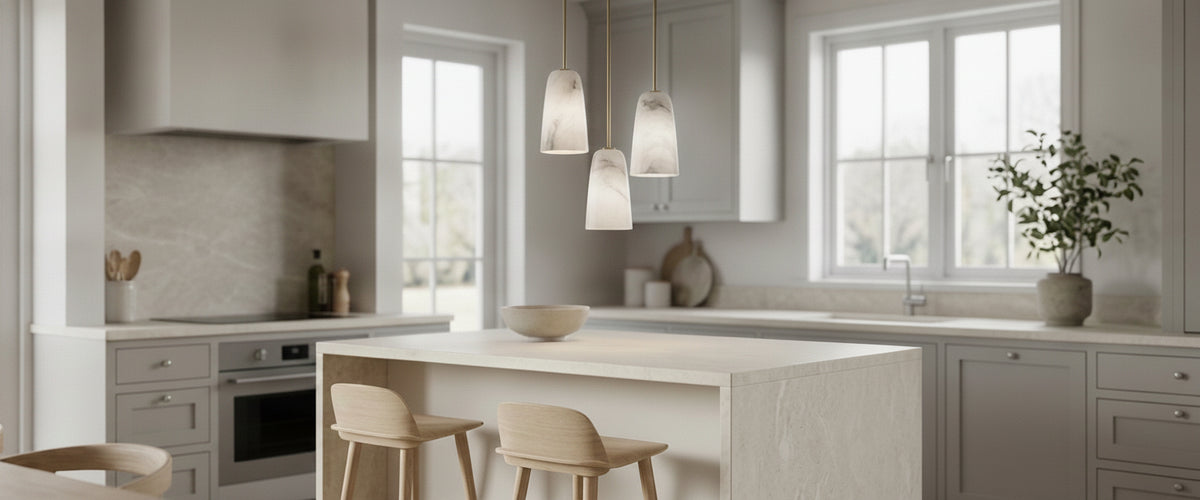
Two shades over a mid-length island: enough repetition to read as a run, not enough to fence the worktop off.
Materials That Age Well, and Materials That Just Look Worn
Patina is a material property, not a finish you can fake indefinitely. Some surfaces improve; others simply degrade.
The Ones That Reward Time
Unlacquered brass. Darkens unevenly around handling points and settles into a soft bronze tone. It is the single most forgiving metal in a working kitchen.
Copper. Moves from pink to russet to a dry brown. Above a hob it will change faster because of heat and steam, which is either the point or a problem depending on your temperament.
Vitreous enamel. Genuinely hard-wearing, and the white interior of a good enamel shade bounces light efficiently. Chips at the rim are the weak point; once the steel is exposed it will rust.
Alabaster and onyx. Stone does not corrode, tarnish or yellow. Veining reads as age from day one, which is precisely why it sits so comfortably with reclaimed timber and older brickwork.
The Ones That Disappoint
Lacquered "antique" brass. The coating wears through in patches rather than mellowing evenly, and you cannot polish it back.
Powder-coated steel in a distressed finish. Applied wear stays exactly where the factory put it while real wear appears somewhere else.
Heavily smoked glass. Attractive unlit; often disappointing over a prep surface, because the tint eats a significant share of the output before it reaches your chopping board.
This is where stone earns a place in a scheme that leans vintage. Alabaster is translucent rather than transparent, so it glows across the whole surface instead of showing you a bright filament through tinted glass. In our studio we hold sample slabs up to a lamp before a piece is cut, because two blocks from the same quarry can differ enormously in how much warmth they pass. If you want the soft, aged quality of vintage pendant lighting without the glare of an exposed bulb, the pieces in the alabaster lighting collection are worth comparing side by side with a metal shade.
Vintage Pendant Lighting and Modern LED: Where the Combination Quietly Fails
Three failure points come up again and again.
Beam angle. A filament bulb radiated in every direction and the shade did the shaping. Many LED lamps throw a narrower cone. Drop one into a wide conical reproduction shade and you get a hot circle on the worktop with dark edges either side. Look for LED filament lamps with a genuine 300-degree-plus distribution if the fitting relies on the shade to spread light.
Dimming. A trailing-edge dimmer sized for a couple of hundred watts of incandescent load will not behave with three 6W LED lamps. Below the dimmer's minimum load you get flicker, buzz or nothing at all. The Lighting Industry Association publishes useful background on dimming and lamp compatibility; check the manufacturer's compatibility list rather than assuming.
Colour temperature. Aged brass, copper and warm stone are all built for warm light. At 4000K they turn grey and slightly sour. Specify 2700K to 3000K throughout, and keep the whole kitchen run consistent; one mismatched lamp in a row of three is immediately visible.
Stone behaves well here, incidentally. Because alabaster diffuses across its full thickness, it hides the small imperfections of an LED source, including the faint pinpoint you often see through clear glass.
Translucent stone spreads a 3000K LED across the full shade instead of showing a bright point through the glass.
Kitchen, Dining and Café: Where Vintage Pendant Lighting Earns Its Place
Over an island or peninsula. This is the natural home for vintage kitchen pendant lighting. You need directional task light, the run is long enough to take repetition, and there is nothing below to obstruct. Keep the bottom of the shade at 75 to 90cm (30 to 35in) above the surface, then check sightlines from the seated position on both sides.
Over a dining table. A single larger pendant usually reads better than a row, and this is where a stone or alabaster piece outperforms metal. Diners look up at each other through the light. An opaque metal shade lights the table and leaves faces in shadow; a translucent shade lights both. Where one generous shade has to do all the work, a 48cm fitting such as the Calice White LED Pendant Light 16W 3000K gives you the diameter and the warm 3000K output the table needs, rather than a narrow cone dropped from height.
In a café or small restaurant. Durability and maintenance access matter more than provenance. Reproduction fittings with standard lampholders can be relamped by staff in a minute. A rare salvaged piece cannot.
Over a sink run. Fine, with care about splash and steam. Enamel and stone both cope; unlacquered copper will change colour quickly.
One project sticks in the mind: an Edinburgh townhouse kitchen where the client had already bought three salvaged factory shades. Hung together, they crowded a 2.4m (8ft) island and blocked the view through to the garden window. We kept one over the sink for character and ran two alabaster pendants over the island instead. The room finally read as one space.
One Pendant as Focal Point, or Three as Clutter
The cluster decision is where kitchen pendant lighting vintage schemes most often tip over.
Under 1.5m (5ft) of island: one pendant, centred.
1.5m to 2.4m (5 to 8ft): two, spaced evenly with roughly a quarter of the island length from each end.
Over 2.4m (8ft): three, but only if each shade is modest in diameter. Three large shades on a long island look like a barrier.
A useful sanity check: total shade width should occupy less than half the length of the surface below. When it creeps past that, a row of vintage pendant lighting stops being lighting and starts being architecture. In practice that means a run of three wants shades around the 32cm mark; a fitting the size of the Calice Green & White LED Pendant Light 9W 3000K keeps the row visually light, while the same silhouette at 48cm would close the island off.
Scale also depends on ceiling height. In a room under 2.4m (8ft), a slim profile or a compact stone dome keeps the space open, and where a period silhouette would simply crowd the room, a small-diameter fitting on the scale of the Sphere Small LED Pendant Light Chrome 4.8W 3000K reads as a point of light rather than an object overhead. In a converted barn or a double-height extension, a small shade at the end of a long cable simply vanishes. Browsing the wider lighting range by fixture type rather than by style is the quickest way to work out whether your ceiling wants a pendant, a chandelier or a pair of wall lights doing the work instead.
Wiring, IP Ratings and Bulb Compatibility: The Pre-Purchase Checklist
Run through this before any vintage pendant lighting order is confirmed.
Confirm the fitting is CE or UKCA marked and supplied with a current test certificate. Salvaged pieces will need professional rewiring before installation.
Check the lampholder type and maximum wattage stamped on the fitting, not on the listing.
Match the dimmer to the load, including the minimum load figure. Replace old dimmers when you switch a run to LED.
Specify IP44 or better for any fitting within splash range of a sink, and remember bathroom zone rules are stricter again.
Check ceiling fixing and weight. Stone and cast metal pendants are heavy; plasterboard alone will not hold them. A joist, noggin or proper fixing plate is essential.
Plan cable drops before plastering. Moving a pendant 30cm (12in) after the ceiling is finished is a genuinely irritating job.
Use a qualified electrician for new circuits and alterations. Notification rules under Part P differ between England and Wales, so confirm what applies before work starts.
Living With Them
Metal shades want a dry microfibre cloth and, for unlacquered brass, a decision: polish it or let it go. Pick one and stay consistent, because half-polished brass looks neglected.
Stone asks for less but has one firm rule. Never use vinegar, lemon-based sprays or bathroom descalers on alabaster, marble or onyx; acids etch calcite surfaces permanently. A soft dry brush handles dust, and a barely damp cloth with pH-neutral cleaner handles grease. In a kitchen, wipe stone pendants roughly every couple of months, since cooking film builds up quietly and dims the glow long before anyone notices why.
Choosing vintage pendant lighting is ultimately a lighting decision dressed up as a styling one. Pick the material that ages the way you want, pair it with a lamp that suits the shade's job, and get the drop height right. Do that and vintage pendant kitchen lights stop being a mood board choice and start being the reason the room works after dark. If you are weighing metal against stone for a specific project, the Niori team can talk through diffusion, scale and fixing before you commit.