
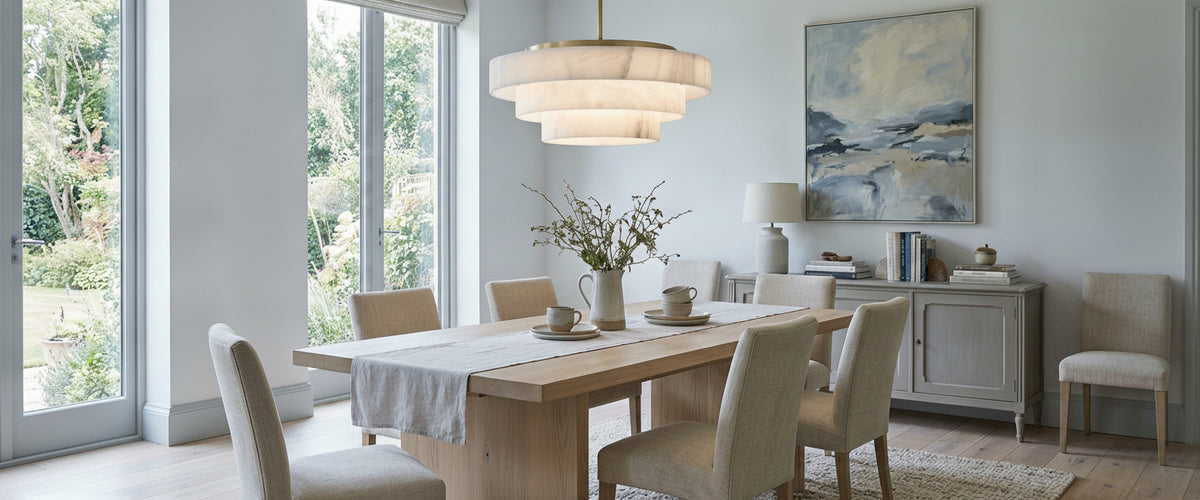

Plenty of fixtures sold as Deco are simply angular. Chamfer a shade, wrap it in a brass ring, photograph it against a dark green wall and the listing writes itself. Genuine vintage art deco lighting follows a much stricter grammar than that, and once you can read it, the imitations become obvious at a glance. The good news for buyers is that the grammar is learnable, and it applies just as neatly to a reissued alabaster bowl pendant as it does to a 1930s original pulled out of a Paris apartment.

At a Glance: What Separates Real Deco from Deco-Ish
- Geometry with a rule. Authentic Deco repeats one motif at shrinking intervals. Random facets are just faceting.
- Material honesty. Period pieces used alabaster, opal glass, amber and smoke glass, bronze, nickel and gilded brass. Sprayed finishes over thin steel read wrong even in photographs.
- Weight in the hand. Deco fixtures were engineered for heavy shades on chain or rod suspension, not on flex.
- Diffusion, always. The period aesthetic was glowing light, not visible filament.
- One statement per room. Over-committing to the period is the single fastest way to date an interior.
- Price by specification, not by category. Material, scale, metal finishing and installation complexity all move the figure, so ask for a tailored quote.

The Geometric Grammar of Vintage Art Deco Pendant Lights
Deco design came out of a specific moment: the 1925 Exposition Internationale des Arts Décoratifs et Industriels Modernes in Paris, which gave the style both its name and its obsession with disciplined ornament. The Musée des Arts Décoratifs still holds much of the material culture from that period, and what strikes you looking at it is how mathematical the decoration is. Stepped ziggurats. Sunbursts with even radial spacing. Concentric rings that reduce by a consistent ratio. Chevrons at a repeated angle.
Apply that test to any pendant you are considering. Does the ornament repeat to a rule, or does it just look busy? A stepped alabaster bowl where each tier drops by the same increment reads as Deco. A bowl with three arbitrary ledges reads as a manufacturing shortcut. The same goes for metalwork: period collars and finials were machined with tight, symmetrical repetition, because the style was celebrating industry as much as luxury.
Silhouette matters more than surface. Real Deco pendants tend toward strong primary forms, an inverted dome, a stepped cylinder, a flattened saucer, with the ornament subordinate to that shape. When ornament starts fighting the silhouette, you are usually looking at a later revival piece rather than something in the vintage art deco tradition.
Amber Glass, Frosted Opal, Alabaster and Gilded Metal
Materials are where vintage art deco really separates itself from its imitators, and where the period overlaps most usefully with what we make at Niori. French Deco lighting leaned hard on alabaster bowls suspended on three chains, precisely because the stone does something glass cannot: it scatters light through mineral depth. You see the veining lit from within, so the fixture reads as a warm object even when it is doing serious ambient work. Opal glass gives you a cleaner, more even glow with no character in the surface. Amber pushes warmth and smoke pushes depth, but both cut output noticeably, which catches buyers out in rooms with dark joinery.
Metalwork behaved differently too. Period gilding was applied over bronze or brass and developed an uneven, slightly warm patina; modern gold-tone lacquers sit flat and uniform on the surface. If you are pairing a stone shade with brass detailing, look for a finish with some variation in it. Antique and brushed brass hold their own against alabaster veining. High-polish gold tends to shout over it.
Suspension is part of the material question, not an afterthought. Stone and thick cased glass belong on chain or rod. Where the shade is light glass and the drop needs to stay visually thin, a simple corded suspension such as the 1.8m ES Vintage Pendant Set in Black Nickel keeps the fixture honest about its weight rather than pretending to a grandeur it cannot carry.
One practical difference between originals and contemporary pieces: reissued fixtures are built for current wiring standards, sealed lampholders and LED heat loads, while genuine vintage stock almost always needs rewiring before installation. That is not a reason to avoid originals, only a reason to budget for a qualified electrician and to ask what has already been done. Our alabaster lighting collection shows how stone behaves in a modern fitting, because the shade thickness is tuned to LED output rather than to 1930s incandescent lamps.
Where Vintage Art Deco Pendant Lighting Earns Its Drama
Deco pendants want height and a clear sightline. Stairwells are the obvious win: a single large bowl on chain suspension, hung so it is visible from both the hall and the landing, does more for a period property than any amount of wall decoration. Dining rooms are the second natural home, with the shade centred over the table and the lower edge sitting roughly 76 to 91cm (30 to 36in) above the tabletop so diners can see across it.
The scale tips into pastiche in two places. First, ceilings under about 2.4m (8ft), where a heavily stepped shade crowds the room and the ornament stops being readable. Second, rooms where the pendant has to compete with strong pattern on the floor or walls. Deco geometry needs quiet around it. In the 1930s mansion-block hallways we supply most often, the decision that makes a large stepped bowl work is rarely the fixture itself: it is stripping the walls back to plain plaster and letting the pendant carry the whole room.
Corridors and long landings are underused. Two smaller pendants in sequence, spaced evenly and hung at matched heights, give you rhythm that suits the period far better than a single fixture stranded in the middle.
The Contemporary Rooms That Absorb Deco Most Naturally
Vintage art deco lighting sits surprisingly well in restrained modern interiors. Pale plaster walls, wide oak boards, a slab of honed marble in the kitchen: those surfaces give the geometry something plain to work against, and the warm diffused output from stone or opal takes the chill off minimal architecture. Hotel and restaurant clients use the same trick, running one strong period pendant over a bar or reception desk and keeping everything else deliberately neutral.
Where it struggles is in heavily traditional rooms with existing cornice detail and patterned textiles. There the Deco motif becomes one more voice in an already crowded conversation. If your scheme is layered, choose a simpler form: a plain alabaster dome, or a wall light with a single stepped detail, where something like the Zelda 1 Light Wall Light in Vintage Brass carries the metal tone without adding another pattern to the room.
Mixing across fixture types helps. A geometric pendant over the dining table, then softer shapes elsewhere in the room, keeps the period reference deliberate. Browsing across a broad lighting range rather than fixating on pendants alone usually produces a better scheme, because table lamps and floor lamps carry the low-level warmth that ceiling fixtures cannot. For that low corner light, a leaded glass piece such as the Chastain 2 Light Tiffany Table Lamp in Vintage Bronze leans Art Nouveau rather than Deco, but it diffuses in the same warm register as an alabaster pendant overhead, which a bare-shade modern lamp does not.
The Pairing Mistake That Dates a Room
Over-committing. Matching pendant, matching wall lights, matching table lamp, fan-shaped mirror, velvet in a period shade. At that point the room stops being an interior and becomes a set. The strongest Deco-influenced homes we ship to use one, occasionally two, period-referencing fixtures and let everything else be plainly contemporary.
There is a subtler version of the same error: matching metal finishes too rigidly across the whole scheme. Period interiors mixed nickel, bronze and gilded brass without anxiety. If your vintage art deco pendant lights is antique brass, a nickel wall light nearby is fine and often better than the safe matching option.
Bulb Choice: Why Bare Filament Is Almost Always Wrong
Exposed squirrel-cage filament lamps became shorthand for "vintage" about a decade ago, and they are historically backwards. Deco designers went to considerable trouble to hide the light source behind alabaster, opal and frosted glass. Putting a glaring filament under a translucent shade destroys the effect you paid for, throwing a hot spot through the stone instead of an even wash.
What to specify instead:
- Colour temperature 2400K to 2700K. Warm enough to flatter amber glass and alabaster veining without going orange.
- CRI 90 or above. Stone reveals poor colour rendering faster than almost any other material; low-CRI lamps make veining look muddy.
- Frosted or opal envelope, not clear. Even behind a shade, a clear lamp casts visible shadow lines through thinner sections of alabaster.
- Dim-to-warm LEDs where you want the light to deepen as it lowers, which suits dining and hallway use.
- Trailing-edge dimmers matched to the driver. Mismatched dimming causes flicker and buzz; guidance from bodies such as the Society of Light and Lighting is worth reading before you finalise controls.
Always have a qualified electrician confirm the ceiling fixing and load, especially for stone shades, which weigh considerably more than glass of the same size.
Buyer's Checklist for Vintage Art Deco Pendant Lighting
- Measure ceiling height and set the drop before you shortlist anything.
- Check the suspension type: chain and rod suit heavy shades far better than flex.
- Ask whether the shade is solid stone, stone veneer or resin. The difference shows the moment it is lit.
- Confirm the fixing point can take the weight, and get the ceiling reinforced before delivery if needed.
- Specify lamps and dimming at the same time as the fixture, not afterwards.
- For originals, confirm the rewiring status and that the work was carried out and certified by a qualified electrician.
- Check what a quote actually covers: material, scale, metal finishing and installation.
Living with It
Alabaster is a gypsum stone and it is soluble in water, so cleaning is dry work: a soft brush or dry microfibre cloth, no sprays, no vinegar, no ammonia. Gilded metal should never meet metal polish, which strips the gilding in a single pass. Amber and opal glass tolerate a barely damp cloth followed immediately by a dry one. Do this twice a year and a good pendant will outlast several redecorations.
Buy on geometry, materials and drop height, light it properly, and resist the urge to theme the whole room. That is genuinely most of what a vintage art deco scheme asks of you. If you want to see how stone shades handle Deco forms in practice, start with the Niori collections and work back from the room, not the fixture.