
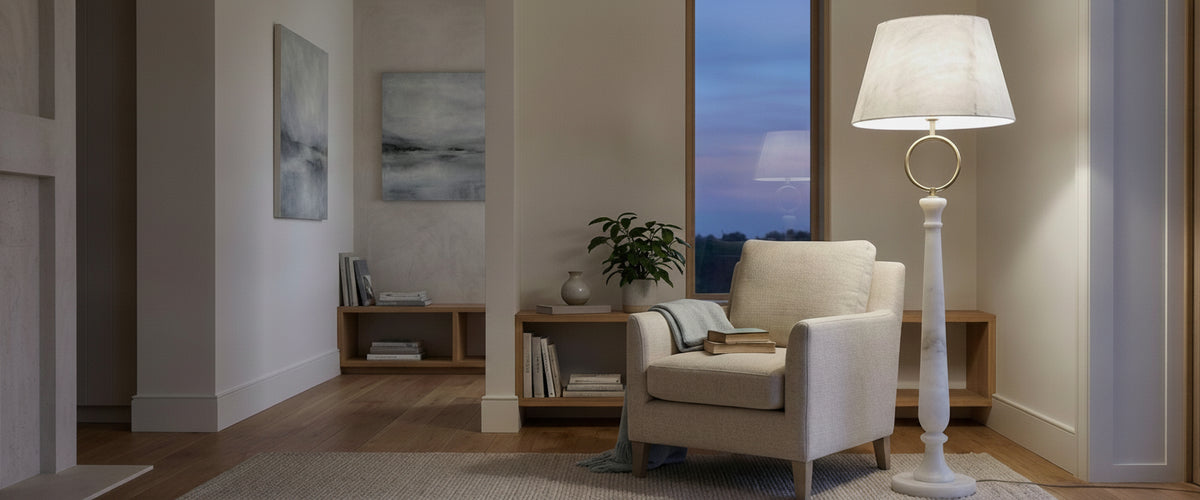

Most traditional floor lamps look completely correct at noon and do almost nothing useful at nine at night. The proportions read well, the brass catches the daylight, the shade sits at a sensible height, and then the sun goes down and the thing throws a hard cone onto the rug while the rest of the room stays flat. That gap between how a lamp photographs and how it performs is the single biggest reason a traditional floor lamp gets moved to a guest bedroom within a year.
At Niori we make and ship alabaster and natural-stone lighting, so we spend more time than most people arguing about what a shade is actually doing to a room. The short version: traditional floor lamps live or die on the relationship between base weight, shade diffusion and bulb spec. Get those three right and you have a piece you keep for decades.

Quick Answer: What to Get Right Before You Buy
Most of the risk in buying traditional floor lamps sits in six decisions:
Silhouette: a defined base, a slim upright stem, and a shade with visible taper. Anything with a flat disc top and an exposed LED strip is not traditional, whatever the listing says.
Base material: brass for warmth and reflectivity, wood for softness and grain, alabaster or marble for weight and glow.
Height: around 147 to 165 cm (58 to 65 inches) for reading positions, with the shade bottom near eye level when you are seated.
Shade: lined fabric, parchment or translucent stone. Opaque metal shades give you a spotlight, not a room.
Bulb and control: 2400K to 2700K, high colour rendering, and a dimmer confirmed as compatible with the lamp's driver.
Placement: beside a seat, near a corner, never floating alone in the middle of a wall.
Traditional floor lamps sit best beside a seat or into a corner, where the shade can wash the wall as well as the page.

What "Traditional" Actually Means in Floor Lamp Design
Traditional is not a period, it is a set of proportions. The shapes behind traditional floor lamps descend from candlestands and oil lamps: a weighted foot, a turned or fluted stem, a shoulder where the stem meets the fitting, and a shade that flares outward. Column lamps, urn-based lamps, swing-arm reading lamps and the tall club lamp all sit inside that family. What they share is a visible hierarchy from bottom to top, so your eye travels up the piece rather than landing on it all at once.
Modern lamps flatten that hierarchy on purpose. A single tube, a single plane, no shoulder. Put the two side by side and you can see why a traditional floor lamps in shape feels calmer in a room with mouldings, panelled doors or a deep sofa: the lamp repeats the vertical rhythm the architecture already has. In a plain white box with flush skirting, the same lamp can look like it wandered in from another house.
Detail level is the other marker. Reeded stems, cast collars, small brass finials, a stone plinth with a chamfered edge. These are the elements that read at three feet and disappear at thirty. Traditional floor lamps with no detail at close range feel thin in a room designed for close inspection.
Brass, Wood, Stone: How the Base Changes the Room
The base is where traditional floor lamps diverge most, and a traditional brass floor lamp is the default for a reason. Brass bounces warm light back into the room from its own surface, so even before the bulb is on, the lamp is contributing colour. Unlacquered brass patinas over years into something browner and softer; lacquered brass holds its shine and is easier to live with in a household that dusts fast. Antique brass sits between the two and hides fingerprints best. Pair brass with dark upholstery and it lifts the corner; pair it with pale linen and it warms the whole seating group.
Traditional wooden floor lamps behave differently. Wood absorbs light instead of reflecting it, so a turned oak or walnut stem quiets a room rather than brightening it. That makes a traditional wood floor lamp a strong choice in a library, a study or a bedroom where you want the light to feel contained. The trade-off is visual weight: a thick turned wooden column can dominate a small room in a way a slim brass stem never does. Check the stem diameter against the arm of the chair it will stand beside.
Stone is the third route, and the one we know best. Alabaster is a gypsum stone soft enough to carve finely and translucent enough to glow from within, which is why it has been used for lamps and window panels since antiquity. The Metropolitan Museum of Art holds Egyptian alabaster vessels worked thin enough to pass light, which tells you how far the material can go before it loses structure. A stone base gives a traditional floor lamp physical weight, real thermal mass and a veining pattern no two lamps share. Marble is harder and more graphic; onyx is more dramatic and banded; alabaster is the softest in tone. Browse the range across our alabaster lighting collection and you will see how differently each stone handles the same bulb.
Shade Choice Decides How the Lamp Performs at Night
This is where most purchases go wrong. A shade does two jobs: it controls glare at eye level and it decides how much light escapes sideways into the room. Opaque metal or heavily lined card shades send light straight up and straight down, giving you a bright pool and dark walls. Fabric with a pale lining lets a portion through the sides, so the shade itself becomes a soft secondary source. Translucent alabaster or thin marble goes further again, glowing evenly across its whole surface at a brightness the eye reads as candlelight rather than lamplight.
Translucent stone lets traditional floor lamps light the walls rather than punching a single bright pool into the rug.
Shape matters as much as material. An empire shade with a strong taper throws a wider downward wash, useful next to a reading chair. A drum shade spreads more evenly and suits a lamp standing behind a sofa. A tall coolie shade at the wrong height puts the bulb in your sightline the moment you sit down, which is the most common complaint we hear about inherited lamps. Where a room needs several small pools of diffused light rather than one hard downward cone, a multi-globe form such as the Giro 5 Light Globe Glass Floor Lamp works on the same principle as a translucent shade: the source itself glows instead of hiding behind an opaque cover.
The cheapest test of all this costs nothing. Leave the lamp positions and the wattage exactly as they are and change only the shade. Clients who move from metal shades to translucent stone describe the same shift almost word for word: a room that used to feel like a waiting area after sunset suddenly has lit walls. Nothing else changed.
Three Rooms Where Traditional Floor Lamps Read Wrong
Tight hallways. Buyers try this constantly because the corner looks empty. A floor lamp in a corridor is a shin hazard and its light hits the wall at an unflattering angle. Wall lights or a small stone table lamp on a console do the job better.
Open-plan kitchens. Cooking heat, airborne grease and a fabric shade are a bad combination, and the fixture rarely earns its footprint next to an island that already has pendants over it. If you want warmth at the edge of a kitchen-living space, put the floor lamp inside the seating zone, not the cooking zone.
Rooms with a strong contemporary ceiling scheme. If the ceiling carries flush architectural downlights and a sculptural pendant, a heavily detailed traditional lamp below it can look like a costume change. In that case, keep the proportions but strip the ornament: a plain stone column, a brass collar, a clean drum shade. A restrained upright like the Index 1 Light Cylinder Floor Lamp is closer to the right design language in that setting, holding the vertical line without adding decoration the ceiling is already competing with. Our full lighting collection is a useful place to compare how much detail a room can carry.
Bulb Temperature, Dimming and Scale
Two specifications decide whether traditional floor lamps flatter a room or flatten it, and colour temperature is the first. Push past 3000K and brass goes flat, wood grain loses its depth and stone reads cold. Stay at 2700K, and go to 2400K if the lamp sits in a bedroom or a room used mainly in the evening. Colour rendering matters just as much: look for CRI 90 or higher so upholstery, rugs and skin tones keep their depth. The US Department of Energy publishes plain-language guidance on LED performance and dimming behaviour that is worth five minutes before you buy bulbs.
Dimming is the second, and it is non-negotiable on a traditional floor lamp. A fixed-output lamp has one mood; a dimmed lamp has five. Check whether the lamp uses a standard socket with a replaceable dimmable bulb or an integrated LED with its own driver, because the second type needs a matched dimmer or it will flicker at the low end. If the lamp is being hard-wired to a wall switch rather than plugged in, have a qualified electrician do the work.
Scale is the last check and the one people skip. Measure the seat-back height of the chair or sofa it will stand beside. Anything at 170 cm and above sits well clear of seated eye level, which is why a taller piece such as the Astro 3 Light Crystal Floor Lamp belongs behind a sofa or in a high-ceilinged room rather than tucked beside a low reading chair. A stone-based lamp also carries real mass; alabaster and marble bases can run past 14 kg (30 lb), which is a virtue on a rug and a nuisance on a landing you plan to rearrange every season. Price tracks material, carving complexity, scale and finishing rather than height, so compare like for like instead of by category.
Buying Checklist
Run through this before you commit to any traditional floor lamp:
Sit in the chair. Is the shade bottom at or just below eye level?
Check base diameter against the walkway beside it. Allow 60 cm (24 inches) of clear passage.
Confirm the shade material lets light through the sides, not just up and down.
Confirm socket type and whether the bulb is user-replaceable.
Confirm dimmer compatibility in writing before ordering.
Ask for the finish detail: lacquered or unlacquered brass, sealed or unsealed stone.
Check cord length and exit point against the nearest outlet.
Ask how the base is weighted, especially in a home with pets or children.
Living With It
Traditional floor lamps ask very little once they are in place. Brass wants a dry microfibre cloth and nothing else; polish only if the piece is unlacquered and you actively want it brighter. Wood wants the same, plus distance from a radiator. Alabaster and marble are porous and react badly to acidic or ammonia-based cleaners, so a barely damp cloth and an immediate dry-off is the whole routine. Never let water sit in a carved groove. If a stone shade picks up a shadow of dust in its veining, a soft dry brush lifts it without scratching the surface.
Done properly, a traditional floor lamp is one of the few pieces of furniture that improves the room whether it is on or off. Get the base material, shade and dimming right, and you stop replacing lamps. That is the whole ambition.