
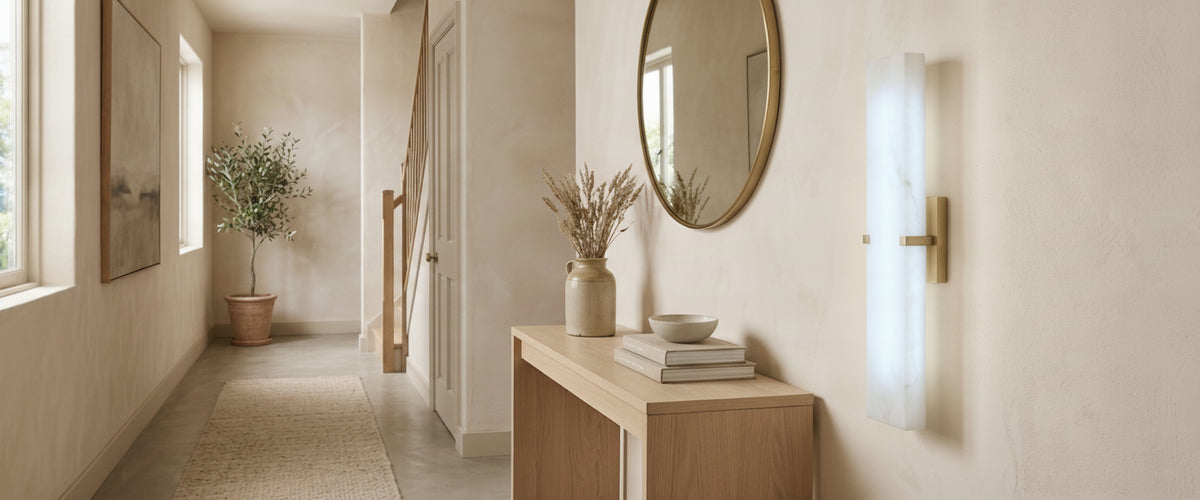

Hold a thin slab of alabaster in front of a bulb and you understand the appeal in about two seconds. The stone does not simply block or pass light; it carries it, spreading brightness sideways through the material until the whole panel glows from within. Natural stone wall lights are wall-mounted fixtures whose shade is a thin panel of translucent mineral, usually alabaster, travertine, or onyx, lit from behind so the stone itself becomes the glowing surface. That single behavior is why they read so differently from frosted glass or perforated metal, and why designers keep specifying them for rooms where a hard bright sconce would wreck the mood.

Key Takeaways
Natural stone wall lights scatter light inside the material itself, so the fixture becomes the light source rather than a shade hiding a bulb.
Alabaster runs warm and creamy, travertine reads earthy and matte, onyx is the most dramatic and the most veined.
Mounting height and wall color decide whether the veining on natural stone wall lights reads as a feature or disappears into the plaster.
Warm bulbs (2700K, sometimes 2200K) and a genuinely smooth dimming curve flatter stone; cool or flickering LEDs expose it.
Slab thickness, cut, and finish quality matter more than the marketing copy. Thicker is not better.
Always use a qualified electrician for hardwired sconces, especially in bathrooms.

Why Stone Transmits Light in a Way Glass and Metal Cannot
Glass diffusers work by roughening or coating a surface so light bounces on its way through. The glow sits on the face of the shade. Stone works deeper. Gypsum alabaster and calcite onyx are crystalline, and light entering the surface scatters repeatedly between crystals before it exits, which is what produces that soft, edge-to-edge luminosity with no visible hot spot. Modern stone sconces borrow that physics wholesale. Sculptors and window makers have used the effect for centuries; medieval and Renaissance workshops cut alabaster thin enough to fill window openings before clear glass was widely available, a tradition documented in museum collections including the Getty.
The practical consequence for a wall light is glare control. A bare bulb behind glass creates a bright point your eye keeps finding. Behind a well-cut stone panel, that same bulb becomes a plane of even light, which is why natural stone wall lights work at eye level in hallways and beside beds where most sconces feel aggressive. You also get color. The mineral content of the slab tints the output, so the light arriving on your wall has already been warmed and softened by the material before it reaches the paint.
There is a second, quieter effect worth knowing. Because the stone is opaque enough to hold its own presence, a natural stone wall light still looks like an object when it is switched off. Compare that to a glass sconce during daylight, which often reads as an empty shell. Think of a natural light stone wall in an atrium at midday: the same grain and veining that make the surface look alive under the sun are exactly what make a stone fixture look alive after dark. Daylight rakes across the material; lamplight travels through it. Both depend on the stone having something to show.
Alabaster, Travertine, and Onyx at the Wall
Alabaster
The default choice for a reason, and the material behind most natural stone wall lights worth buying. Fine white and honey alabaster transmits generously, produces a creamy cast even with a neutral bulb, and carries subtle cloudy veining that reads as texture rather than pattern. It is a soft stone (roughly 2 on the Mohs scale), so it takes crisp carved profiles, curved discs, and slim rectangular plates without chipping. If you want the light itself to be the story and the veining to whisper, alabaster is the pick. Most of the sconces in our alabaster lighting collection use this behavior deliberately, pairing the stone with brass so the metal picks up the warmth instead of fighting it.
Travertine
Travertine transmits far less, which puts it in a quieter family of natural stone wall lights. It is porous, formed by mineral springs, and the natural pitting scatters light in a grainier, more matte way. What you get is a beige, sandy, low-glow fixture with strong architectural presence: think disc-shaped travertine sconces in a beach house corridor, or a rectangular travertine plate above a console. Where a room needs the stone to register as a quiet architectural object rather than a bright panel, a honed disc such as the Caldera 1 Light Large Disc Travertine Wall Light is closer to the right design language than a highly translucent alabaster plate. Because travertine is porous, filled and honed surfaces perform and clean better over time; the Natural Stone Institute publishes solid technical guidance on how fill and finish affect porous stone in use.
Onyx
The showpiece, and the most theatrical of all natural stone wall lights. Onyx is banded calcite with translucency that can exceed alabaster, and the veining is loud: amber, green, honey, sometimes near-red. Backlit, it turns a wall into a piece of art. Backlit badly, it turns into a lava lamp. Onyx wants a considered position (a bar back wall, a powder room, the flank of a fireplace) rather than repeated eight times down a hallway. Slab matching matters more here than with any other stone, because two adjacent onyx sconces cut from different blocks will not look like a pair.
The Rooms Stone Rewards, and the Rooms That Neutralize It
Stone earns its keep where light is the atmosphere rather than the task. Bedrooms are the strongest case: a pair of alabaster sconces flanking a headboard replaces bedside lamps, frees the nightstands, and gives a glow soft enough to read by without waking the person next to you. Hallways and stairwells come second, since natural stone wall lights let you get away with a rhythm of low-output fixtures instead of one harsh overhead. In a narrow corridor where a deep sconce would catch shoulders, a shallow rectangular plate like the Bravora 1 Light Small Rectangular Travertine Wall Light holds the line of the wall better than a large disc. Dining rooms, powder rooms, and the walls flanking a fireplace all suit stone because your eye is already looking for warmth there.
Rooms that flatten stone: anywhere with high ambient brightness and cool surfaces. A north-facing kitchen with white quartz counters and 4000K downlights will render a warm alabaster sconce as a slightly yellow smudge. Home offices and utility spaces have the same problem, since task lighting has to win and natural stone wall lights are ambient by nature. One client fitted alabaster sconces in a mirrored home gym lit by 5000K ceiling panels. They looked wrong until the ceiling circuit was changed to 3000K and put on its own switch. The sconces had never been the issue.
Outdoors and in bathrooms, treat natural stone wall lights with respect. Natural stone is porous, moisture affects it, and gypsum alabaster in particular does not enjoy wet environments. Bathroom use is usually fine in a well-ventilated space away from direct spray, typically outside the shower and bath zones where an IP-rated fitting is required, but confirm the fixture's rating and zone suitability with your electrician before committing.
Wall Color and Mounting Height That Let the Veining Read
Contrast decides everything for natural stone wall lights. Cream alabaster on a chalky white wall vanishes; the fixture reads as a bright patch with no edges. Put the same sconce on a clay, olive, deep plaster pink, or limewashed taupe wall and the stone suddenly has a silhouette, and the veining registers. Dark walls are even better for onyx, which needs the surrounding surface to go quiet.
The same logic applies when the backdrop is itself stone. Mount a sconce on a natural light stone wall, travertine cladding or honed limestone that already catches the daytime sun in its own grain, and the two textures can cancel each other out. Either choose a fixture in a contrasting mineral, or give it a metal frame and a deeper shadow line so it still holds an outline once the daylight goes.
Mounting height rules of thumb for natural stone wall lights, adjusted for ceiling height and eye line:
General wall sconces: center around 152 to 168 cm (60 to 66 inches) from the finished floor.
Bedside: 76 to 91 cm (30 to 36 inches) above the mattress top, or roughly shoulder height when sitting up in bed.
Flanking a mirror: center at approximately 163 to 168 cm (64 to 66 inches), spaced 71 to 102 cm (28 to 40 inches) apart.
Hallways: 168 to 183 cm (66 to 72 inches), spaced 2.4 to 3 m (8 to 10 feet) apart for an even rhythm.
Stairs: keep the centers on a consistent line parallel to the stair nosing, not level with each other.
Scale follows the same logic as height. Beside a bed, where natural stone wall lights sit close to the eye and need warmth without a broad wash, the Caldera 1 Light Small Disc Travertine Wall Light makes more sense than the larger version of the same design, which wants a wider stretch of wall to sit against.
One more spacing note. Uplight-only natural stone wall lights throw a strong scallop on the wall above, so allow at least 46 cm (18 inches) of clear wall above the fixture or the scallop clips into the ceiling and looks cramped.
Bulb Temperature and Dimming: The Specs Stone Exposes
Stone is honest. A cheap LED behind a translucent slab shows every fault, because the whole panel amplifies whatever the source is doing. Natural stone wall lights are only ever as good as the bulb you put behind them.
Color temperature: 2700K for most rooms. 2200K if you want a candlelit read in a dining room or bar. Skip anything at or above 3500K behind alabaster or onyx; it turns the warm minerals muddy.
Color rendering: CRI 90 or better. Below that, the veining loses depth and the brass detailing goes gray.
Dimming: insist on a smooth dimming curve down to 5 percent or lower, and match the driver to the dimmer. Mismatched trailing-edge dimmers are the most common cause of flicker complaints we hear about.
Output: lower than you think. Stone absorbs some of it, but these are ambient fixtures, not task lights. A pair of 400 to 600 lumen sources per wall is usually plenty.
Bulb shape: a frosted candle or globe placed centrally avoids a visible bright core through thinner areas of the slab.
Warm-dim LEDs (which shift toward amber as they dim, mimicking an incandescent) are worth the premium in bedrooms and dining rooms specifically. Behind alabaster the effect is close to firelight, which is the best single argument for putting natural stone wall lights on a proper dimmer.
Provenance, Slab Thickness, and Finish Quality
Two natural stone wall lights can look identical in a photograph and behave completely differently on the wall. The differences sit in three places.
The block. Stone from a good quarry run is consistent in density and color. Poor material carries iron staining, fractures, and cloudy patches that turn into dark blotches once illuminated. Ask where the stone comes from and whether pieces in a pair are cut from the same block.
The thickness. Too thin and you see the bulb and every internal flaw. Too thick and the fixture stays dull and heavy. Good makers tune thickness to the specific stone, then thin the panel slightly where a deeper vein would otherwise block transmission. That is craft, not machinery.
The finish and fixing. Hand-honed edges catch light softly; machine-ground edges look chalky. Check how the stone is held: metal clamps that pinch a soft stone crack it eventually, while a well-designed brass cradle spreads the load. And expect weight. A pair of substantial natural stone wall lights can run several kilograms each, so blocking or a proper mounting plate is not optional. Browsing the wider lighting range side by side is the fastest way to see how differently each stone behaves once lit.
Buying Checklist
Confirm the stone type in the natural stone wall lights you are pricing, and whether paired fixtures are block-matched.
Check the wall color behind the fixture for contrast before ordering.
Set mounting height against eye line, not against a generic number.
Specify 2700K, CRI 90+, and a dimmer confirmed compatible with the driver.
Verify wall construction and fixings can carry the fixture weight.
Ask about a spare panel or repair policy for natural stone components.
Book a qualified electrician for installation and for any bathroom zone check.
Ask for a full quote rather than assuming a price band; cost tracks the stone, scale, engineering, and finishing.
Living With Stone
Care for natural stone wall lights is undramatic if you start right. Dust with a dry microfiber cloth; skip vinegar, citrus, and any acidic or abrasive cleaner, which etch calcite-based stones permanently. Wipe fingerprints with a barely damp cloth and dry immediately. Keep sconces off walls that get sustained direct afternoon sun, since prolonged UV combined with heat cycling is unkind to soft stone over years. If a panel picks up a scuff, a specialist can usually re-hone it; that is one of the advantages of stone over glass.
The last thing worth saying is that natural stone wall lights reward patience at the specification stage far more than at the checkout. Get the wall color, the height, and the bulb right, and even a modest pair carries a room. Get them wrong, and the finest slab in the world looks like a night light.