
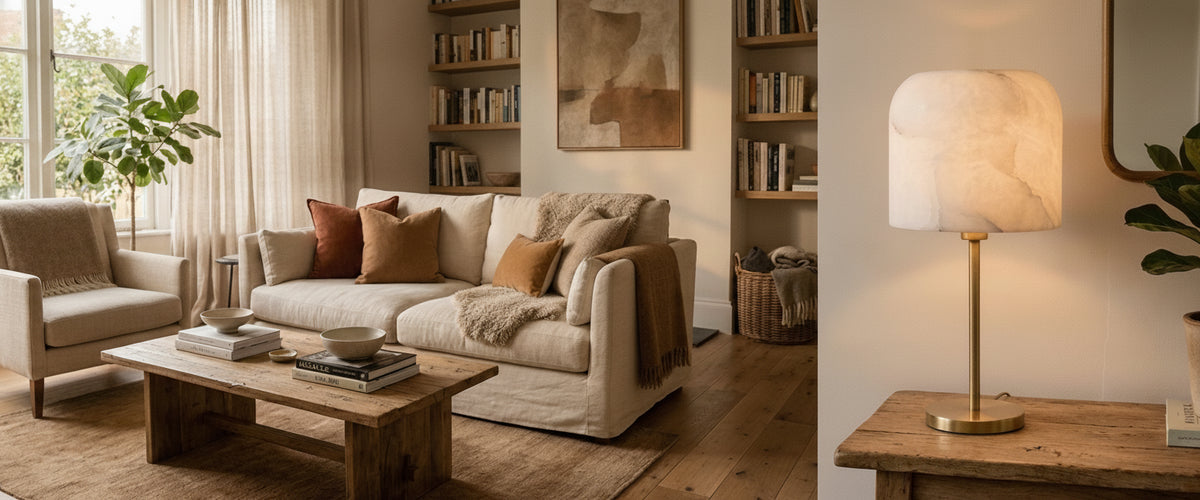

Most modern table lamps fail on the table, not in the showroom photograph. Photographed alone against a pale backdrop, almost anything looks composed. Put it on a real console beside a real stack of books, switch it on at seven in the evening, and the flaws show up fast: a base too slim for the surface, a shade that fires light at the ceiling instead of across the room, a chrome collar that fights every other metal in the space. The modern table lamps worth buying survive that seven o'clock test, and choosing one is less about style labels than about a handful of decisions you can actually check before you order.

Key Takeaways
- Material sets the mood. Alabaster and onyx glow from within; ceramic and metal stay opaque and throw light only from the shade.
- Shade opacity decides the room. A dense linen shade lights a table; a translucent stone or opal shade lights the wall behind it.
- Scale beats style. Beautifully designed modern table lamps at the wrong height will quietly wreck an otherwise coherent scheme.
- Warm and dimmable wins. Aim for 2700K in living rooms, 2200 to 2400K at the bedside, with a driver and dimmer that are genuinely compatible.
- Finishes date at different speeds. Natural stone, unlacquered brass and matt bronze age gracefully; high-polish chrome and novelty forms rarely do.

What "Modern" Actually Means When You Buy Modern Table Lamps
"Modern" has become a filter category rather than a design position, which is why searching for modern table lamps returns everything from Bauhaus-derived cylinders to sculptural resin blobs. It is more useful to read the word as three concrete decisions the designer made: a reduced silhouette, honest material, and a light output that suits how rooms are actually used now.
Reduced silhouette means the form does the work instead of applied ornament. Honest material means the base looks like what it is, so stone reads as stone and brass reads as brass, with no printed grain or sprayed antiquing. And light output matters more than it did twenty years ago, because table lamps are no longer supplementary. In plenty of British homes the central pendant barely gets switched on through winter, and lamps carry the evening.
That last point is the one buyers underestimate. Modern table lamps bought purely as objects disappoint the moment you need to read under them.
Stone, Ceramic, Glass and Metal Bases: What Each Does to the Light
In modern table lamps the base is not just a plinth. The material changes what happens to the light spilling downward and outward, and it determines how the lamp behaves when it is switched off during daylight.
Alabaster and Onyx
Translucent stone is the only base material that participates in the light. Thin-cut alabaster transmits a warm, honeyed glow through its veining, so the lamp reads as a small illuminated object rather than a stand with a bulb on top. Each block is different; a seam of iron or clay in the quarry face produces the amber and grey drift you see in the finished piece. Onyx pushes further, with stronger banding and higher contrast. Alabaster is a gypsum stone and onyx a calcite one, which makes both soft, workable and considerably more sensitive to moisture than granite or slate. We cover that in the care section below.
Marble
Marble is denser and mostly opaque, so it acts as visual weight rather than a light source. That is a virtue on a slim console where a glowing base would compete with a mirror or artwork above it. Honed marble absorbs the ambient glow and looks calm; polished marble reflects it and looks sharper.
Ceramic
Glazed ceramic gives you colour and a crafted surface at a lower weight than stone. The trade-off is that a glaze reflects the light from above in a hard highlight, which can look busy on a glossy finish. Matt and eggshell glazes sit far better beside natural stone.
Glass
Blown or cased glass reads as light and modern, and it is the material most likely to disappear in a room. Useful on a bedside table in a small room. Less useful if you want the lamp to anchor a large surface.
Metal
Brass, bronze and blackened steel bases are the most architectural option and the most likely to date if the finish is trend-led. Brushed and unlacquered brass develop a patina over years of handling and look better for it. Where the metal is meant to warm the light rather than reflect it back at you, a softly finished piece such as the Cranbourne LED Table Lamp in brushed brass sits more comfortably beside stone and timber than a mirror-polished base ever will. Bright chrome does not age in the same way; it stays exactly as bought and pins the lamp to the decade it came from.
Shade Geometry and Opacity Reframe the Whole Surface
The shade decides where the light goes, and by extension what the lamp is for. It is the quietest variable in the whole purchase and the one that changes a room most. A straight-sided drum with a dense fabric lining pushes light straight up and straight down. That is a working lamp: excellent over a desk or a reading chair, poor as ambient light because the wall behind it stays dark and the room feels smaller.
An empire or tapered shade widens the downward pool and softens the edge of it, which is why it still suits sofa-side tables. A translucent shade, whether that is thin alabaster, opal glass or a fine unlined linen, glows across its whole surface and lifts the wall behind the lamp. In a narrow hallway or a dark corner of a sitting room, that wall-wash is what makes the space feel bigger. Where a room needs a soft diffused glow rather than a hard downlight, a curved, light-toned form like the Arc Large Table Lamp in white is closer to the right design language than a tightly lined drum.
Two practical checks before you commit. First, look at where the shade edge sits relative to your eye when seated. If you can see the bulb from your usual chair, you will be irritated by it every evening. Second, consider the surface underneath. A polished walnut console will bounce a hard reflection back up into a glossy shade lining; a stone or matt-painted top will not.
Scale Mismatches: When a Good Lamp Undermines a Good Room
This is where most schemes come unstuck. Modern table lamps are often photographed on oversized plinths in double-height rooms, and buyers replicate the look on a 90cm (35in) hall console where the proportions collapse.
A few rules of thumb that hold up in real homes:
- Bedside: the bottom edge of the shade should sit at roughly the eye level of someone sitting up in bed. Too high and you get glare across the pillow; too low and you cannot read.
- Sofa side table: keep the total lamp height within about one and a half times the height of the table, and check that the shade does not overhang the table edge.
- Console or sideboard: the lamp (or pair) should occupy roughly a third of the surface length. A single small lamp on a long sideboard always looks stranded.
- Weight matters too. A solid stone base of several kilograms will not shift when the flex is knocked. A hollow metal base will.
The practical version of these rules is usually a choice between two sizes of the same design. On a shallow bedside table, where the shade edge needs to fall below eye level and the footprint has to share space with a book and a glass of water, something on the scale of the Brenmont Medium Table Lamp in matt black does more work than a taller statement piece squeezed onto the same surface.
We shipped a pair of alabaster table lamps to an Edinburgh flat last winter where the client had already tried three smaller lamps on a long Georgian sideboard and could not work out why the wall above it still felt empty. The issue was never the quality of the lamps. It was that nothing on that surface was tall enough to reach the bottom of the picture frame and connect the two. Going up in scale solved a problem that swapping styles had not touched.
Colour Temperature and Dimming: Living Rooms Versus Bedrooms
Colour temperature is where modern table lamps most often go wrong, because LED retrofit bulbs are bought in a hurry and 4000K is stocked everywhere. In a living room, 2700K is the reliable default: warm enough to feel domestic, clean enough that white paint does not turn yellow. In bedrooms, drop to 2200 to 2400K for the last hour of the evening. Warmer, lower-level light in the evening suits the way our eyes and body clocks respond to light after dark, a principle set out in guidance from the Illuminating Engineering Society.
Two more specifications worth insisting on. Choose bulbs with a colour rendering index of 90 or above, particularly with stone and brass, because low-CRI light flattens the warmth out of both. And where the lamp has a translucent alabaster or opal shade, always use an opal or frosted bulb rather than a clear filament one, or you will see a bright hotspot burned through the material.
On dimming: check that the driver or bulb is stated as dimmable and that your dimmer type matches, since trailing-edge dimmers generally suit LED loads better than older leading-edge units. Inline foot dimmers and switched-live lamps behave differently, and modern table lamps with integrated LEDs often need their own compatible control. If you are changing a wall dimmer or altering fixed wiring, use a qualified electrician rather than improvising.
Finishes That Age Well, and Finishes That Date Fastest
Ageing well is a material question, not a trend question, and finish is where modern table lamps separate quickly into the ones you keep and the ones you replace. Natural stone improves in the sense that it never looked mass-produced in the first place, so it does not read as "from a particular season". Unlacquered and brushed brass earns a patina. Matt bronze, blackened steel and honed marble all stay quiet.
What dates fastest: high-polish chrome, rose gold, printed faux-marble on resin, exposed cage shades, and any silhouette that is doing something clever for its own sake. Colour-drenched glazes are riskier than they look, because they tie the lamp to a paint scheme you may change. If you want colour, put it in the shade, which is far cheaper to replace than the base.
You can see how these decisions play out across a range in our alabaster lighting collection, where the same stone appears in table lamps, wall lights and pendants and behaves slightly differently at each scale.
Buyer's Checklist for Modern Table Lamps
Run through this before committing to any of the modern table lamps on your shortlist.
- Decide the job first: reading light, ambient glow, or sculptural presence. Very few lamps do all three well.
- Measure the surface, then check lamp height against furniture and eye level from your usual seat.
- Match the base material to the surface it sits on, and avoid stacking three glossy finishes on one console.
- Confirm shade opacity. Translucent for ambience and wall-wash, opaque for task light.
- Specify bulbs: 2700K living areas, 2200 to 2400K bedrooms, CRI 90+, opal glass inside translucent shades.
- Confirm dimmability and dimmer compatibility before ordering; involve an electrician for any fixed wiring.
- Check the switch position. A cord switch dangling down the front of a stone base will annoy you daily.
- Check weight and cable exit for UK plug fitting if you are ordering from overseas.
- Ask about replacement shades and spare parts. Long-life lighting needs a route back to the maker.
Living with Stone: Care That Actually Matters
Alabaster is soft and partly soluble in water, which is why conservators handle gypsum-based stone very differently from granite. Dust with a dry, soft brush or a clean microfibre cloth, never a damp one. Skip household sprays, ammonia and anything acidic, and keep lamps away from steam and radiators. Museum conservation bodies such as the Getty Conservation Institute publish work on stone deterioration that makes the same underlying point: moisture and salts, not everyday handling, are what damage soft stone over time.
Marble and onyx tolerate more, though a sealed honed marble base still prefers a dry cloth to a wet one. Brass details can be left to patinate or gently polished; decide once and stay consistent, because half-polished brass looks like an oversight.
Choose on these terms and modern table lamps stop being a decorative afterthought and start doing the structural work in a room: warm pools of light at seated height, wall surfaces lifted out of shadow, and an object that still looks considered long after the trend cycle has moved on. If you are working through a whole scheme rather than a single surface, it is worth browsing the wider lighting range so pendants, wall lights and lamps share a material language rather than competing.