
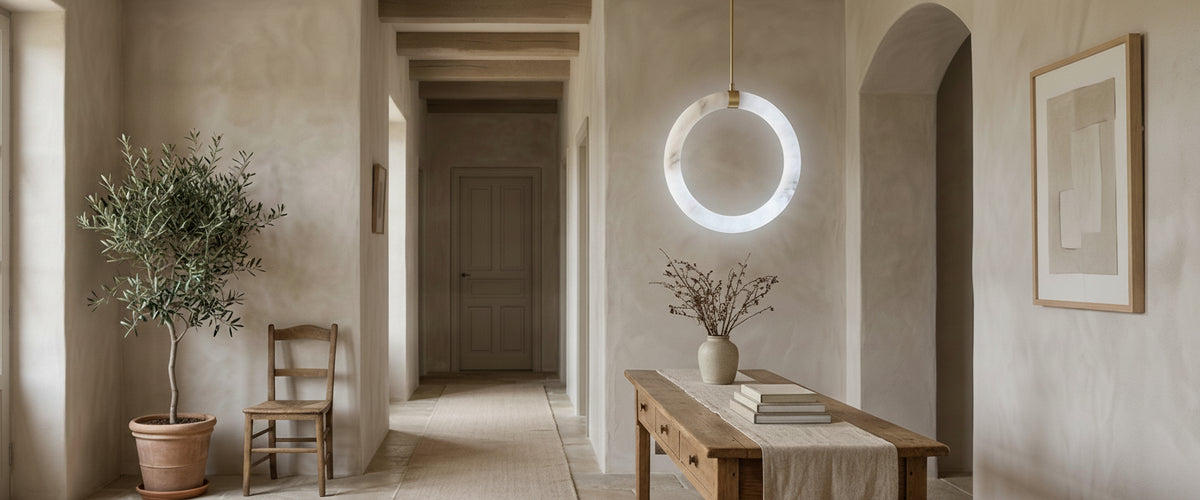

Most rooms that miss the French country brass look miss it for the same reason: the brass is too new, too yellow, and too evenly finished. The shape is right, the arms curve the way they should, and yet the fixture reads like a stage prop rather than something that has hung in a farmhouse hallway for forty years. Getting French country brass right is less about buying a particular silhouette and more about understanding how the metal ages, what it sits next to, and how the light leaves it.

Quick Answer: What French Country Brass Actually Is
- Finish over form. Unlacquered or lightly aged brass carries the style. Bright, mirror-lacquered brass rarely does.
- Soft, warm output. The look depends on diffused light, which is why alabaster, opal glass and linen shades work harder than bare bulbs.
- Honest materials nearby. Limewash plaster, unpolished stone, oak, and washed linen make the brass read as lived-in rather than staged.
- Restraint in scale. One generous chandelier plus quiet wall lights beats six matching pieces in the same room.
- Buy for the long game. Solid cast or spun brass with visible hand-finishing ages well; thin plated steel does not.

What Defines the Look Beyond Aged Patina and Curved Arms
Strip away the obvious cues and the style rests on three things: weight, warmth, and irregularity. Weight, because French provincial metalwork was made from solid stock rather than folded sheet, and you can see it in the thickness of a chandelier arm where it meets the central column. Warmth, because the light was always candle-derived, then bulb-derived, and it was never white. Irregularity, because hand-raised and hand-chased components never match perfectly from one arm to the next.
That last point is the one most reproductions get wrong. A machine-perfect casting with a uniformly sprayed antique finish looks correct in a photograph and slightly hollow in person. Genuine French country brass pieces show variation: a slightly deeper tone in the crevices of a scrolled arm, a lighter tone on the high points where hands and cloths have passed over the metal for decades. Good makers replicate this by hand-burnishing after patination rather than by spraying a single graded coat.
Form matters too, but less than people assume. Curved arms, tiered candle cups, simple bobeche discs, and a plain central body are the classic vocabulary. Push past that into heavy rococo scrollwork and you have left the countryside for the chateau, which is a different look with different rules.
Why Unlacquered Brass Reads as Authentically Aged
Brass is a copper-zinc alloy, and left bare it reacts with air, moisture, and the oils on your hands. That reaction is the whole point. Over months it moves from a bright yellow towards amber, then bronze, then a dark patina in the recesses, and it does it unevenly because your hands touch some parts more than others. Conservation bodies including the Smithsonian's Museum Conservation Institute treat this surface layer as part of the object's history rather than a fault to be polished away, and the same logic applies at home.
Lacquered brass freezes the metal at day one. That has a practical benefit in bathrooms and coastal properties where humidity accelerates tarnish, and a bright lacquered finish suits a crisp modern scheme. In a French country brass scheme it works against you. The finish stays glossy while everything around it softens, and that mismatch is what makes the fixture read as costume.
We keep a row of brass sample plates on the studio windowsill, half lacquered and half raw. After a winter, the raw plates had gone a mottled honey-brown with darker edges where condensation ran; the lacquered ones looked exactly as they had in September. Clients unsure about unlacquered brass tend to make up their minds the moment they pick up both.
If you want the aged look without the wait, antique brass and aged brass finishes are chemically patinated at the workshop and then sealed lightly or waxed. They are a reasonable compromise. Ask whether the patina is applied by hand and whether it will continue to develop, because some sealed finishes are effectively fixed.
The Materials Around the Metal Decide Whether the Style Lands
Brass on its own is just metal. What turns it into French country brass is the company it keeps. Limewash or clay plaster walls scatter light in a way that flat emulsion cannot, so the glow from a brass fixture spreads rather than pooling. Washed linen curtains, an unlacquered oak table, terracotta tile, and unpolished stone all absorb a little light and give back texture.
Alabaster belongs firmly in this group, which is why we return to it so often. It is a soft, translucent stone that diffuses light through its own body, producing a warm, slightly milky glow with visible veining when lit. Paired with aged brass, alabaster does something bright glass cannot: it removes the hard edge from the light source while keeping the metal warm rather than cold. A carved alabaster bowl suspended on brass chains reads as unmistakably rural French, even when the fixture itself is contemporary. Our alabaster lighting collection is built around exactly this pairing of stone and warm metal.
Marble and onyx work too, with caveats. Honed marble bases under a brass table lamp are quietly correct. Heavily figured onyx, backlit, tips towards drama and suits a dining room or bar more than a farmhouse kitchen. Polished, high-gloss stone fights the look; honed and matt surfaces support it.
Rooms That Absorb French Country Brass, and Rooms That Fight It
Kitchens and pantries. The strongest room for the style. Aged brass pendants over an island, hung roughly 75 to 85cm (30 to 33in) above the worktop, with alabaster or opal shades to keep glare off polished stone.
Dining rooms. A brass chandelier is the anchor. Keep the bottom of the fixture around 75cm (30in) above the table, and resist the urge to add matching wall lights in the same finish and same scale.
Hallways and stairwells. Wall lights in aged brass with small alabaster or glass shades give a low, layered wash that suits older houses with uneven plaster.
Bedrooms. Table lamps with stone bases and linen shades, on dimmers. This is where warmth matters most and where cool LED colour temperatures do the most damage.
Where it struggles. High-gloss minimalist kitchens, all-white apartment interiors with recessed downlights, and rooms dominated by chrome or brushed nickel hardware. French country brass in a scheme with no other warm materials looks like a single borrowed object. It also fights bright cool-white ambient lighting; if the ceiling grid is running at 4000K, no amount of patina will rescue the fixture.
Last spring we shipped a pair of alabaster and aged-brass wall lights to a converted mill house in Somerset where the owner had already stripped the walls back to lime plaster. She sent a photo two weeks after fitting. The brass had barely started to move, but the plaster was doing half the work already, throwing the light sideways across the texture. That is the pairing working as intended.
Mixing Scales Without Tipping into Pastiche
The failure mode is repetition. Six matched brass fixtures in one open-plan space stop looking collected and start looking catalogued. Treat lighting the way you would treat furniture in the same room: one dominant piece, one or two supporting pieces, and enough variation to suggest they arrived at different times.
A workable structure for an open kitchen and dining space is a substantial brass and alabaster chandelier over the table, two or three smaller pendants over the island in a related but not identical finish, and a single table lamp on a sideboard with a stone base. Vary the shade material across at least one of those. Alabaster over the table and opal glass over the island keeps the family resemblance without the uniform.
Finish mixing is also allowed, and usually improves things. Aged brass with blackened iron, or brass with a pale stone, reads as accumulated. If you want to see how different metal and stone combinations sit together across pendants, chandeliers and wall lights, it is worth browsing the wider lighting range side by side before committing to a single finish for a whole floor.
Finish Quality Signals Worth Checking Before You Buy
Most of the difference between convincing French country brass and a costume version is decided at this stage, before anything is wired in.
- Is it solid brass or brass-plated? Plated steel will wear through at handling points and cannot be re-patinated. Ask directly.
- Is the patina applied by hand? Hand-burnished highlights beat a single sprayed gradient every time.
- Lacquered, waxed, or bare? Each is valid. You need to know which, because it determines how the piece will look in five years.
- How are the arms joined? Brazed or threaded joints on a chandelier outlast crimped or glued ones.
- Is the stone natural or resin? Real alabaster shows irregular veining that changes when lit. Cast resin lookalikes glow flat and evenly.
- Are shades replaceable? Natural stone can chip. A maker who sells replacement shades is planning for a long life.
- Weight and mounting. Heavier fixtures need appropriate ceiling fixings; a qualified electrician should confirm the mounting point and wiring before installation.
- Dimming compatibility. Confirm the driver or lamp works with your dimmer type rather than assuming.
On budget, treat any figure quoted before the specifics are settled with suspicion. Cost tracks material (natural alabaster versus glass), scale, arm count, engineering complexity, hand-finishing time, and installation. Specify the piece properly, then request a tailored quote.
Bulbs and Dimming for Warm Brass and Stone
Colour temperature does more damage than any other single choice. Stay at 2700K or lower for French country brass schemes; 2200K to 2400K in candle-form lamps on a chandelier is closer to the original effect. Choose lamps with a high colour rendering index, ideally CRI 90 or above, so the stone veining and the brass tone both read accurately.
Dimming should be smooth and warm rather than simply darker. Warm-dim lamps that shift towards amber as they lower suit alabaster particularly well, since the stone already carries a warm cast. Put every fixture in the room on a dimmer if you can, and check circuit loading and control compatibility with your electrician. The Chartered Institution of Building Services Engineers publishes technical guidance on lighting levels and control that is worth a look if you are specifying for a larger project or a hospitality space.
Living With the Finish Over the Years
Unlacquered brass wants very little. Dust with a dry, soft cloth. Leave the patina alone unless you actively want it brighter, in which case a light burnish with a wadding polish on the high points only, never the recesses, keeps the depth intact. Avoid abrasive creams and never use acidic household cleaners near brass or stone.
Alabaster and marble are the more sensitive partners. Both are calcium-based and will etch on contact with acids, so no vinegar, no citrus, no bathroom spray. Dust with a dry microfibre cloth and, if a shade genuinely needs it, wipe with a barely damp cloth and dry immediately. Never soak natural stone. In steamy rooms, choose sealed or lacquered brass and check with the maker that the stone has been treated for humidity.
Done properly, a French country brass and alabaster fixture improves rather than deteriorates. The metal darkens where you touch it, the stone stays exactly as it was, and the light stays warm. That gap between an ageing metal and a stable stone is the quiet thing that makes the combination work. If you want a sense of how the two behave together across different fixture types, start with the collections on the Niori homepage and compare pendants against wall lights before you decide where the statement piece goes.