
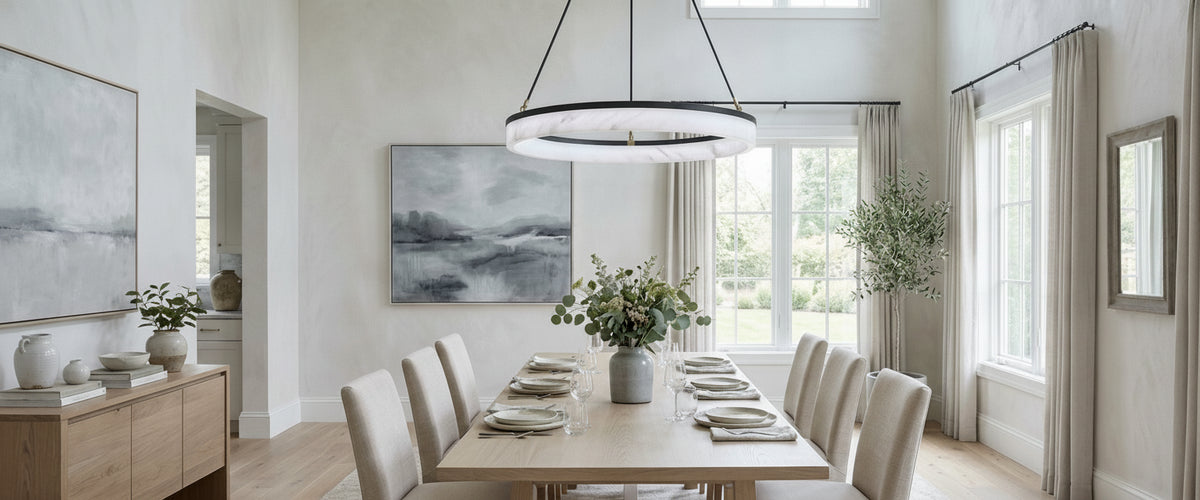

Black and brass is the boldest metal pairing you can hang from a ceiling, and the one buyers most often overplay. Done well, a black and brass chandelier gives a room a spine: it draws a firm graphic line across a pale ceiling, then warms the whole thing back up with the glow of polished or brushed metal. Done badly, it reads like stage jewelry, all outline and no light. The difference almost never comes down to taste. It comes down to ratio, scale and what the fixture is asked to sit beside.

Key Takeaways
Ratio decides the mood. A black and brass chandelier built on a black-dominant frame with brass details reads architectural and quiet. A brass-dominant frame with blackened joints reads decorative and warm.
Contrast adds visual weight. A two-tone fixture always looks larger than a single-finish one of the same size, so measure before you fall for a photograph.
Warm light flatters brass; cool light kills it. Stay between 2200K and 2700K, and dim.
The shade material matters more than the metal. Clear glass sharpens the contrast on a black and brass chandelier, alabaster softens it and adds a third, mineral tone.
Clean dry, not wet. Most black finishes are powder-coated or blackened, and most brass is lacquered. Polish is the enemy of both.

What the Black-and-Brass Combination Actually Signals
Two metals in one fixture is a deliberate statement of formality. Single-finish lighting slips into a scheme; two-tone lighting announces itself. Black gives you weight and edge, brass gives you warmth and age, and together they carry a faint memory of period ironmongery: gas-era brackets, cast iron balustrades, blackened steel window frames with brass catches. That historical echo is exactly why a brass and black chandelier suits high Victorian ceilings and hard-edged new-build extensions equally, but flatters neither of them by accident.
The tension is the point. Black absorbs light and leaves shape behind. Brass is reflective; it collects whatever light you throw at it and hands some back. Put them in one frame and you get a black and brass chandelier that looks solid from across the room and glowing up close. That double reading is the whole appeal, and it is also why proportion is so unforgiving.
Dominant Frame or Dominant Arm: The Ratio Changes the Reading
Ask one question before anything else: which metal is doing the structural work?
Black-Dominant, Brass-Accented
Here the arms, stem and canopy are matt or satin black, and brass appears only at the sockets, cups, collars or a slim horizontal band. The fixture reads as drawing rather than object. It disappears against a dark ceiling and silhouettes crisply against a pale one. This is the version of the black and brass chandelier to choose in a room that already has plenty going on: patterned tile, strong joinery, a busy gallery wall. It behaves like a line of ink over the top of the scheme. Where you want that restraint but still need the metal to catch light, a slim-framed piece such as the Galaxy 10 Light Glass Globe Chandelier in Black & Brass keeps the structure graphic and lets the brass sockets do all of the warming.
Brass-Dominant, Blackened Detail
Flip it and the mood changes entirely. A brass black chandelier where the frame is brushed or antique brass and only the joints, backplates or shade caps are blackened reads warmer, older and more decorative. It sits comfortably with walnut, oxblood, deep green and unlacquered hardware elsewhere in the room. It also picks up candlelight and low winter sun in a way an all-black frame never will.
The Even Split
Fifty-fifty is the hardest to pull off and the most commonly bought. It works when the two metals are organized by geometry rather than sprinkled: a black horizontal bar carrying brass verticals, or brass rings holding black rods. It fails when the finishes alternate randomly across the frame, which is the point at which a black brass chandelier starts to look like a sample board.
Proportions That Read Confident Rather Than Heavy
Contrast adds apparent bulk. A black and brass chandelier of a given diameter will look noticeably bigger in the room than a single-finish one, because the eye counts each color block separately. That means the usual sizing habits need adjusting downward slightly, not upward.
Over a dining table: keep the fixture narrower than the table by a comfortable margin on both sides, and hang the lowest point roughly 75 to 90cm (30 to 35in) above the tabletop. High-contrast fixtures can sit at the lower end of that range because the frame is more open than it looks.
In an open-plan room: add the width and length of the space in feet, and treat that total in inches as a starting diameter. A 4m by 5m room (13ft by 16ft) points to roughly 75cm (29in) across, and a two-tone frame is better sitting on or just under that figure than above it.
Ceiling height: below about 2.4m (8ft), go for a flush or semi-flush two-tone fitting rather than a suspended black and brass chandelier. Black arms at head height feel oppressive in a way brass alone does not.
Stairwells and double-height voids: this is where black-dominant chandeliers in black and brass earn their keep. Vertical, linear forms with brass sockets hold the drop without filling the void with mass.
One more rule from the studio: count the arms. Beyond about twelve lights, a heavily contrasted black and brass chandelier starts to look busy from below, because every socket becomes a small dark or bright punctuation mark. If you need that many lamps, choose a design where the arms branch from a common structure rather than radiating separately. The Galaxy 12 Light Branching Chandelier in Black & Brass spreads its lamp count across a shared armature, so the frame reads as one gesture instead of twelve competing ones.
Rooms That Reward the Contrast, and Rooms That Resist It
Dining rooms are the natural home. The table gives the fixture a job and a boundary, and the low, focused light flatters brass. Entrance halls come second: a black and brass chandelier at the top of a stairwell sets the tone for everything behind it, and the graphic outline survives being seen from three floors and four angles.
Kitchens with dark cabinetry or blackened steel glazing are an easy win, particularly with brass tapware already in play; a black and brass chandelier over an island picks up that hardware without repeating it exactly. Studies, snugs and panelled rooms take it well too, because there is enough dark timber to absorb the black without the fixture looking marooned.
Now the rooms where the pairing tends to fight. Soft, tonal bedrooms rarely want the hard outline of a black and brass chandelier overhead; the contrast is too awake for a room that should quieten down after dark. Bathrooms with a lot of chrome or nickel are a clash you cannot resolve, and damp-rated requirements narrow the field further. Very small rooms with low, textured ceilings suffer too, because the black element visually lowers the ceiling further. If a scheme already runs on subtlety, a translucent stone fixture usually serves better than a two-tone metal one; our alabaster lighting collection is built around exactly that softer approach, and many pieces still carry brass detailing if you want a hint of the same warmth.
Bulb Temperature and Shade Material: What Flatters the Finish
Brass carries a color of its own. Push cool white light through a brass frame and the metal turns faintly green and sour. Keep the source warm and it reads golden and deep. For any brass and black chandelier, specify 2200K to 2700K, a color rendering index of 90 or above, and a properly matched dimmer. Vintage-style filament lamps at 2200K suit clear glass globes; a slightly higher 2700K suits frosted or stone shades, which absorb a little warmth on the way through.
Shade material then decides how hard the contrast lands:
Clear glass globes: maximum sparkle, maximum contrast, visible filament. Best where the fixture is the focal point and glare is controlled by dimming.
Smoked or amber glass: softens the black, warms the brass, and hides the lamp. Good over dining tables where guests look up.
Alabaster: the most flattering partner of the three. Stone glows rather than glares, and its warm ivory and honey veining bridges the gap between the two metals, so a black and brass chandelier stops looking like a two-color object and starts looking like a three-material one.
Opal glass: clean and even, but flatter than stone. It reads modern rather than warm.
One client came to us after living with a clear-globe black and brass chandelier over a long dining table and finding it unbearable at dinner. Same footprint, same metals; swapping glass for stone dropped the glare, and the brass suddenly looked warm instead of brassy. That is the change most people are actually chasing when they say a fixture feels too harsh. Over a table that needs diffused light rather than a row of bright points, a piece like the Aurevia 14 Light Linear Alabaster Chandelier in Matt Black & Brass is closer to the right design language. If you want to compare forms before you commit, the full niori lighting range shows the same finishes across pendants, wall lights and floor lamps so you can carry a thread through the house without repeating the chandelier.
A Buyer's Checklist Before You Commit
Decide the ratio of your black and brass chandelier first: black-dominant for graphic restraint, brass-dominant for warmth.
Check the black finish type. Powder-coated matt black is durable; painted or sprayed finishes chip at the arms and canopy over time.
Ask whether the brass is lacquered, unlacquered or plated. Unlacquered brass will patina; that is a feature, not a fault, but you should choose it knowingly.
Measure the drop, including canopy and rod, against your ceiling height and any door swing beneath it.
Confirm the weight and ceiling fixing. Anything heavy needs joist-mounted support, specified by whoever installs it.
Match the dimmer to the lamps before purchase, not after.
Look at the black and brass chandelier switched off. It spends more hours dark than lit, and a two-tone frame has to earn its place as an object.
Ask for a tailored quote rather than assuming a price. Cost tracks material, scale, the complexity of the metalwork, stone selection, engineering and finishing, and those vary widely between designs.
How to Clean a Black and Brass Chandelier Without Ruining It
Most damage we see is caused by enthusiasm. Commercial brass polish will strip the lacquer on a black and brass chandelier, leave cloudy patches, and abrade blackened steel. Ammonia-based glass cleaner will do the same to a powder-coated arm if it runs down from a shade.
The safe routine: isolate the circuit at the consumer unit, let the lamps cool completely, and dust with a dry microfiber cloth or a soft long-handled brush. For fingerprints on lacquered brass, use a barely damp cloth with a drop of pH-neutral soap, then dry immediately. Never let moisture sit in a socket or joint. Unlacquered brass that has darkened unevenly can be evened out with a light metal polish, but only if you have confirmed there is no lacquer to remove. Conservation guidance on caring for metalwork is worth reading before you start; the National Trust's conservation team publishes sound advice on handling and cleaning historic metals that translates well to modern fixtures.
Alabaster and marble shades need a different hand entirely: dry dusting only, no solvents, no water sitting on the surface. Stone is porous and will mark. Wear cotton gloves when handling, because skin oils show on pale calcite.
Should You Paint a Brass Chandelier Black?
The question almost always comes up about an inherited fixture. It can be done, and it is often the wrong call. If the piece is solid cast brass with good detailing, painting it removes the exact quality that makes it worth keeping. If it is a thin plated frame with a dated finish, painting is reasonable, though the result rarely matches a purpose-built black and brass chandelier where the two finishes were designed together.
The method that actually holds: dismantle and remove all shades, lamps and electrical components; clean off lacquer with an appropriate stripper; degrease thoroughly; key the surface with fine abrasive; apply a self-etching metal primer in thin coats; finish with a matt or satin black enamel or a two-pack lacquer, again in thin coats, allowing full cure between them. Mask every socket, terminal and earth point. Skipping the etch primer is why most home attempts peel within a year.
Anything involving rewiring, new flex, earthing or the ceiling fixing itself should go to a qualified electrician; the Electrical Safety First guidance is clear on where competent-person work begins. A repainted fixture that fails its earth continuity check is a genuine hazard, not a decorating mishap.
Where Niori Fits
We build lighting around alabaster and natural stone, so our black and brass chandeliers tend to use those two metals as a frame for a glowing material rather than as the whole story. That is a deliberate position. Metal gives a chandelier its geometry; stone gives it its light. If you want the graphic confidence of a black and brass chandelier without the hard glare that often comes with it, pairing those metals with hand-selected alabaster is the most reliable route we know.