
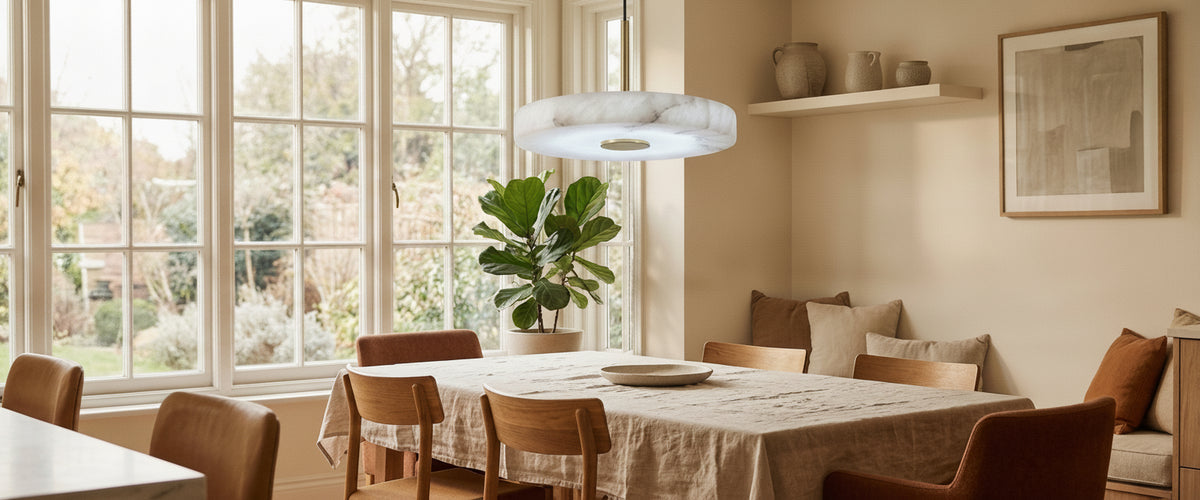

Gold and alabaster get paired constantly, and often enough the pairing falls flat. The metal looks brassy against a stone that reads too grey, or the bulb inside is too cold and the whole fitting turns the colour of a hospital corridor. A gold alabaster pendant is a genuinely lovely thing when the stone, the trim and the lamp inside are pulling in the same direction. When they are not, the gold looks stuck on. Choosing a gold alabaster pendant well is less about taste than about a handful of technical variables most buyers never get told about.
Key takeaways
- Gold reflects a warmer, longer wavelength than chrome or nickel, so a gold alabaster pendant pushes the stone's glow towards honey rather than bone.
- Low vein density and even translucency suit gold best; heavy grey or slate veining fights it.
- Deep carving reads as shadow in daylight and as pattern after dark, which changes how much gold trim you actually want.
- Use 2700K lamps as your default. Alabaster is a subtractive filter, and a cool source turns it lifeless.
- The canopy and drop rod are doing more visual work than most people notice; a mismatched gold ceiling plate undoes the fitting.

Why Gold Shifts Alabaster's Glow Warmer Than Chrome Ever Manages
Polished chrome and nickel reflect across the visible spectrum fairly evenly. Gold does not. It absorbs the blue-green end and bounces back the warm end, which is why a gold-finished collar sitting directly against a translucent stone shade tints the light spilling past it. The effect is small on a single ring but obvious on a gold alabaster pendant with a deep cup, an exposed rod and a broad canopy, because the metal is catching light from the shade and returning it to the ceiling.
Sit a polished chrome fitting and a gold one side by side under the same lamp and the stone looks like two different materials. Chrome tends to pull alabaster towards a cool, milky white; the veining looks more silver. Gold does the opposite, warming the base tone and making the caramel and ochre threads in the stone step forward. If you have chosen alabaster in the first place because you want that lit-from-within honey quality, gold amplifies the thing you already wanted.
Finish matters as much as metal. Brushed brass scatters light and reads soft; polished gold or PVD gold plating reflects harder and gives a sharper highlight line along the collar. Antiqued gold has a darker chemical patina that mutes the reflection and works better with browner, more heavily veined stone. Where a room needs the warmth of gold without a hard highlight running down the metalwork, a brushed treatment like the one on the Aurevia LED Dome Alabaster Pendant Light in brushed brass does the job better than a mirror-polished collar. Look across a range of finishes in the alabaster lighting collection and the gap between a brushed and a polished gold alabaster pendant on identical shade shapes becomes obvious quickly.

Vein Density and Translucency: The Stone Variables That Make or Break the Pairing
Alabaster is not one material. Most decorative lighting stone is gypsum alabaster, soft enough to carve by hand and translucent in a way marble rarely matches. Calcite alabaster, sometimes sold as onyx marble, is harder and often more dramatically banded. English medieval carvers worked gypsum alabaster from the Midlands for centuries precisely because it took fine detail; Historic England holds extensive records of that alabaster carving tradition, and the same softness is why the material still suits lighting today.
For a gold pairing, two things count. The first is vein density. Stone with sparse, fine veining lets the gold be the accent. Stone with heavy, wide grey-slate veining competes; the eye reads the veins as the pattern and the gold as clutter. The second is translucency, which varies block to block. A denser slab lit from behind glows unevenly, with bright hotspots where the stone is thinner. Gold trim sitting next to a patchy glow draws attention to the patchiness.
What we look for on the bench is consistency across the whole shade rather than a single beautiful face. Because every piece is cut from natural stone, no two pendants are identical, and that is part of the appeal. Ask what the veining tends towards in a given design: warm brown and amber threads sit happily with a gold alabaster pendant, while cold grey and near-black threads usually look better with matt black or bronze hardware.
How Carving Depth Changes the Way Gold Trim Reads After Dark
A flat disc shade and a fluted or ribbed shade behave completely differently once the light goes on. In daylight, carving reads as shadow, and the deeper the relief, the more sculptural the piece looks with the lamp off. After dark, that same relief becomes a light pattern, because the thin points of the carving transmit more light than the thick points. Ribbing effectively turns the shade into a striped lantern.
The practical consequence for gold: heavily carved stone already has a lot going on, so a slim gold collar and a discreet rod are usually enough. Add a wide gold band, a decorative gallery and a chunky finial to a deeply fluted shade and you get visual noise. Conversely, a plain smooth dome or disc can take much more gold, because the metal supplies the detail the stone is deliberately withholding. That is the logic behind an uncarved form such as the Luna LED Large Alabaster Pendant Light, where the smooth stone stays quiet and the brass edge does the drawing.
There is a timing point too. Most people choose a pendant online in daylight conditions and then live with it at night. Look at product photography lit and unlit if you can, and ask for both. A gold alabaster pendant that looks restrained in a daytime shot can read considerably richer at 8pm on a dimmed circuit.
The 2700K Rule: Why Bulb Choice Matters More Through Alabaster
Alabaster is a subtractive filter. Whatever light you push through it comes out altered, and it cannot put back warmth the lamp never produced. That is why a 4000K lamp behind a gold alabaster pendant does not look neutral; it looks grey and slightly dead, and it kills the gold reflection at the same time. Treat 2700K as your default and only go to 3000K when the room is full of cool greys and you want to hold the scheme together.
We shipped a pair of disc pendants to a kitchen refit in Bath a while back where the client had already installed 4000K downlights across the ceiling. The pendants went up and looked wrong. Nothing was faulty. The stone was simply being asked to filter cold light while sitting under a cold wash from above. Swapping the downlight lamps to 2700K fixed it in an afternoon, and the gold collars stopped looking sickly.
Two more specifics. Choose lamps with a high colour rendering index, ideally CRI 90 or above, because alabaster's subtlety lives in the mid tones. And check dimming compatibility before you buy: integrated LED modules and retrofit lamps behave differently on trailing-edge dimmers, and cheap drivers flicker at low output. The Energy Saving Trust publishes straightforward guidance on LED lamp specification worth reading before you commit. Any hard wiring should be done by a qualified electrician.
Drop Height and Canopy Scale: The Gold Ceiling Plate Is Doing Real Work
The canopy is the part buyers think about last and notice most. A gold ceiling plate on a white plaster ceiling is a punctuation mark, and if it is undersized the pendant looks as though it is hanging from nothing. Oversized, it looks like a repair. On multi-light installations, decide early whether you want individual canopies (lighter, more flexible spacing) or a single elongated plate (more formal, better over a long island).
Drop heights, as a working starting point: over a kitchen island, hang the base of a gold alabaster pendant roughly 76 to 90cm (30 to 35in) above the worktop. Over a dining table, 71 to 86cm (28 to 34in) above the tabletop tends to sit well. In a hallway or stairwell, keep at least 2.1m (7ft) of clear headroom below the fitting. Raise those numbers slightly for a very large shade so the pendant does not block sightlines across the room.
Shade diameter follows the same logic. Across a narrow breakfast bar or a run of three lights over a modest island, a 200mm disc such as the Luna LED Alabaster Disc Pendant 200mm keeps the rhythm light, whereas a single fitting asked to anchor a whole table needs noticeably more diameter to hold the space.
Rod versus cable is a real decision on any gold alabaster pendant. A solid gold-finished rod is rigid, formal and shows the metal along its whole length; braided cable with a gold collar is quieter and copes better with sloped ceilings. If the ceiling is pitched, confirm the canopy tilts before ordering.
Where a Gold Alabaster Pendant Earns Its Place
- Kitchen islands. The strongest case. Warm downward light over a work surface, gold picking up on tap and handle finishes.
- Dining rooms. Excellent, particularly on a dimmer. Alabaster gives flattering face light with no glare, which few glass pendants manage.
- Entrance halls. A single sculptural pendant does more than a row of downlights, and the gold reads well against darker paint.
- Bedrooms. Paired pendants either side of the bed free up the bedside table. Keep output low and dimmable.
- Hospitality. Restaurants and hotel lobbies benefit from the low-glare quality; specify robust drivers and plan access for lamp changes.
The rooms where it competes: bathrooms with heavy chrome brassware, kitchens already committed to polished nickel or stainless, and any scheme with strong cool-toned metallics elsewhere. A gold alabaster pendant set against chrome in the same sightline rarely settles. Mixing metals can work, but it needs a deliberate hierarchy rather than an accident. Bathrooms also raise a zoning question, so check the IP rating requirements with your electrician before specifying stone anywhere near a shower.
Buyer Checklist Before You Order
- Confirm the gold finish: brushed, polished, antiqued or plated, and whether it is lacquered.
- Ask what the stone's typical veining looks like and whether warm or cool tones dominate.
- Measure your ceiling height and calculate drop from finished floor, not from the joists.
- Check canopy dimensions against your existing ceiling rose or back box.
- Specify 2700K, CRI 90+, and confirm the dimmer type.
- Ask about weight, since the stone shade on a gold alabaster pendant needs proper fixing into a joist or a rated ceiling plate.
- Check lead times for made-to-order pieces and whether spare lamps or drivers are available.
- Ask for a tailored quote rather than assuming a figure; cost depends on stone selection, scale, carving complexity, metalwork, engineering and installation.
Keeping the Stone and the Gold Looking Right
Gypsum alabaster is soft, around 2 on the Mohs scale, and it reacts badly to water. Dust with a dry, soft brush or a clean microfibre cloth. Never use vinegar, ammonia, kitchen sprays or anything abrasive; acidic cleaners etch the surface permanently and moisture can cloud it. If a shade picks up kitchen grease, a barely damp cloth followed immediately by a dry one is as far as you should go, and only on a fitting that has been switched off and cooled.
Gold finishes need the same restraint. Lacquered gold should never meet metal polish, which strips the coating; solid brass with a living finish will darken over time, and that patina is intended. Wipe with a dry cloth only. Once a year, have the fixings and canopy on a gold alabaster pendant checked while the lamps are being replaced.
Choose carefully and a gold alabaster pendant becomes the piece guests comment on, glowing steadily at dinner and looking sculptural at noon. Browse the full lighting range if you want to compare shade forms before narrowing down the finish, or start at the Niori homepage for an overview of how the alabaster and natural-stone collections are organised.