
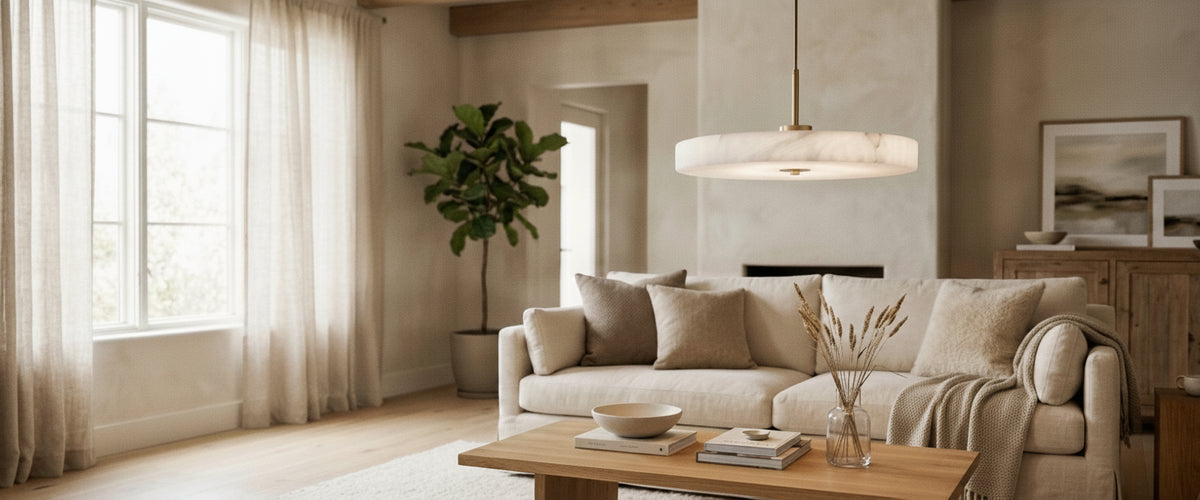

Most living room smart lighting projects fail on the very first evening. The app pairs, the bulbs cycle obediently through pink and teal, and the room still feels like a departure lounge. The technology worked; the lighting design never existed. Smart control only changes how you operate a room that has already been lit properly, and if the fixtures, positions and light quality are wrong, no amount of automation rescues them. At Niori, where we make alabaster and natural-stone lighting for homes and hospitality projects, we see the pattern constantly: clients arrive with a hub, a routine and no plan for where the light itself comes from.
An alabaster pendant dimmed to a third of output does more for a room than a grid of tuneable spots.

At a Glance
Design the layers first. Ambient, task and accent. Then decide what needs to be controllable.
Fixtures with integrated LED and a driver are usually easier to dim smoothly than a stone pendant fitted with a retail smart bulb.
Warm-dim beats colour-changing nine evenings out of ten. Colour is a party trick; warmth is what you live with.
Older UK homes often lack a neutral at the switch, which rules out many smart switches unless you rewire or move control into the fitting.
Three or four scenes are plenty. Anything more and you will reach for the wall plate anyway.
Always use a qualified electrician for any fixed wiring, switch replacement or new circuit.

Layer the Room Before You Choose a Protocol
Ask what each part of the room needs to do after dark. A sofa needs low, sideways light at roughly seated eye level, not a downlight boring into the top of your head. A reading chair needs a focused pool. A fireplace or a stone chimney breast wants grazing light that flatters texture. Once those jobs are written down, the shopping list writes itself, and whether you run Zigbee, Thread, Bluetooth mesh or a wired system becomes a technical footnote rather than the headline decision. Good smart living room lighting starts as a lighting plan and only later becomes a network.
This is where material choice does more work than software. Alabaster is translucent, so a pendant or wall light in stone behaves like a lamp and a light source at once: the shade itself glows, spreading soft light across the ceiling and walls rather than punching a hard circle into the rug. In a living room, that diffusion is worth more than a hundred colour presets. Browse the range at alabaster lighting to see how differently a carved bowl, a slab wall light and a table lamp shape the same wattage.
Which Fixtures Take Smart Control Well
Not every fitting is a good candidate for living room smart lighting. Decorative pieces with exposed lamps, multi-lamp chandeliers and anything using a screw-in smart bulb are the fussiest, because you are asking a mass-market bulb to dim smoothly inside a fitting it was never matched to. Stone shades are unforgiving here: alabaster's veining acts like a magnifying glass for flicker and for the colour shift many cheap LEDs produce at the bottom of the dimming range. In the studio we keep an offcut panel of alabaster over a test rig for exactly this reason, and the difference between a good driver and a bad one is visible within seconds.
Easier candidates are fittings with a dedicated LED module and a specified driver, plus plug-in table and floor lamps controlled by a smart socket or an in-line dimmer. If you are shopping bulb-first, remember that most living room smart lights sold as starter kits were designed for plain drum shades rather than carved stone. Wall lights on a dedicated circuit are excellent, because they can be dimmed as a group without touching the room's brightest fixture. If you are building a scheme around living room smart lighting, keep the number of independently dimmed circuits to three or four and give each one a job, rather than making every fitting individually addressable.
One practical note on stone. Solid alabaster and marble shades carry real weight, and a lath-and-plaster ceiling in a Victorian terrace needs proper fixing into a joist or a noggin. A larger stone pendant can weigh well over 9 kg (20 lb), and that is a conversation to have before the electrician arrives, not after.
Warm-Dim Versus Colour-Changing on a Wednesday Evening
Colour-changing systems sell on the showroom demo. Warm-dim sells on the tenth week of ownership. The typical smart light living room bundle leads with a colour wheel because colour photographs well, and then sits at soft white for the next three years. A warm-dim fixture shifts from around 2700K at full output down towards 2200K or lower as you dim it, mimicking the way an incandescent lamp or a candle behaves. Your eye reads that shift as evening arriving. Through alabaster the effect is particularly good: the stone already pushes light towards honey and cream, so the last 20% of the dimming curve is where the room genuinely relaxes.
Tuneable white is the sensible middle ground if you want daytime flexibility, and it is worth specifying where a living room doubles as a home office. Full RGB has its place for a media wall or a run of concealed cove light, but keep it off your main decorative fixtures. Nobody sits under a green marble pendant twice. When you compare products, look for a high colour rendering index (CRI 90 or above) and a low minimum dim level, ideally 1% or better. Those two numbers predict how living room smart lighting actually feels far more reliably than the app screenshots do.
Two-Way Switching, Dimmers and the Wiring Realities
Here is the part the adverts skip. Many UK living rooms have two-way switching, typically one plate by each doorway. Retrofitting smart switches into a two-way arrangement is possible but rarely plug-and-play, and a large number of older homes have no neutral conductor at the switch box, because the lighting circuit was wired as a loop-in at the ceiling rose. No neutral means most smart switches will not work without a bypass module, a rewire, or moving the intelligence into the fitting itself.
Dimmer compatibility is the other trap. Leading-edge dimmers designed for filament lamps often behave badly with low-load LED drivers, producing buzz, flicker or a dead band at the bottom of the range. Most smart lighting living room complaints we hear begin here rather than in the app. Trailing-edge dimmers matched to the driver are the answer, and the Lighting Industry Association publishes useful guidance on LED and dimming compatibility. If you take one thing from this section: specify the fixture, the driver and the dimmer together as a set, and have a qualified electrician confirm the load and the circuit before anything is ordered.
A client refurbishing a Georgian flat in Bath found this the hard way. Beautiful alabaster wall lights, a hub, a sunset routine, and a flicker at low level that turned out to be a leading-edge dimmer left over from the previous owner. A twenty-minute swap fixed a fault that had been blamed on the light fittings for a month.
Wall lights on their own dimmable circuit carry the room at low level with almost no glare.
How Ceiling Lights, Wall Lights and Table Lamps Divide the Work
A living room works best when three tiers share the load and no single fixture is asked to do everything.
Ceiling layer: a pendant or chandelier over the seating group or coffee table, hung so the base sits roughly 2.1 m (7 ft) above the floor in a walkway and lower over a fixed table. This is your evening anchor, not your general illumination.
Wall layer: pairs of alabaster or marble wall lights flanking a chimney breast, a bookcase or a sofa. Dimmed to 30%, they carry the whole room and produce almost no glare.
Portable layer: table and floor lamps on smart sockets. The cheapest part of the scheme to change your mind about, and the most useful for reading.
Weight the control towards the wall and portable layers. When a scene calls for low light, the pendant should drop to a glow and the side lights should carry the room. That hierarchy is what makes living room smart lighting feel designed rather than automated. If you are still deciding which fixture types suit your ceiling height and room proportions, the full lighting collection is a reasonable place to compare pendants, wall lights and lamps side by side.
The Scenes Worth Programming
Four scenes cover almost every living room smart lighting setup:
Evening. Pendant at 25%, wall lights at 40%, table lamps on. Your default for six months of the year.
Reading. One focused lamp at full output, everything else low, so the contrast stays comfortable.
Film. Ceiling off, wall lights barely on, a little light behind the screen to reduce eye strain.
Clean and find. Everything at 100%. Unglamorous and used more than you expect.
Scenes that sound clever and die quietly: geolocation triggers that switch lamps on when a phone crosses a boundary, colour cycles tied to weather, and anything requiring voice commands longer than four words. Be careful with a hard sunset schedule too; in the UK it drifts by hours across the year, and a fixed 6pm routine looks absurd in June. Tie routines to sunset offsets rather than clock times.
A Buyer's Checklist for Living Room Smart Lighting
Map the seating, reading and feature areas before choosing any product.
Confirm whether your switch positions have a neutral conductor.
Decide between warm-dim and tuneable white; skip full colour on decorative fixtures.
Check CRI 90+, minimum dim level, and driver compatibility with your chosen dimmer.
Group circuits into three or four zones rather than dozens of addressable points.
Check ceiling fixing and fitting weight for stone pendants and chandeliers.
Ask for a sample or a detailed photo of the stone; alabaster veining varies piece to piece.
Book a qualified electrician for the fixed wiring and have them sign off the installation.
Care and Longevity
Stone lighting outlives most electronics, which is an argument for keeping the intelligence in the driver, socket or switch rather than embedded permanently in the fixture. Alabaster is a gypsum stone and relatively soft, so dust it with a dry, soft cloth and keep it away from water and household sprays. The Getty Conservation Institute publishes research on stone conservation that sets out why moisture and acidic cleaners are so damaging to soft, porous surfaces. Treat the stone as furniture and the electronics as replaceable, and a pendant bought today will still be working when its third generation of control system arrives.
Budget for living room smart lighting depends on material, scale, the complexity of the carving, the driver and control specification, and the installation itself, so ask for a tailored quote rather than working from a headline figure. If you want to talk through a room, the team at Niori can advise on fixture type, sizing and dimming before you commit to a control system.