
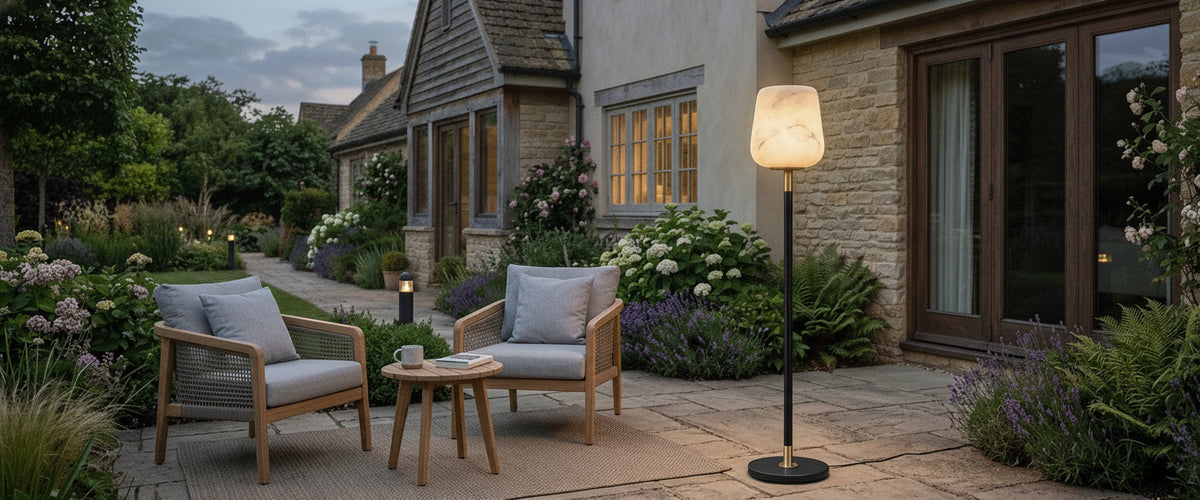

Most cordless garden lighting fails for a dull reason: nobody asked where the lamp would spend the night. An outdoor rechargeable floor lamp bought for a covered loggia and then left on an open lawn through February is not a design mistake, it is a specification mistake. Get the exposure question right and an outdoor rechargeable floor lamp becomes the most useful light you own, moving from the dining table to the pergola to the poolside corner as the evening drifts. Get it wrong and you are looking at a swollen battery, a fogged diffuser and a brass collar that has gone green by spring.
The short definition: an outdoor rechargeable floor lamp is a freestanding, battery-powered luminaire, usually between 40cm and 150cm tall, built around an integrated LED source, a weather-rated sealed body and a USB or cradle charging point. It runs for a few hours per charge with no fixed wiring at all. That last detail is both the appeal and the limitation, in the same sentence.

Key Takeaways Before You Buy
Exposure first, style second. Covered terrace, semi-covered pergola and fully open garden are three different briefs with three different IP requirements.
IP44 is a splash rating, not a weather rating. For an outdoor rechargeable floor lamp that stays outside year-round, look for IP65 or better, plus a sealed charging port.
Assume about a third of the quoted runtime. Battery claims are usually measured at the lowest dimmer setting, in a warm room.
Warm light wins outdoors. Aim for 2700K to 3000K; anything cooler makes planting look grey and faces look tired.
Alabaster and marble belong under cover. Gypsum alabaster is water-soluble and should never take direct rain, which is why our stone pieces live on sheltered terraces and interiors.
Charging cradles and hardwired alternatives need a qualified electrician the moment you introduce a permanent outdoor socket or fixed wiring.
Rule of thumb: buy for the worst weather the lamp will actually stand in, not the weather you are picturing on the day you buy it.

The Covered Terrace Versus the Open Garden
Exposure changes everything about an outdoor rechargeable floor lamp, and it is the one question showrooms rarely ask. A deep loggia with a solid roof and two walls behaves almost like an interior: no direct rain, limited wind-driven spray, stable-ish temperatures. A pergola with slatted timber or planting overhead is semi-exposed; water gets through, but slowly and unevenly. A lawn, a gravel path or an open roof terrace is full exposure, where the lamp takes rain, wind, frost, UV and, near the coast, salt.
Those three conditions justify different money and different materials. On a covered terrace you can use finer finishes, softer stone and more delicate detailing, because the lamp is sheltered and easy to bring indoors. The same outdoor rechargeable floor lamp in an open position needs a sealed, gasketed body, a diffuser that will not craze in sunlight, and a base heavy enough to stay upright in a gust. We had a client on the north Cornish coast who worked this out the hard way: two seasons of salt air had pitted the unlacquered brass on a set of garden lamps while an identical pair, ten feet (three metres) inside a covered veranda, still looked new. Same product, different postcode within the same garden.
The Same Lamp, Four Different Names
Retail listings are inconsistent, which makes comparison harder than it needs to be. An outdoor rechargeable floor lamp, a rechargeable outdoor floor lamp and a filter labelled outdoor floor lamp rechargeable all describe one category: a portable, battery-powered, weather-rated freestanding light. You will also see rechargable outdoor floor lamps spelled exactly that way on marketplace listings and in search suggestions. None of those labels tells you the IP rating, the runtime at full output, or whether the cell can be replaced when it dies, so ignore the wording on the tile and read the specification underneath it.
Where a Rechargeable Outdoor Floor Lamp Earns Its Keep
Cordless lighting is at its best where you cannot or should not run a cable. Long dining tables on a terrace, a corner sofa on decking, a poolside seat where trailing flex would be genuinely dangerous, a balcony with no exterior socket. An outdoor rechargeable floor lamp also solves the rental problem: no drilling, no chasing walls, no electrician invoice for a fixture you will take with you when you move.
There are four situations where an outdoor rechargeable floor lamp is the wrong answer, and they are worth saying plainly. If you need light every night at consistent output, from dusk to midnight, a wall light on a permanent circuit will always beat a battery. Steps, thresholds and level changes want fixed light for safety reasons, not a portable that might be flat. Wide-area wash across a garden wall or a facade needs the wattage a mains fixture can carry. And any hardwired outdoor work should go to a registered electrician; exterior circuits, RCD protection and cable routing are not weekend jobs. Where fixed lighting makes sense, our sculptural stone wall lights and pendants for sheltered porches and loggias sit in the wider lighting collection, and they pair well with cordless portables used as accent light.
IP Ratings and Casing Materials That Survive the First Winter
The IP code is two digits: solids, then water. The second digit is the one that matters here. IP44 means protection from splashing water, which is fine under a solid roof. IP54 adds dust protection but exactly the same splash-level water resistance, so it is not the rain upgrade it looks like. IP65 means low-pressure jets of water from any direction, and it is the sensible floor for an outdoor rechargeable floor lamp that lives outside permanently. The classification comes from BS EN 60529, published by BSI, and it is tested on new products in laboratory conditions, so treat it as a ceiling rather than a promise after three years of gasket compression.
Casing material decides the rest. Powder-coated aluminium is the workhorse: light, corrosion-resistant, forgiving. Stainless steel is stronger but shows salt spotting. Solid brass ages into a warm patina if you accept the patina; if you want it bright, expect regular polishing and a lacquer that will eventually need renewing. Polycarbonate diffusers resist impact but yellow under UV over time; acrylic stays clearer for longer but chips. Where the exposed corner of a garden needs a coated body and a low, warm output rather than a decorative finish, an outdoor rechargeable floor lamp such as the Veloxis Rechargeable Outdoor LED Floor Lamp 1.5W 3000K in brown is closer to the right design language than anything carved. On the natural-stone side, the honest answer is that most decorative stone wants shelter. Gypsum alabaster is soft and dissolves slowly in water, which is why conservators treat it as an indoor material; the CAMEO materials database at the Museum of Fine Arts, Boston, notes its solubility and vulnerability to moisture. Sealed marble and dense granite cope better with a covered terrace. Onyx and alabaster are terrace-and-interior materials, full stop.
Battery Life and Brightness: The Real Numbers
Quoted runtimes are marketing figures, and they are almost always measured at the lowest of three or four brightness steps. A lamp advertised as lasting a long evening on full output usually manages far less once you actually turn it up. Our rule of thumb from testing portables in the studio: whatever the box says for an outdoor rechargeable floor lamp, plan for about a third of it at maximum brightness, then be pleasantly surprised.
Brightness itself is where expectations need managing. Cordless outdoor lamps typically produce a fraction of the output of a mains fixture, because the battery has to last. That is fine, because outdoor ambient light does not need to be bright; it needs to be low, warm and placed well. Two or three modest pools of light at knee and table height read far better than one harsh flood. Look for stepped or stepless dimming, a colour temperature in the 2700K to 3000K band, and a high colour rendering index if the lamp will light food, skin or planting.
Cold matters too. Lithium cells lose usable capacity below roughly 5C (41F), so a winter evening will shorten runtime noticeably. Charging a very cold battery is worse than storing it cold, so bring the lamp indoors, let it reach room temperature, then charge. Look for USB-C rather than a proprietary barrel plug, and check whether the charging port has a screw-down or gasketed cover. That little rubber bung is the single most common weak point on an outdoor rechargeable floor lamp, and it is the first thing to inspect in a shop.
What Fails First, and the Build Details That Delay It
An outdoor rechargeable floor lamp tends to fail in a predictable order. Gaskets harden and shrink. Charging port covers tear or go missing. Batteries lose meaningful capacity after a few hundred cycles. Switches and touch dimmers admit moisture. Diffusers yellow. Coated finishes chip at the base where the lamp gets dragged across stone paving.
The build details worth paying for are unglamorous. A replaceable battery, ideally user-serviceable, roughly doubles the useful life of the lamp. Stainless or brass fixings rather than mild steel, so nothing weeps rust down the body. A recessed switch rather than a proud one. A felt or rubber foot that protects the base and the terrace. Weight low in the body, so the lamp does not tip. And service support: ask whether spares exist before you buy, because a sealed unit with a dead cell is landfill. When the lamp does reach the end of its life, both it and its battery belong at a proper recycling point rather than the household bin.
Placement Case Studies for Three Common Spaces
The Pergola
Slatted overhead structures create wonderful shadow patterns and terrible weather protection. Place outdoor rechargeable floor lamps at the corners of the seating area rather than the centre, so light grazes upward across the timber and the planting rather than glaring into eyes. Two lamps diagonally opposite beat four in a row. Scale matters more than output here: a low, wide piece around 55cm, such as the Luxtra Outdoor LED Floor Lamp 18W 3000K in brown, throws light up into the structure without sitting in anyone's eyeline, whereas a tall stem does the opposite. If the pergola has a solid section, that is where a stone piece can live.
The Outdoor Dining Area
Light the table from beside it, not on it. A floor lamp positioned just off the corner of the table, at roughly shoulder height when seated, gives a flattering side wash without a centrepiece competing with the food. Keep the output low and warm; you want to see the wine, not the tablecloth weave. On covered terraces we often see a hybrid setup: a sheltered alabaster pendant or wall light providing the soft background glow, then a portable filling the darker end of the table. The translucent stone pieces in our alabaster lighting collection do that background job especially well, because the veining scatters light instead of throwing it.
The Poolside Corner
Water and cables do not mix, which is exactly why an outdoor rechargeable floor lamp works here. Set lamps back from the coping, on a stable surface, and use the lowest setting; reflections off water amplify output considerably. Check local requirements for anything electrical near a pool, and if a permanent fixture is involved, that is an electrician's job every time. Salt or chlorine atmospheres also argue for aluminium and stainless over unprotected brass, so a coated body in a pale finish like the Veloxis Rechargeable Outdoor LED Floor Lamp in white will hold its appearance better than a polished metal that spots and pits within a season.
A Short Buying Checklist
Ten questions to answer before you pay for any outdoor rechargeable floor lamp:
Define exposure: covered, semi-covered or open. Buy to the worst case, not the best.
Check the second IP digit: IP44 for shelter, IP65 or above for permanent outdoor use.
Inspect the charging port cover and ask whether the battery is replaceable.
Ask for runtime at maximum brightness, not the headline number.
Confirm colour temperature sits between 2700K and 3000K, with dimming.
Match materials to atmosphere: coastal salt, chlorine and hard water all attack finishes differently.
Plan winter storage: somewhere dry, frost-free, charged to roughly half.
Keep stone under cover: alabaster, onyx and soft marble are for sheltered terraces and interiors.
Buy in pairs or threes for larger terraces; low, repeated light beats one bright source.
Budget honestly: material, scale, engineering, battery quality and finishing all move the price, so compare like with like rather than by headline figure.
Where Niori Fits
Niori works primarily in alabaster and natural stone, so we are candid about the boundary: the translucent, honey-warm glow that makes carved stone worth owning comes from a material that hates standing water. Our pendants, chandeliers, wall lights, table lamps and floor lamps are made for interiors and sheltered outdoor rooms, where diffused stone light does something a sealed aluminium portable never will. Use a good outdoor rechargeable floor lamp for the exposed positions, use stone where it is protected, and the two systems flatter each other rather than compete. If you are planning a terrace scheme and want a second opinion on which zones need fixed light and which want an outdoor rechargeable floor lamp instead, the Niori team is happy to talk it through before you commit.