
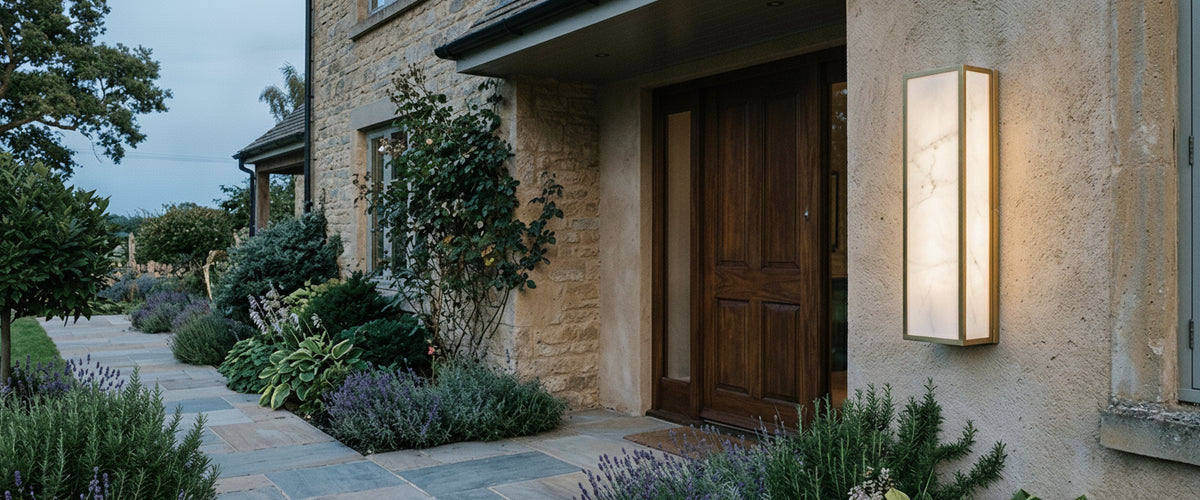

The most common reason a garden wall stays dark is not budget or taste. It is a trench. Running armoured cable across a terrace, under a path or through a listed wall turns a two-hour job into a fortnight of quotes, and plenty of people simply give up and live with a dim security floodlight. rechargeable outdoor wall lights exist to break that deadlock, and when they are specified properly they do it well. When they are specified badly, you end up charging six dead lamps every Sunday in February and wishing you had paid the electrician.

At a Glance
- The real benefit is siting freedom. No cable run means you can light the wall that actually needs light, not the one nearest the fuse board.
- Runtime figures are lab figures. Quoted hours for rechargeable outdoor wall lights usually assume the lowest brightness setting at room temperature, not 2°C in a Yorkshire January.
- IP44 is a starting point, not a badge of honour. Check the rating against the exposure of that specific wall.
- Finish outlasts form. Matte powder-coated black and textured graphite weather far more gracefully outdoors than polished brass.
- Alabaster stays indoors. It is a gypsum stone and water is its enemy, which is why Niori keeps alabaster and natural-stone pieces to interiors and sheltered spaces.
- Four scenarios still call for wired fixtures. They are listed at the end of this piece.

The Wiring Problem Rechargeable Outdoor Wall Lights Were Invented to Solve
Exterior lighting is expensive because of civil work, not because of fixtures. A single wall light on a boundary wall twelve metres from the house needs a route, a depth of dig, protective ducting, a suitably rated circuit and an electrician willing to certify it. Multiply that by four elevations and the lighting scheme quietly becomes the second most expensive line on the landscaping quote.
Rechargeable outdoor wall lights sidestep the whole chain. The fixture carries its own lithium cell, charges over USB-C or a magnetic dock, and mounts on a bracket, keyhole plate or magnetic base. Because there is no cable to anchor the position, you can hold the light against the wall at dusk, look at where the beam lands, and move it 200mm left before you drill anything. That is a genuine luxury. Most wired schemes are designed on a plan and corrected afterwards with regret.
There is a second, less obvious advantage. Portability. We have had clients who move the same pair of rechargeable outdoor wall lights between a courtyard wall in summer and a hallway console in winter, treating them as furniture rather than fittings. That is only possible when there is no cable in the equation.
Rented Walls, Listed Facades and Gardens You Do Not Own
The calculation changes completely the moment the wall is not fully yours to modify. A tenant cannot chase a cable into brickwork. A leaseholder often cannot touch the external envelope at all. And on a listed building, drilling and cable routing on a principal elevation can require consent, which is a slow conversation with the local authority and not always a successful one.
outdoor rechargeable wall lights are the pragmatic answer in all three cases. A magnetic base on a discreet steel plate, or a two-screw bracket into a mortar joint rather than the face of the brick, leaves a repairable mark instead of a permanent alteration. We shipped a pair to a client with a Georgian terrace in Bath who had been quoted for external wiring, refused consent on the front elevation, and ended up with a pair of rechargeable outdoor wall lights, up-and-down units flanking the door on removable plates. The scheme reads as though it was always meant to be there.
Rented gardens follow the same logic. If you are likely to move within a few years, spending four figures on buried cable that stays behind is a poor allocation. Rechargeable wall lights outdoor come with you.
Battery Runtime Claims Versus a Real British Winter
Here is where most disappointment with rechargeable outdoor wall lights starts. Manufacturers quote runtime honestly, but they quote it at the kindest setting: minimum brightness, a fresh cell, a warm room. Turn the light to full output on a cold night and the picture shifts considerably. Lithium cells lose usable capacity as temperature drops, and an exposed north-facing wall in Cumbria in January is not a laboratory.
Layer on the other British problem: darkness. Between late November and mid-January you can be looking at sixteen hours of dark per day. If the light is on from 4pm to 11pm, that is seven hours of duty, every night, in the coldest conditions of the year. A fixture that comfortably lasts a summer evening at 20 per cent brightness may need charging every second day in midwinter.
Practical fixes that actually work:
- Buy in pairs plus one. Rotate a spare on charge so a light is never off duty.
- Use the dimming steps. Most rechargeable outdoor wall lights offer three or four levels; the second-lowest is usually plenty for a doorway or path edge and multiplies runtime dramatically.
- Prefer fixtures with a removable or dock-charged battery module so you are not carrying the whole fitting to a socket.
- Bring lights indoors during long freezing spells if the wall is fully exposed. Charge at room temperature, not in an unheated garage.
- Choose warm colour temperature, roughly 2200K to 2700K. It reads better against brick and stone at low output, and low output is where you want to live. The Energy Saving Trust has sensible general guidance on LED output and efficiency if you want the numbers.
IP Ratings, Finish Weathering and Why Matte Beats Polished
The IP code is two digits: solids first, water second. IP44 means protection against splashing water from any direction, which suits a sheltered porch or a wall under an overhang. IP54 and IP65 step up to dust protection and directed water jets, which is what an exposed coastal or open-garden wall really needs. The rating system is defined internationally, and the IEC's own explanation of IP ratings is worth two minutes of reading before you buy anything for a wet wall.
One caution specific to rechargeable outdoor wall lights: the charging port is the weak point. A rubber bung that gets left open after charging turns an IP65 light into an IP-nothing light. Magnetic contact charging or a fully sealed removable cell is the better engineering answer.
On finishes, we are firmly on one side of this argument. Matte powder-coated black, textured graphite and off-white all age quietly outdoors. Polished brass does not. Unlacquered brass will patinate into a warm brown and eventually a green-flecked verdigris, which some people love and most people did not expect. Lacquered brass is worse in exposure, because the lacquer fails unevenly, giving you bright patches next to dull ones. Aged and antiqued brass sits between the two: the finish has already started its life cycle, so weathering looks intentional rather than like a fault. If you want brass on a sheltered porch or loggia, buy aged brass and accept that it will keep moving; something like the Ashstead LED Rechargeable Wall Light in Aged Brass starts from a settled, softened surface rather than a mirror one, so the next few winters read as character rather than damage.
Mounting Height and Beam Angle Without a Cable to Anchor the Decision
Freedom of placement means you actually have to think about placement. A few rules we use in the studio:
- Doorways: centre of the fixture around 1.9m to 2.1m (roughly 6ft 3in to 7ft) from the ground, slightly above eye line so the source is never in direct view.
- Path and boundary walls: lower, around 1.4m to 1.6m, with a narrow downward beam. Anything higher spills into a neighbour's window.
- Up-and-down fixtures: these live or die on wall texture. Against smooth render they produce two flat cones and look cheap. Against brick, flint, limestone or rough stucco the grazing light picks up every ridge, which is the whole point. Where the wall has that texture and you want the hardware to stay quiet, a slim matte body such as the Conchita Rechargeable Up Down 32cm Wall Light in Matt Black gives a taller pair of cones for a full-height elevation, while the 22cm version suits narrower piers and gate posts.
- Spacing: keep repeated wall lights on a consistent rhythm, typically 2.5m to 4m apart, and align them with architectural features such as window centres rather than splitting the difference between them.
- Test first. Charge the light, hold it up on two evenings at different times, then drill. Rechargeable outdoor wall lights are the only category where this is easy, so use the advantage.
Four Situations Where Wired Still Wins
- Security and access lighting. Anything that must be on, every night, without human intervention needs a permanent supply. A battery that dies at 2am on the one night it matters is a failure of design, not of luck. Where a circuit already reaches a sheltered entrance, a straightforward lamp-holder fixture such as the Helsingor Outdoor Wall Light in Black is the more sensible choice, with an IP44 rating and an E27 lamp you can swap for output and colour temperature.
- Commercial and hospitality entrances. Venues have duty-of-care obligations around lit access routes. Staff will not reliably charge fourteen fittings. Wire them and be done.
- High or awkward mounting positions. If retrieving the light means a ladder, you will not charge it often enough. Above roughly 3m, go wired.
- Large integrated schemes. Once you want dimming, zones, timers or app control across a whole facade, a wired circuit with proper drivers gives control that individual battery units cannot match.
In all four cases, exterior wiring should be designed and certified by a qualified electrician. It is not sensible DIY, and the certification matters for insurance as much as safety. None of this makes rechargeable outdoor wall lights a lesser product; it makes them a specific one, best used where the cable run is the genuine obstacle.
Where Alabaster Belongs in an Outdoor Scheme
People ask us for alabaster outdoor wall lights fairly often, and the honest answer is that alabaster should not go on an exposed wall. Alabaster is a fine-grained gypsum stone, soft enough to scratch with a fingernail, and it is slightly soluble in water. Frost, rain and freeze-thaw cycling will craze and pit it within a season or two. Conservators keep alabaster sculpture indoors and away from damp for exactly this reason.
What works instead is a considered handover. Weather-rated metal, glass and stone-composite fixtures handle the exterior; alabaster and marble carry the warmth the moment you step inside. That transition is one of the most satisfying effects in domestic lighting: a crisp matte-black up-and-down light on the porch, then a softly glowing alabaster wall light or pendant in the hall behind the door. Browse the alabaster lighting collection when you plan the interior side of that threshold, and think about colour temperature continuity so the two sides of the door do not clash.
A covered loggia or a fully sheltered porch with no wind-driven rain is the only grey area, and even then we would specify a sealed fixture and check for standing damp. If you want the stone look outdoors, choose a fixture in a dense weather-stable material and save the translucent stone for the rooms where its glow can actually be appreciated. Our wider lighting range is organised to make that indoor-outdoor pairing straightforward.
Buyer's Checklist for Rechargeable Outdoor Wall Lights
- Confirm the IP rating against the actual exposure of the wall, not the general area.
- Check how the light charges: sealed magnetic contacts or a removable cell beats a rubber-bung USB port.
- Ask whether the battery is user-replaceable. Cells degrade; fixtures should not become disposable.
- Look for at least three brightness levels and a memory function that recalls your last setting.
- Choose 2200K to 2700K for warmth against brick, stone and timber.
- Prefer matte or aged finishes; expect polished brass to change.
- Buy one more than you need so charging never leaves a dark gap.
- Check bracket type against your wall: mortar-joint fixings are kinder to listed and rented walls than face-of-brick drilling.
- Plan the interior fixtures at the same time so the scheme reads as one decision.
Budget for outdoor wall lights, rechargeable or wired, depends on material, scale, engineering, finish quality and installation, so the sensible route is to describe the wall, the exposure and the effect you want, and request a tailored quote rather than working from a headline figure.
Used well, rechargeable outdoor wall lights are not a compromise. They are the right tool for walls you cannot or should not cable, and they let you test a lighting idea before you commit to it. Used badly, they become six flat batteries and a dark garden. The difference is entirely in the spec.