
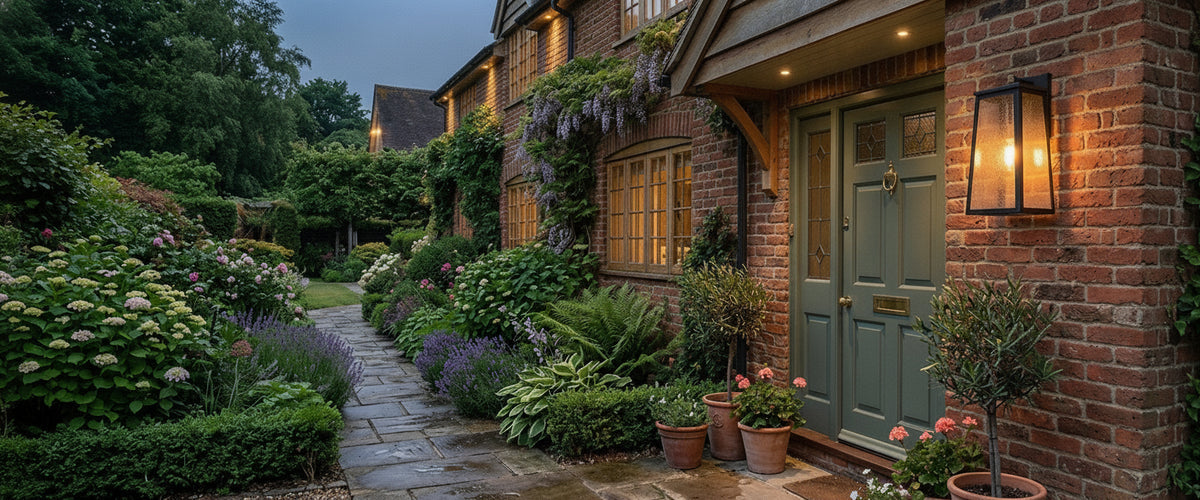

Rust bleeding down white render is one of the most common repair jobs on a British front elevation, and the culprit is almost always a badly specified lantern. Type outdoor wall lantern black into any search bar and you get a thousand near-identical thumbnails; the one that arrives is light in the hand, looks right for a season, and by the second winter the paint has lifted around the fixings, the gasket has hardened, and there is a brown tidemark under the backplate that no amount of scrubbing will shift. Outdoor wall lantern black listings rarely say what sits underneath the coating, which is exactly why so many of them fail early. The lantern form is the oldest exterior fitting we have and still the best for most doorways, so when a black outdoor wall lantern fails, blame the finish, the ingress protection, and the lamp choice rather than the shape itself. Buying well from the outdoor wall lantern black category is a materials decision wearing the costume of a style decision.

Black Outdoor Wall Lanterns at a Glance
Finish first. Powder coat over untreated mild steel is the shortest path to rust, and a good deal of what sells as outdoor wall lantern black is exactly that. Ask what sits beneath the black.
IP44 is a starting point, not a target. Covered porches still see wind-driven rain; IP54 or IP65 is the sensible specification for anything within a metre or two of the weather.
Warm lamps only. 2200K to 2700K inside a black outdoor wall lantern. Anything cooler reads as security lighting.
Mount to the light, not the door. Roughly 1.8m to 2m (6ft to 6ft 6in) above the finished ground level puts the glow on the threshold rather than in your eyes.
Scale to the wall material. Brick, render, and timber cladding each carry a different visual weight, and each wants a different projection.
Light escaping through several glazed faces of a black outdoor wall lantern washes the surrounding brickwork instead of cutting a hard scallop down the wall.

Why the Lantern Form Casts Light Differently
A flat exterior fitting, the kind with a single downward aperture or a slim up/down profile, throws light in defined planes. Two beams, hard edges, a clean scallop on the wall. It is architectural and it suits a modern elevation, but it leaves the space between the beams dark.
A black outdoor wall lantern does something else. Because light escapes through four or six glazed faces before it reaches anything, the fitting itself becomes a small glowing object, and the surrounding brick or render picks up a soft ambient wash. You see the fitting; you also see the wall around it. That matters at a front door, where the job is partly practical (find the keyhole, see the step) and partly welcoming. It matters less down the side return, where a shielded fitting is usually the better call and something like the Alana Outdoor Up/Down Wall Light in black will put light exactly where it is needed without lighting the neighbour's window.
The trade-off is glare. Clear glass in an outdoor wall lantern black finish at eye level will dazzle anyone approaching. Seeded, reeded, or lightly frosted glass solves it without killing the output, and it is the single detail most buyers overlook when comparing two similar lanterns online.
Outdoor Wall Lantern Black Finishes: Powder Coat or Hot-Dip Galvanising
Black describes a finish. The phrase outdoor wall lantern black says nothing about the material carrying that finish, and "matt black" tells you nothing at all about what happens in year five. Three constructions dominate the outdoor wall lantern black market.
Powder-Coated Aluminium
Aluminium does not rust. It oxidises to a stable grey surface, so even if the powder coat chips near a fixing, you get a small blemish rather than a spreading stain. For most urban and suburban homes this is the practical default for an outdoor wall lantern black finish. Look for marine-grade or low-copper aluminium if you are anywhere near salt air.
Powder-Coated Steel
Heavier, crisper edges, and a satisfying feel in the hand. It also depends entirely on the coating staying intact. One drilled hole, one knock from a wheelie bin, and moisture gets underneath. Most budget outdoor wall lantern black stock is built this way, and it is the construction that produces the tidemarks. If you want a steel outdoor wall lantern in black, you want it galvanised before it is coated.
Hot-Dip Galvanised and Then Coated
Steel dipped in molten zinc gains a metallurgically bonded layer that corrodes sacrificially in place of the steel beneath. Coating over that (a duplex system) gives you both colour and long-term protection, and the Galvanizers Association notes that the combined life of the two systems typically exceeds the sum of each used alone. For coastal Norfolk, exposed Pembrokeshire, or anywhere road salt gets thrown up in winter, this is the specification worth paying for when you shortlist outdoor wall lantern black options.
Solid brass and bronze lanterns finished in black sit slightly outside this comparison. They will not rust at all, and as the black finish wears at the corners, brass shows through as a warm highlight. That is the one case where an outdoor wall lantern black finish is supposed to age visibly. Some clients hate it. Others buy it specifically for that.
How Brick, Render, and Timber Change the Right Size
The same black outdoor wall lantern can look confident on one house and undersized on the next, and the wall material is usually why.
Brick has visual texture and a strong horizontal rhythm. A black outdoor wall lantern with a slim backplate tends to get lost against it; something with a bit of shoulder and a projection that casts its own shadow on the brickwork reads far better. Victorian terraces in particular carry a taller, narrower lantern well.
Painted render is unforgiving. Flat, pale, no texture to hide behind, so the silhouette is doing all the work and every fixing hole shows. Go slightly smaller than you think, keep the geometry clean, and be ruthless about drilling accuracy. On a narrow render panel beside a door, a compact cylinder such as the Atom black outdoor wall light in 10cm holds the wall better than an oversized lantern, while the 20cm version suits a broader elevation or a garage return where the smaller size would disappear. Render is also where corrosion staining under an outdoor wall lantern black finish shows up first, which loops back to the finish question above.
Timber cladding changes colour as it weathers, often towards silver-grey. A black outdoor wall lantern holds its own against that beautifully, but timber moves, so mount to a batten or a solid rail rather than trusting a single board.
Stone and flint walls need mass. A delicate outdoor wall lantern in black on a knapped flint elevation looks apologetic. Mounting into stone also demands the right anchors, which is one of several reasons a qualified electrician should be doing the installation rather than a confident weekend.
IP Ratings for UK Porches: Why IPX4 Is Often the Wrong Minimum
The IP code has two digits: solids first, water second. The second digit is what matters outdoors. IPX4 covers splashing water from any direction, which sounds adequate until you have stood in a Cornish porch in February. Wind-driven rain arrives horizontally and it does not care that there is a roof overhead.
As set out in the IEC's definition of IP ratings, the step up to 5 covers water jets and 6 covers powerful jets. For a genuinely deep, enclosed porch with a door on three sides, IP44 is defensible. For an open porch, a recessed doorway, or any wall that gets weather, specify IP54 as the floor for a black outdoor wall lantern and IP65 where the fitting is fully exposed or within reach of a pressure washer.
Two details buyers miss. First, gaskets are consumables; an outdoor wall lantern black finish wrapped around an accessible, replaceable seal will outlive a sealed unit. Second, a fitting mounted glass-face-up on a soffit collects standing water in a way a wall-mounted one never does, so soffit installations always want a higher rating than the porch wall beside them.
Warm Filament or Cool LED Inside a Black Outdoor Wall Lantern
The colour temperature gap that reads as subtle indoors becomes glaring outside. There is no ceiling bouncing light around, no pale plaster softening it, and everything the light touches at night is wet or dark. A 4000K lamp inside a black lantern turns brick a corpse-grey and makes a front door look like a service entrance.
Stay between 2200K and 2700K. A 2200K decorative filament LED, ideally dimmable, gives the amber flicker-free glow that suits a lantern's glazed faces. 2700K is the safe all-rounder if you also want the light to be useful for finding the lock. Outdoor wall lantern black fittings supplied with a stock lamp are usually shipped at 4000K, so check the box before you wire anything in. Cooler light also scatters more in the atmosphere and contributes disproportionately to sky glow, which is why warm, shielded exterior lighting is standard advice from dark-sky groups and increasingly from planning officers in rural parishes.
Check the CRI too. Above 90 and your brickwork, planting, and front door paint all keep their colour after dark. Below 80 and everything looks slightly ill. If your black outdoor wall lantern runs on a PIR sensor, confirm the lamp is compatible; some filament LEDs stutter on motion detectors designed for older loads. Where motion sensing genuinely matters, on a back door or a bin store, an integrated fitting such as the Eamon outdoor up/down wall light with PIR in black avoids the lamp compatibility question entirely, because the sensor and the light source are matched from the outset.
Mounting Height and Where the Light Lands
Centre the black outdoor wall lantern around 1.8m to 2m (6ft to 6ft 6in) above finished ground level, which usually sits just above the door head on a standard opening, so the pool of light reaches the step rather than your eyes.
Get this wrong and no amount of finish quality saves the installation. Mount higher and the pool of light spreads thin and misses the step. Mount lower and you are staring straight into the glass, whatever the glazing is doing to soften it.
For a pair of black outdoor wall lanterns flanking a double door, hold both at the same height regardless of any slope in the path, and set them out from the frame by enough that the light overlaps on the threshold rather than forming two separate puddles. On a stepped approach, mount to catch the step nosings; a shadow across a wet stone step is a genuine hazard, not a design quibble.
Where a doorway is narrow, one black outdoor wall lantern to the handle side beats two crowded ones. And if the path curves away from the house, resist the urge to make the lantern do that job as well. Low-level path lighting handles the walk; the lantern handles the arrival.
Your Pre-Order Checklist
Ask what a listing means by outdoor wall lantern black: the phrase describes a colour, not the base material underneath it.
Match the IP rating to actual exposure, allowing for horizontal rain in a covered porch.
Check whether gaskets and glass panes can be replaced later.
Choose glass type deliberately: seeded or frosted at eye level, clear only when mounted high.
Specify 2200K to 2700K, CRI 90+, and confirm dimmer or PIR compatibility.
Set mounting height from ground level, not from the door frame.
Ask about fixings for your wall type; stone, flint, and render all need different anchors.
Book a qualified electrician for the connection and earthing. Exterior circuits are not a DIY category.
Ask for a tailored quote on any outdoor wall lantern black specification rather than assuming a figure. Cost tracks material, finish system, glazing, engineering, and installation complexity.
The Threshold Moment: Matching Outside to Inside
Here is the detail that separates a considered entrance from a competent one. Stand outside at night with the front door open. You see the lantern's light and, beyond it, whatever is glowing in the hallway. If one is 2700K amber and the other is 4000K white, the eye reads the mismatch instantly, even if nobody can name what is wrong.
We had this exact conversation with a client in a converted coach house in Suffolk. They had specified black outdoor wall lanterns either side of the door and an alabaster wall light in the hall. The lanterns arrived with a stock 4000K lamp. Swapping to 2400K filament LEDs took ten minutes and did more for the entrance than the fittings themselves had.
Alabaster belongs on the inside of that threshold, always. It is a gypsum stone, soft and slightly soluble, so rain will etch it and frost will open its natural fissures. What it gives you indoors is the quality worth matching outside: a warm, low-glare glow that comes through the material rather than off it. If you are pairing an outdoor wall lantern black finish with something softer in the hall or stairwell, the alabaster lighting collection is where to start; the same stone reads very differently in a wall light than it does in a pendant. Across the wider niori lighting range, the through-line is that diffused, veined quality of light, and getting your exterior colour temperature to sit alongside it is the cheapest upgrade in the whole scheme.
Buy the lantern for the weather it will actually face. Light it warm. Mount it where the light needs to land. Do those three things and a black outdoor wall lantern will still look intentional in ten years, which is more than most exterior fittings manage.