

Most outdoor string lighting fail in the same few places: the first plug-in joint, the seal around a lamp holder, and the tree branch someone lashed them to back in August. By March the cable has gone chalky, one bulb in six is dead, and the whole run sags like wet washing. That is almost never bad luck. It is a spec problem, and it is fixable before you buy.
We spend most of our time at Niori on alabaster and natural-stone lighting for interiors, which means we get asked a very specific question by clients finishing a garden room or a terrace: what goes outside so the view through the glazing still hangs together? Outdoor string lights are usually the answer, and choosing them well is more technical than the product photography suggests.

Key Takeaways
- Mains beats solar for anything you want lit reliably between November and February. Solar string lights outdoor are a summer-terrace pleasure, not a year-round fixture.
- Festoon for dining, fairy for texture. Bulb spacing decides the effect more than bulb count does.
- 2200K to 2700K keeps the garden warm and flattering. Cool white belongs to frost and Christmas, not to a summer supper.
- IP44 is a minimum, IP65 is the sensible target for permanent runs, with RCD protection and a qualified electrician for any fixed outdoor socket.
- Catenary wire, not the cable itself, should carry the load on any span over a couple of metres.

Mains, Solar and Battery Compared Honestly
Let us be blunt about solar, because the category is full of optimistic marketing. A midwinter day in the UK delivers a small fraction of the usable light a June day does, and it often arrives through cloud at a low angle. outdoor solar string lighting charged under those conditions will give you a short, dimming run in the early evening at exactly the time of year you most want light. In July, with the panel angled properly and clear of shade, the same set will run happily until you go to bed.
So the honest rule is seasonal. Solar string lights outdoor suit a summer terrace, a pergola over a dining table used from May to September, or a rented garden where you cannot run a cable. Buy a set where the panel is on a separate lead rather than integrated into the first bulb holder, because panel placement is the single biggest variable in performance. A panel in dappled shade under an apple tree will never charge properly, however good the cells are.
Battery sets earn their place in one situation: short decorative runs where no supply exists and you accept changing cells. Mains-powered outdoor LED string lights are the choice for anything structural, anything above a dining area, and anything you expect to switch on in December. They also dim properly on a compatible controller, which solar rarely does.
Where Festoon Ends and Fairy Lights Begin
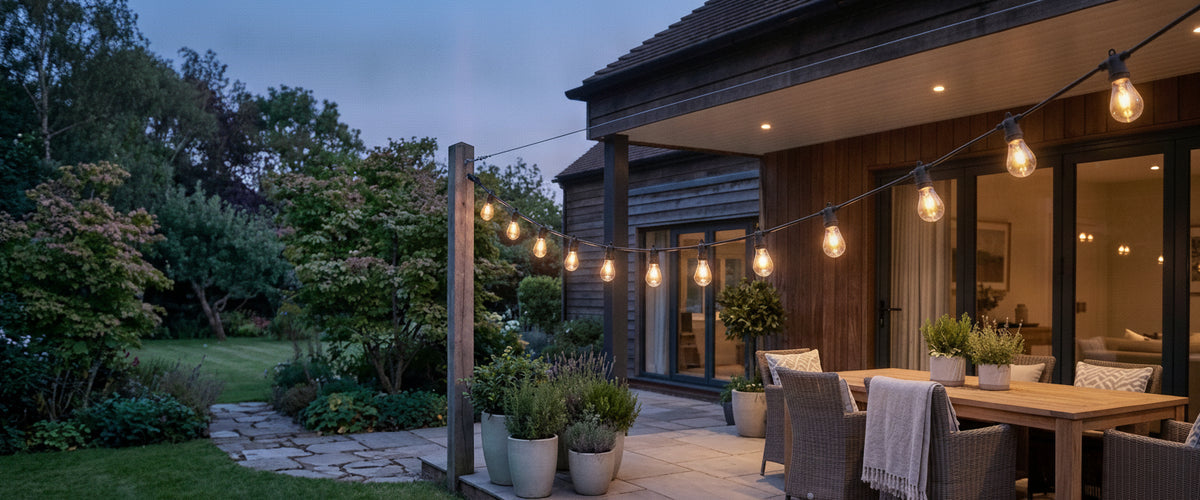
Bulb spacing is the design decision. Festoon runs typically space larger bulbs anywhere from around 20cm to a metre apart, and they read as architecture: a defined edge over a dining table, a line along a wall, a rhythm across a courtyard. Fairy lights sit far closer together and read as texture, which is why they work wrapped through planting, along a hedge line, or up a trunk where you want glitter rather than structure.
Colour temperature matters more outdoors than most people expect, because there is no wall bouncing light back to soften it. Warm amber at roughly 2200K flatters brick, timber and skin and blends with candlelight. A standard warm white around 2700K is a safer general choice and keeps foliage looking green rather than muddy. Cool white pushes towards blue, drains greens and makes a garden feel like a car park in June, but it is genuinely lovely against snow and frost. That seasonal split is the argument for a switchable set: where a terrace has to work for summer suppers and again in December, something like the LYYT 960 LED Outdoor String Lights in Dual Colour Warm/Cool White lets you change the mood without buying twice.
One trick worth stealing from our interiors work. If your kitchen or garden room is lit by alabaster pendants or stone wall lights, the glow reaching the glazing is warm and heavily diffused. Matching the garden to that temperature stops the outside reading cold and flat through the window at night. Clients who have specified pieces from our alabaster lighting collection for a rear extension almost always end up dropping the outdoor colour temperature to match. RGBA sets with a controller give venues even more room to tune the scene, though for domestic gardens they are usually more capability than anyone uses.
Catenary Spans, Pole Runs and Pergola Wraps
Three configurations cover almost every garden, and each one does a different job.
Catenary Spans
A stainless steel catenary wire fixed between two solid anchor points, with the string lights cable-tied along it, is the professional answer. The wire carries the tension; the light cable carries only itself. Use straining eyes into masonry (not mortar joints), turnbuckles at one end so you can retension after the first few weeks of settling, and allow a deliberate sag rather than pulling the run drum-tight. A taut wire transfers every gust straight into the fixings. Long spans usually need an intermediate support, and any span crossing a route where people walk needs enough clearance that nobody catches their head on a bulb.
Pole-to-Pole Runs
Where you have no walls to fix to, poles set into concrete or heavy planted pots give you a floating ceiling of light over a lawn or gravel terrace. Guy the end poles backwards, because the whole run pulls inwards once tensioned. This configuration is what turns an open patch of garden into a defined outdoor room, and it is the arrangement event hire firms default to for exactly that reason.
Pergola and Structure Wrapping
Wrapping a pergola gives the most controlled result because the structure does all the work. Run the cable along the top of beams rather than the underside where possible, so the fixings are hidden and rainwater cannot pool in a loop. Keep bulb spacing consistent across each bay; the eye picks up an irregular rhythm immediately.
IP Ratings, Cable Gauge and Fittings That Stay Clear
IP44 means protection against splashing water. It is a legitimate rating for a set you take down each autumn. For anything staying out through a winter of driven rain, aim for IP65 on the fittings and connectors, and pay particular attention to the joints, because that is where water gets in. Look for rubber-sheathed cable rather than thin PVC, moulded holders rather than screw-together ones, and gaskets you can actually see.
Cable quality is where the difference shows after two seasons. Thin PVC goes brittle and chalky under UV; a rubber flex holds up far better and stays flexible enough to coil in October without cracking. The same applies to the bulbs themselves: cheaper polycarbonate covers yellow within a season or two, while better-grade covers and glass bulbs stay clear. If you are extending a run, use a proper outdoor-rated extension cable with a sealed IP-rated connection rather than an indoor lead inside a plastic box; a black rubber lead such as the LYYT 5m IP44 Outdoor String Light Extension Cable keeps the joint sealed and the run tidy where the supply sits away from the anchor point.
On safety, every outdoor circuit should be RCD protected, and any new fixed outdoor socket or permanent supply is work for a qualified electrician rather than a weekend project. Electrical Safety First sets out clear guidance on garden electrics, and it is worth ten minutes of your time before you drill anything.
How to Hang Outdoor String Lights Properly
- Plan the run on the ground first. Lay the lights out and count bulbs per span so spacing lands symmetrically over the table or seating.
- Pick real anchor points. Masonry, structural timber or set poles. Never fence panels, never guttering, never a single branch.
- Fit the catenary wire before the lights. Tension it, walk away, come back and retension.
- Attach with UV-stable cable ties or wire clips at regular intervals so no load sits on the lamp holders.
- Form a drip loop below every connection so water runs off rather than into the joint.
- Keep the plug end high, dry and accessible, ideally in a weatherproof enclosure near the supply.
- Test the whole run before final fixing. Finding a dead section from a ladder is a miserable way to spend a Saturday.
- Photograph the layout if the set comes down seasonally. Reinstalling from a photo is far quicker than working it out again.
Layering Without the Garden Looking Busy
A garden lit entirely by string lights reads flat, because everything sits at one height. The fix is layering at different levels and letting each layer do one job. String lights give you the canopy. Wall lanterns near a door or along a boundary give a lower anchor and light the threshold. Discreet spike lights in planting give depth beyond the seating area, so the garden does not end in a black wall at the edge of the terrace.
Restraint matters. Choose two or three focal points and leave the rest dark; contrast is what makes lighting look designed rather than decorated. Keep aiming angles low and shielded, both for neighbours and for wildlife. DarkSky International publishes sensible guidance on reducing spill and glare, and the principles translate directly to domestic gardens.
Indoors, the same logic applies with warmer, heavier materials. A stone or alabaster wall light in a boot room or garden room reads as the interior equivalent of a lantern, and the diffusion through natural stone gives a glow that sits comfortably beside a warm festoon outside. Browsing the wider niori lighting range alongside your outdoor plan is worth doing early, because matching temperatures across the glazing line is much easier at the specification stage than after installation.
Permanent Versus Seasonal Installs
Seasonal sets can be lighter in every sense: lower IP rating, thinner cable, cheaper fixings, a plug-in transformer that lives in the shed for nine months. Outdoor Christmas string lights fall squarely here, and cool white or dual colour sets, icicle strings along a fascia and a controller with a timer make sense for six weeks of use.
Permanent installs change the spec in specific ways. You want IP65 or better, rubber flex, stainless or marine-grade fixings that will not bleed rust stains down render, and a supply on its own RCD-protected circuit with a timer or smart switch. For a span that stays up year-round over a terrace or courtyard, a heavier-gauge run such as the LYYT 180 LED Heavy Duty String Light 20m in Warm White is closer to the right specification than a decorative summer set, both in cable construction and in the length available before you need a join. Budget shifts too, because the cost sits in engineering and installation rather than in bulb count alone. That is also why the best outdoor string lights for a hospitality courtyard rarely resemble the set that suits a small back garden. If you are planning something structural across a venue or a large terrace, ask for a tailored quote based on span lengths, anchor conditions and how many hours a year the run will actually be on.
Get the electrics and the anchor points right and string lights outdoor become genuinely low-maintenance: a wipe of the bulbs each spring, a turnbuckle check, and years of evenings under a warm line of light.