
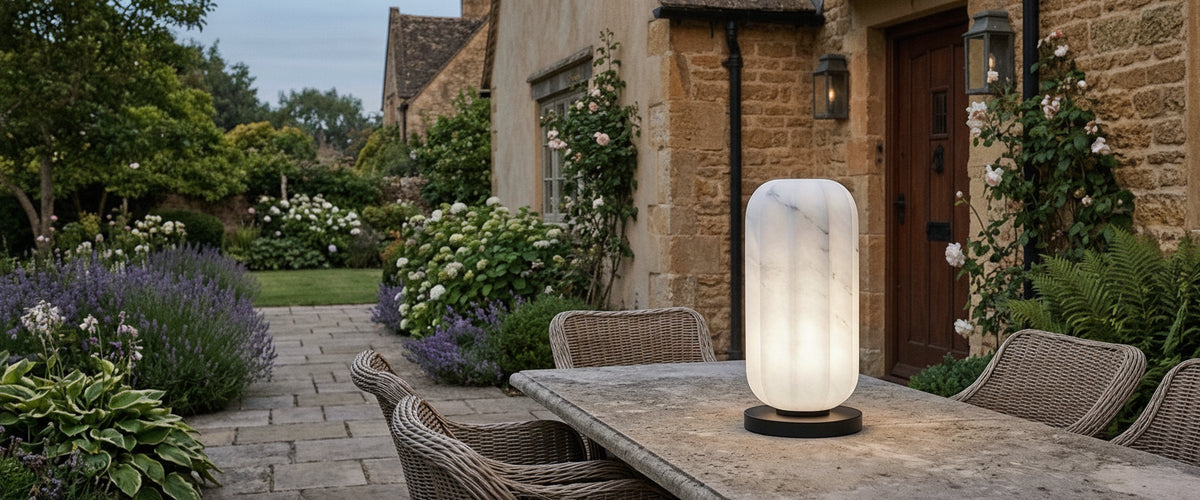

Most people buy their first outdoor rechargeable table lamps in June and forget about it by August. The battery drains faster than the listing promised, the light is a cold blue-white that makes everyone at the table look faintly unwell, and one heavy shower later the base has a tide mark it will never lose. That is a shame, because a good cordless lamp does something no wired fixture can: it puts warm light exactly where people are sitting, then moves when they do. The difference between the two outcomes comes down to a handful of specification details, and almost none of them are the ones product pages shout about. Get those right and an outdoor rechargeable table lamp will still be earning its keep five summers from now.

At a Glance: What Separates a Good Outdoor Rechargeable Table Lamp from a Disposable One
- IP54 is a sensible minimum for a table lamp that lives on a covered terrace. IP65 or above if it will be left out in driving rain.
- Warm light wins outdoors. Look for 2700K to 3000K. Anything above 3500K reads clinical once the sky goes navy.
- Battery claims are quoted at the lowest dim setting. Assume real-world runtime at usable brightness is a fraction of the headline figure.
- Wattage is low by design. Between roughly 1.5W and 3W is normal; these lamps are for atmosphere and table-level glow, not floodlighting.
- Real alabaster and onyx belong indoors. Gypsum alabaster is water-soluble. Outdoor lamps use cast aluminium, powder-coated steel, or UV-stable polymers instead.
- Plan the charging before you buy. Two sets of lamps rotating on a charging tray beats one set that dies mid-dinner.

Genuinely Outdoor-Rated versus Merely Weather-Tolerant
The IP code is two digits and each one has a job. The first digit covers solids, the second covers water. So IP54 means dust-protected and shielded against water splashing from any direction; IP65 means dust-tight and able to take a low-pressure water jet. The full definitions sit in IEC 60529, and the International Electrotechnical Commission publishes a plain-language summary worth reading before you spend anything.
Here is where buyers get caught. A rechargeable outdoor table lamps rated IP54 is entirely happy on a covered loggia, a pergola with a solid roof, or a garden table under an overhang. It is not designed to sit uncovered on a lawn through a February storm. Search for rechargeable table lamps outdoors and you will get thousands of near-identical results, plenty of them described as "weatherproof" or "garden-ready" without ever quoting a rating, which usually means the seal is decorative. If the number is missing, treat the lamp as an indoor piece that tolerates a warm evening on the patio.
The other half of the story is the charging port. Many outdoor-rated lamps only hold their rating with the USB-C cover firmly closed, and that little rubber flap is the first component to perish. Check that it is replaceable, or choose a lamp that charges on a contact base or magnetic puck instead. We have seen more lamps lose their rating at the port than anywhere else.
Battery Life versus Brightness: The Trade-Off Buried in Most Listings
Every outdoor rechargeable table lamp quotes a runtime. Almost every one of those figures is measured at the lowest dim step, where the lamp is producing a glow barely brighter than a tealight. Step up to the setting you will actually use over dinner and the number drops sharply. That is physics, not deception, but it does mean you should read a headline runtime as "a long evening at the brightness I want, then a recharge".
What matters more than raw runtime is how the dimming behaves. Good lamps use three or four discrete steps with a warm, stable output at every level and no visible flicker when the cell starts to drop. Cheaper drivers dim by cutting current in a way that shifts the colour slightly cooler as the battery falls, so by the end of the evening your table is lit in a different tone than it started. Sit with a lamp at its lowest setting before committing to a full set.
A practical rule for hosting: for a table of six, one lamp at the centre plus two at the ends gives better modelling on faces than a single brighter unit. Low wattage spread across several points beats one hot spot every time, and it means each lamp can run at a lower step and last longer. Where you are buying in multiples and want each point of light to stay quiet, a 1.5W fitting such as the Veloxis Outdoor Rechargeable LED Table Lamp in Matt Black is a more sensible starting point than one higher-output lamp fighting to cover the whole table. Buyers coming to our lighting collection for a terrace scheme are usually surprised by how little output they need once the light is distributed properly.
Where an Outdoor Rechargeable Table Lamp Earns Its Place
Cordless lighting is at its best where wiring is impossible, undesirable or simply not worth the disruption. A few situations where it genuinely outperforms a fixed fitting:
- Terraces and balconies with no outdoor socket, especially in flats where you cannot chase a cable through a party wall.
- Poolside and waterside tables, where keeping mains voltage away from water is the obvious answer rather than a compromise.
- Pop-up and seasonal dining: long tables laid out for a party, a marquee edge, a garden supper that migrates from the shade at 7pm to the sheltered corner by 9pm.
- Hospitality bar tops and covered terraces, where lamps are collected, charged overnight and redeployed every service.
- Steps, sills and low walls, used as portable markers rather than table lights. A small lamp on a step edge does more for safety than most people expect.
For hospitality use in particular, the lamp needs to survive being carried, stacked and wiped down every night, which usually points towards a slightly heavier body and a simple silhouette; something like the Solitus Rechargeable LED Outdoor Table Lamp in Black at 2.8W and IP54 sits in the right territory for covered terraces and bar tops.
We shipped a run of small cordless lamps to a wedding venue in Somerset last season. Their first order was one lamp per table, which worked beautifully until the third booking, when the staff realised there was no window in the day to recharge between two events. They bought a second set. Now the lamps rotate: one set on the tables, one set on a labelled charging tray in the back kitchen. That single change did more for the look of their evenings than any upgrade in specification would have.
Why Colour Temperature Matters More Outdoors at Dusk
Indoors, your eye has walls, artwork and other lamps to calibrate against. Outdoors at dusk it has almost nothing. The sky is dropping from amber to deep blue, the surroundings are losing colour, and an outdoor rechargeable table lamp becomes the single reference point for what "white" looks like. A 4000K source in that setting reads harsh and slightly institutional, and it makes food look grey.
Warm is the answer. Around 2700K to 3000K flatters skin, wood, linen and terracotta, and it sits comfortably against candlelight if you are mixing the two. Warm output also spills less disruptively into the garden and troubles wildlife less than cool white; the DarkSky lighting principles make a strong case for keeping outdoor light warm, shielded and no brighter than the task requires.
Colour rendering deserves a mention. A CRI of 90 or above keeps greens looking green and reds looking red, which matters when the lamp is lighting a table of food and a border of planting. Low-CRI LEDs flatten everything into a dull sameness, and outdoors there is no other light source to rescue it.
Materials: Why Real Alabaster Stays Indoors
This is the part where a stone lighting specialist has to be honest. Alabaster is gypsum, and gypsum is soft and soluble in water. Leave a piece outside through one wet British week and the surface will bloom, dull and eventually pit. Onyx and many decorative marbles fare little better: freeze-thaw cycles find their way into the natural fissures, and acidic rain etches polished faces. Conservators treat gypsum alabaster as a strictly interior material for exactly these reasons.
So the honest advice is this. Keep alabaster where it belongs, doing the thing it does better than any other material: glowing from within, softening a room, showing its veining when lit. A translucent alabaster table lamp in a garden room, orangery or sheltered veranda with a roof and glazing gives you the stone look outdoors without exposing the stone to weather. For an outdoor rechargeable table lamp on an open terrace, choose cast aluminium, powder-coated steel or a UV-stable polymer diffuser, and let the warm colour temperature carry the mood instead of the material. Cast aluminium is the most forgiving of the three on an exposed table, which is why a body like the Nomad Matt White Cast Aluminium Rechargeable LED Table Lamp ages more gracefully than a moulded plastic shell of the same size. If you want the two languages to speak to each other, pair the cordless lamps outside with alabaster fixtures visible through the doors; browsing the alabaster lighting collection is a good way to find a form that echoes the outdoor pieces.
On degradation: in our experience the components that fail first are the port seal, the plastic diffuser and the battery, roughly in that order. UV yellowing on cheap acrylic can show within two summers even in modest British sunshine, because it is cumulative exposure rather than heat that does the damage. Powder-coated metal bases hold up far better, though salt air on a coastal terrace will find any coating chip and start work underneath it.
Charging, Storage and Winter Care Checklist
- Charge before first use, and give the lamp a full cycle rather than a quick top-up.
- Dry the port before opening it. Water sitting in the recess will run straight into the socket the moment you lift the cover.
- Wipe with a soft damp cloth only. No solvents, no abrasive pads, no pressure washer near the seal.
- Bring lamps in overnight in winter. Lithium cells lose capacity in the cold, and a lamp stored below freezing will hold less charge next season.
- Store at partial charge, not empty. Roughly half charge is kinder to the cell over a long off-season; top up every couple of months.
- Label a charging point. A tray or shelf with a multi-port charger stops lamps disappearing into drawers and dying quietly.
- Check the seal each spring. A perished rubber flap turns an IP54 lamp into an unrated one.
How to Decide: A Short Buyer's Framework
Start with exposure. Fully covered terrace, IP54 is fine. Partly covered or fully open, look for IP65 and a metal body. Then set your brightness expectation: an outdoor rechargeable table lamp is table-level ambience, and if you need to light a whole seating area you should be adding wall lights or a wired scheme rather than asking a 3W lamp to do the impossible. Next, count your lamps by table, not by room, and buy the number that lets each one run gently. Finally, decide whether you need a second set for rotation; anyone hosting regularly or running a venue almost always does.
Price tracks materials, engineering, battery quality, dimming control and finishing, so it is worth asking for a quote once you know the quantities and the exposure conditions rather than working from a headline figure. If you are combining cordless outdoor rechargeable table lamps with interior stone fixtures, our team can spec the two together so the colour temperature matches across the threshold. That single detail, more than anything else, makes a garden read as an extension of the house after dark. Start with the Niori collections and tell us what your terrace has to cope with.