
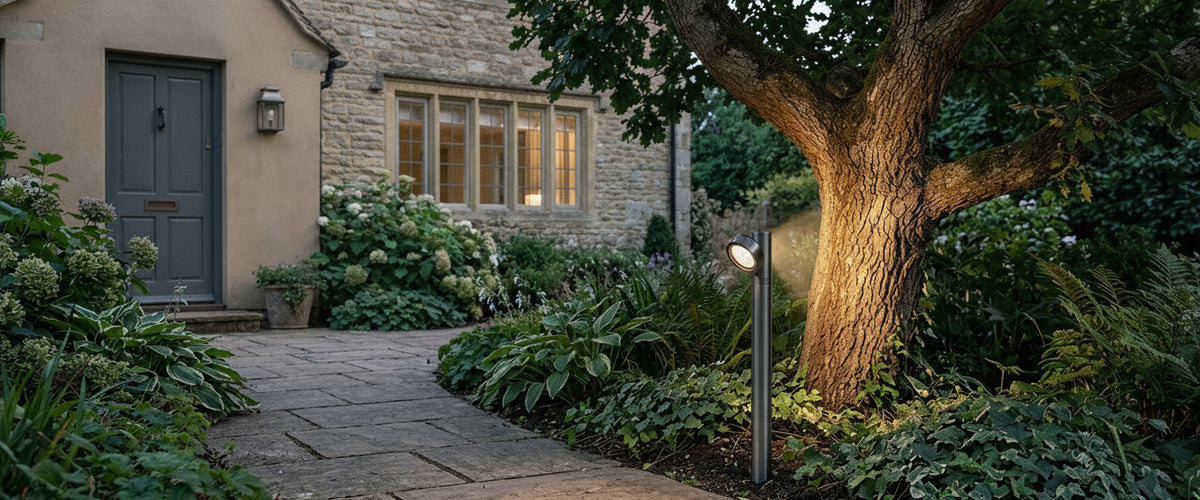

Most gardens are over-lit and under-designed after dark. Ten identical LED garden spike lights get pushed into the borders at equal intervals, all aimed at nothing in particular, and the result is a wash of cold light that flattens every leaf it touches. Two well-aimed LED garden spike lights do more for a mature multi-stem birch than six badly aimed ones, and they cost less to run. The difference is not the product. It is the thinking behind where the fitting goes, how wide the beam spreads, and what the light lands on.

Key Takeaways
Transformer-fed 12V garden spike lights outperform solar spike garden lights in a British climate, where winter light levels are low exactly when you want the garden lit.
Beam angle matters more than wattage on any LED garden spike. Narrow beams sculpt trunks and stone; wide beams wash walls and hedging.
Aim at texture, not at emptiness. Bark, brick, coppiced stems and dry-stone walls repay uplighting. Flat lawn does not.
Color temperature should match the house. Around 2700K keeps your LED garden spike lights in conversation with the warm glow of alabaster fittings indoors.
Anything mains-fed needs a qualified electrician. Low-voltage extensions off an existing outdoor supply are simpler, but the supply itself is not a weekend job.

What an LED Garden Spike Actually Does After Dark
An LED garden spike is the smallest, most adjustable tool in exterior lighting. It sits at ground level, tilts, and throws light upward or sideways across a surface. That low angle is the whole point. Daylight comes from above and reveals color; light from below reveals texture, because every ridge and fissure casts a shadow across the surface behind it. Put an LED garden spike at the foot of an old apple tree and the bark reads like carved relief. Put one behind a stand of miscanthus and the seed heads glow from within.
Path edges are where LED garden spike lights earn their keep practically. You are not lighting the path; you are lighting the planting either side of it, and the spill does the wayfinding. That reads far better than a row of downward-facing markers, and it keeps glare out of the eyeline of anyone walking towards the house. Bollards still have a place on longer drives and open approaches, where a taller column such as the Brillix Black LED Bollard Light 3000K IP54, 100cm throws a usable pool of light much further than a ground-level LED garden spike ever will. For borders, specimen shrubs and boundary planting, though, spikes for garden lighting give you far more control over aim.
The failure most people hit with LED garden spike lights is uniformity. Gardens look best with pools of light and deliberate darkness between them, the same way a room looks best with lamps rather than one ceiling fitting. Leave gaps. The eye fills them in.
12V Versus Solar: Why Transformer-Fed Spikes Win Here
Solar spike garden lights are genuinely useful in one situation: a spot with no cable route, full southern exposure, and low expectations. Everywhere else, physics gets in the way. A solar panel the size of a beer mat collects very little energy on a gray November afternoon in Manchester, which is precisely the season you most want the garden lit at four in the afternoon. Output drops, run time shortens, and the battery ages until the fitting glows apologetically for twenty minutes and gives up. An LED garden spike on a cable never has that argument with the weather.
12V garden spike lights fed from a transformer solve all of that. The transformer sits in a protected location, steps mains down to a safe low voltage, and feeds a cable run that can be extended, re-routed and added to as planting matures. Output from every LED garden spike stays constant in January and July alike. You can dim the circuit, put it on an astronomical timer, or fold it into a smart system so the garden comes on at dusk and steps down to a lower level after eleven.
There is a running-cost argument too. A well-specified low-voltage LED garden spike scheme across a decent-sized garden draws less power than a couple of old halogen floodlights, and because the light is aimed rather than sprayed, you need fewer fittings to achieve more. What a scheme costs depends on cable runs, transformer capacity, fitting quality and how much groundwork the installation involves, so treat any headline figure with suspicion until someone has walked the site.
Beam Angle and Spike Height: The Two Variables That Decide Everything
Beam angle is the number LED garden spike buyers skip and regret. As a rough working rule: 10 to 15 degrees for tall narrow subjects such as a single trunk, a column or a sculpture; 24 to 36 degrees for shrubs, small multi-stem trees and stone piers; 60 degrees and above for washing a wall, fence or hedge evenly. Choose too wide a beam for a slender tree and most of your light sails past it into the neighbour's bedroom. Choose too narrow a beam for a wall and you get a bright spot with dark shoulders.
Spike height changes the geometry. A short LED garden spike sits the lens close to the soil, which is flattering for trunks but gets buried by the first flush of spring growth. A taller stem lifts the fitting clear of ground cover and lets you shoot across a bed rather than straight up through it. In borders that fill out heavily, we generally suggest a taller stem plus a shroud or cowl to cut glare, then a re-aim every spring once the planting has come up.
Color temperature is the third setting worth arguing about. Anything at 4000K or above reads clinical outdoors and turns green foliage a slightly sickly blue-gray. Warm white around 2700K to 3000K keeps foliage looking like foliage. It also matters if the garden is visible from a room lit by warm, diffused fixtures. Bright cool LED garden spike lights seen through glass against soft interior light look like a mistake, because they are one.
Spacing Logic for Trees, Shrubs and Hard Landscaping
For a specimen tree, start with two fittings rather than one. A single LED garden spike gives a flat, slightly theatrical front-lit look; two placed at roughly 120 degrees apart around the trunk build shape and let the canopy carry light into its upper branches. Set them back far enough that the beam catches the whole trunk, not just the first three feet (1m), and angle slightly off-centre so you avoid a hot spot at the base.
Hedging and long walls want spacing tied to beam width and distance, not to a fixed number. Space fittings too far apart and you get scalloped pools with dead ground between them. Too close, and you lose the rhythm that makes the effect worth having. Set the LED garden spike lights out loosely, run them at night, then move them before anything is fixed. Every installer worth using does this.
Hard landscaping is where restraint pays. Dry-stone walls, brick piers, corten steel and rendered garden walls all take grazing light beautifully when the fitting sits close to the surface and shoots almost parallel to it. Pull the same fitting back three feet (1m) and the texture disappears. Steps, on the other hand, rarely want an LED garden spike at all; they want light from the side or above so the treads read clearly without dazzling anyone descending. Where there is a wall alongside the flight, a surface fitting like the Blow LED Up Down Outdoor Wall Light handles that far better, because the downward throw lands on the treads while the upward throw keeps the wall from reading as a black slab.
One thing to plan for: wildlife. LED garden spike lights aimed into tree canopies and along hedgerows cross the flight routes bats use, and the Bat Conservation Trust's guidance on artificial lighting is worth reading before you commit to a scheme near mature trees or water. Warm color temperatures, tight beams, shielding and switching off late all help.
IP Rating, Spike Material and Finish in Clay or Coastal Soil
IP65 is the sensible floor for garden spike lights. IP67 is better where fittings sit in beds that flood, sit under downpipes, or get buried by mulch. The rating on the box only holds if the gland is properly tightened and the cable enters from below, so sloppy installation ruins a good LED garden spike more often than poor products do.
Material choice is dictated by ground conditions. Heavy clay holds water against a fitting for weeks, and the RHS is clear about how poorly clay drains compared with lighter soils. A painted mild steel LED garden spike corrodes fast in those conditions, so stainless steel, marine grade where you can get it, is the safer call. On coastal sites in Cornwall, Norfolk or the west coast of Scotland, salt-laden air attacks anodized aluminium and cheap plated finishes within a couple of seasons. Solid brass ages to a soft brown patina and keeps working; 316 stainless holds up too.
Finish is an aesthetic decision as much as a technical one. Black and anthracite vanish into planting during the day, which is why a half-height marker such as the Brillix Anthracite Outdoor LED Bollard Light 3000K, 50cm sits more quietly among low borders than a pale finish would, and its 3000K output stays in step with warm spikes elsewhere in the garden. Raw brass and copper are meant to be seen, and they suit gardens where the hard landscaping already leans towards natural materials. Consistency helps: if the exterior fittings on the house are dark, keep the LED garden spike bodies dark.
What Installing Mains Garden Lighting Actually Involves
Low-voltage cable running from an existing, properly protected outdoor supply is straightforward to lay and extend. Getting that supply out to the garden safely is not. Outdoor circuits fall under Part P of the Building Regulations in England and Wales, need appropriate RCD protection, and require a competent, qualified electrician to install, test and certify. Anyone telling you otherwise is telling you something that will show up on a future survey.
What a good installation looks like in practice:
Agree the lighting design first, on site, at night, with temporary fittings in place.
Position the transformer where it stays dry and accessible, with capacity to spare for future additions.
Run cable in ducting at a sensible depth, routed along bed edges rather than through the middle of planting areas where spades go.
Use proper waterproof connectors, not tape and hope. Gel-filled or resin joints where connections sit below ground.
Leave a service loop of spare cable at each fitting so every LED garden spike can be moved as planting grows.
Commission at night, aim everything, then tighten and record the layout.
Ask for a wiring diagram and photographs of cable routes before the trenches are backfilled. Three years later, when someone plants a hedge, you will be very glad you have them.
The Buyer's Checklist for LED Garden Spike Lights
Beam angle stated on the spec sheet. If the seller cannot tell you, they do not know.
2700K to 3000K for anything visible from inside the house.
IP65 minimum, IP67 for wet or heavily mulched beds.
Stainless or brass spikes in clay and coastal ground; avoid painted mild steel.
Replaceable or serviceable LED module where possible, rather than a sealed throwaway unit.
Adjustable head with a lockable tilt, so aim survives strimmers and dogs.
Transformer sized with headroom, ideally 20 percent above the load your LED garden spike run draws today.
Glare control: cowls, snoots or recessed lenses on any fitting near a seating area.
Making the Garden Talk to the House
This is the part exterior schemes usually miss. After dark, a large window is a mirror unless the garden beyond it is lit, and the relationship between inside and outside light levels decides whether you see the planting or your own reflection. Get the outdoor levels right and the garden becomes a lit backdrop to the room. Get them wrong and you have created an aquarium.
Color discipline carries the effect. Niori works mainly in alabaster, marble and onyx, and the light those materials give is warm, soft and slightly golden, with the stone's veining visible in the glow. A pendant over a kitchen island or a pair of alabaster wall lights in a garden room sits at a low, warm level. If the LED garden spike lights outside are running at 4000K, the contrast is jarring; matched at 2700K, the eye moves from a warm interior to a warm garden without a jolt. Hang warm alabaster pendants above a dining table facing full-height glazing while cool-white spikes burn away outside, and the room never settles at night. The pendants are not the problem. The garden is.
If you are planning both sides of the glass at once, it helps to browse the interior fittings and the exterior scheme together rather than treating them as separate jobs. Our alabaster lighting collection is a useful starting point for the warm, diffused end of the scheme, and the wider lighting range covers the pendants, wall lights and lamps that set the indoor level your LED garden spike lights need to answer to.
Do that, and an LED garden spike stops being hardware pushed into a border and becomes part of how the whole house reads after dark. Fewer fittings, better aimed, warmer in color, switched off when nobody is looking. That is the entire brief.