
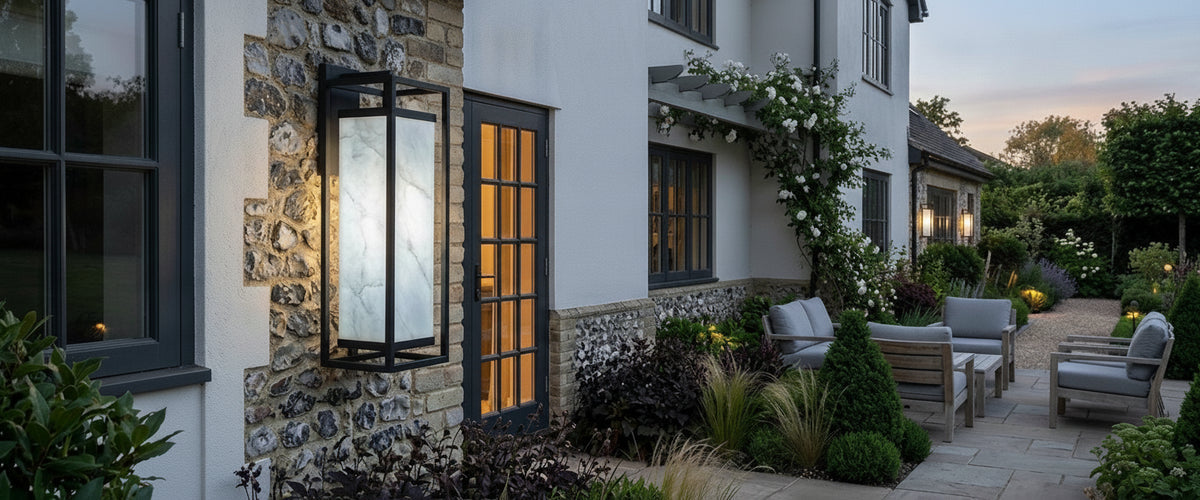

Black is the only exterior lighting finish that behaves itself on brick, render, flint, limestone and painted timber without apology. That is why black garden wall lanterns keep winning: they read as intentional rather than accidental, they hold a line against a busy wall, and they disappear politely in daylight before doing their real work at dusk. The problem is that plenty of the black garden wall lanterns sold here are powder-coated die-cast alloy with a gasket that gives up after two winters, and by the third spring the finish has gone chalky and the fixings are weeping rust down the render.
The difference between black garden wall lanterns that age well and ones that quietly fail is decided at the point of purchase, not at the point of installation.

Key Takeaways Before You Buy
Finish matters less than substrate. Marine-grade powder coating over cast aluminium or 316 stainless outlasts the same coating over mild steel every time.
IP44 is the realistic minimum for a sheltered wall; IP54 or above for exposed boundary walls and coastal sites.
Mount at roughly 1.9 to 2.1m (6ft 3in to 7ft) to the centre of the lantern, adjusted for door and pier height.
Stay at 2700K to 3000K outdoors. Cooler light turns black metal grey and makes planting look flat.
Ask about the gasket, the gland and the fixings before you ask about the shape. Those three decide longevity.
Budget varies with material, casting quality, glass, engineering and installation, so ask for a tailored quote on black garden wall lanterns rather than assuming a headline figure covers the job.

What Black Actually Does to a Façade
Black garden wall lanterns work outdoors for a reason that has nothing to do with fashion. Black has almost no reflectance, so in daylight the lantern reads as a silhouette rather than an object competing with the wall behind it. Brass patinates and shifts colour, and it looks glorious doing so, but it is never neutral. White and cream fittings pick up algae and rain staining fast, and they show every drip line from a lintel above. Black holds its outline against red brick, pale render and grey stone alike.
There is a second effect people rarely notice until it is pointed out. Because the lantern body absorbs light rather than bouncing it, the glow from inside the glass reads brighter by contrast. A black garden wall lantern with a 4W warm LED can look more luminous than a polished nickel one with double the output, simply because the eye has nothing else to lock onto. Designers use that trick constantly on approach elevations where you want the pool of light to feel generous without flooding the whole frontage.
The one thing black cannot do is rescue a badly proportioned fitting. On black garden wall lanterns the outline is everything, so a squat body on a tall pier looks worse in black than it would in bronze. Silhouette is unforgiving.
Cast Iron, Aluminium and Powder-Coated Steel
Traditional black garden wall lanterns were cast iron, and genuine cast iron still has a weight and crispness of detail that nothing else copies. It is also heavy, which matters for fixing into soft brick or lime-mortared stone, and it will rust with real determination the moment the coating is chipped. On listed and period properties it is often the right answer anyway, because the profile is correct and the mass suits the building. Historic England's guidance on maintaining external metalwork is a useful sanity check if you are working on a protected façade (historicengland.org.uk).
Cast aluminium is the sensible default for most black garden wall lanterns. It does not rust, it takes a polyester powder coat beautifully, and the casting can carry a decent amount of detail. Look for a chromate or similar pre-treatment before coating; the coating itself is only as good as what it grips. Thin, brittle die-cast alloy is a different animal to a properly sand-cast body, and you can usually tell by lifting one.
Powder-coated steel gives the sharpest modern lines, particularly on flat-backed box lanterns and up-down forms. Where a contemporary elevation calls for a graze of light rather than a lantern silhouette, something like the Milvane Outdoor Up Down Wall Light 2 Light, Black is closer to the right design language, because the matte black body vanishes against render and only the two shafts of light register. Mild steel needs galvanising under the coating or it will bloom rust from every drilled hole. Stainless grade 316 is the specification to insist on within a few miles of the sea; 304 will tea-stain in salt air, and once it starts it does not stop. The failure point on black garden wall lanterns is rarely the body in any case. It is usually the fixings: a perfectly sound lantern hung on 304 screws will still bleed rust streaks down render within a couple of coastal seasons.
Proportioning Lanterns to Piers, Doors and Walls
A useful starting rule for black garden wall lanterns: the lantern height should be somewhere between one quarter and one fifth of the door height for a front entrance. On a standard 2m (6ft 6in) door, that puts you in the region of 40 to 50cm (16 to 20in) overall. Most people buy too small. A lantern that looks substantial in a showroom shrinks dramatically once it is 2m up a wall with a large expanse of brick around it. It helps to think in stated dimensions rather than impressions: a fitting in the region of the 41cm Delta Black Wall Light 3000K sits squarely in that range beside a standard door, where a 30cm body would read as undersized on anything but a narrow porch.
Gate piers change the maths. Here the lantern reads against sky rather than wall, so it needs more visual weight, not less, and a wider body stops it looking like a birdhouse. Pairs of black garden wall lanterns on flanking piers should be identical and set at exactly matched heights; the eye picks up a small discrepancy across a driveway instantly.
Wall texture is the third variable. On smooth render or ashlar stone, a slim flat-backed lantern sits flush and looks precise. On flint, rubble stone or heavily weathered brick, you need a fitting with enough depth to survive the shadow chaos behind it, plus a backplate large enough to bridge an uneven surface without rocking. Pack behind the backplate with a suitable spacer rather than overtightening; overtightening cracks castings and cracks old brick.
IP Ratings and Wiring Decisions That Separate Lasting Lanterns from Quiet Failures
The IP code is defined in IEC 60529 and the second digit is the one that matters outdoors: 4 means protection against splashing water from any direction, 5 covers water jets, 6 covers powerful jets (iec.ch). For black garden wall lanterns under a porch or deep eaves, IP44 is genuinely adequate. On an exposed boundary wall facing prevailing weather, specify IP54 or better and check that the rating applies to the assembled fitting rather than just the lamp compartment.
Sealing is where budget black garden wall lanterns fail without drama. There is no bang and no tripped breaker. Moist air gets in through a hardened gasket, condenses on the glass overnight, and over a couple of winters corrodes the lamp holder contacts until the light flickers and dies. Ask whether the gasket is silicone or a cheap foam strip, whether there is a drainage path at the base, and whether the cable entry uses a proper gland rather than a rubber grommet.
All exterior wiring should be installed by a qualified electrician working to BS 7671. That includes RCD protection, correctly rated SWA or suitably protected cable runs, and IP-rated junctions. Black garden wall lanterns on an outbuilding or boundary wall usually need a dedicated circuit rather than a spur off a socket ring, and getting that specified at design stage saves lifting a lawn twice.
Height and Spacing Without the Security-Light Look
Three habits create that harsh, forecourt look: mounting too high, spacing too wide, and choosing lamps that are too cool and too bright. Fix all three and a run of black garden wall lanterns reads as architecture rather than surveillance.
On a boundary or garden wall, mount lower than you would at a front door, around 1.7 to 1.8m (5ft 7in to 6ft), so the light lands on the wall and the path rather than into a neighbour's bedroom. Space black garden wall lanterns at roughly three to four times the mounting height for continuous coverage, or double that if you want distinct pools of light with deliberate gaps between them. Gaps are good. Uninterrupted brightness flattens a garden.
For porches and entrances, one black garden wall lantern beside the door works if the door is off-centre; a symmetrical door usually wants a pair. Set the centre of the lantern slightly above eye level so nobody looks directly into the lamp. On outbuildings, up-down forms are the workhorses, throwing a tight double wash that grazes the wall and shows off texture without spilling into the sky. A cone-shouldered fitting such as the Coat 2 Light Up Down Cone Wall Light, Black & Gold shows how a warm metal interior softens the beam edge, which is worth having where the wall is brick or flint rather than flat render. Keep upward output modest and shielded to limit skyglow; the Bat Conservation Trust and most local planning teams take a dim view of unshielded upward light near hedgerows.
Lamps: 2700K for period properties and warm brick, 3000K for grey stone, render and contemporary schemes. Choose a CRI of 90 or above so planting keeps its colour, and specify dimmable drivers if the black garden wall lanterns share a circuit with anything you want to soften later. Photocell and astronomical timer control beats a motion sensor for front elevations; motion sensors belong on side returns and bin stores, not on your best wall.
Keeping Black Sharp Through Salt, Damp and UV
Powder coating degrades from the top down. UV breaks the polymer surface, it goes chalky, then rain carries the pigment away and you get that tired charcoal-grey look. Twice a year, wash with warm water and a pH-neutral soap, rinse properly, dry with a microfibre cloth, and apply a non-silicone wax or a coating-safe protectant. That single hour of work is the difference between black garden wall lanterns that still look composed at year ten and ones that look tired at year three.
Touch up chips immediately with a matched primer and topcoat, zinc-rich if the body is iron or steel, and pay particular attention around fixings. Check the gasket annually by looking for condensation inside the glass on a cold morning; a misted pane is your early warning. On coastal sites, rinse your black garden wall lanterns quarterly with fresh water to lift salt deposits before they sit long enough to pit the coating.
Six-Point Buying Checklist
Substrate: cast aluminium, cast iron or 316 stainless. Ask, do not assume.
Coating: marine-grade or architectural polyester powder over a proper pre-treatment.
Rating: IP44 sheltered, IP54 or higher exposed, with the rating applying to the whole fitting.
Sealing: silicone gasket, drainage path, cable gland, corrosion-resistant fixings.
Scale: measure the door or pier, then size up. Under-scaling is the most common regret.
Light quality: 2700K to 3000K, CRI 90+, dimmable driver, shielded upward output.
Where Black Garden Wall Lanterns Meet the Light Inside
Exterior and interior lighting are read together every evening, from the driveway and from inside looking out. A crisp black garden wall lantern at the door sets a temperature and a mood, and it works best when the hallway behind it picks up the same warmth rather than switching to something colder and brighter. The warm, diffused glow of backlit stone is a natural continuation of a soft exterior lantern, and the shift from black metal outside to translucent alabaster inside gives an entrance real depth. You can see how those pieces behave across our alabaster lighting range.
Practically, that usually means matching colour temperature across the threshold and dropping interior brightness slightly so the eye adjusts comfortably on the way in. An alabaster wall light in a porch or boot room, a stone pendant over an entrance table, or a marble-based table lamp on a console will all carry the warmth of your black garden wall lanterns inward without a jarring change. Niori works almost entirely in alabaster, marble, onyx and natural stone with brass and glass detailing, and the wider lighting collection is a good place to see how those materials pair with darker metal finishes.
Get the black garden wall lanterns right at the boundary and the door, keep the light warm and controlled, and the whole approach to the house feels considered before anyone has turned a handle. That is the point of exterior lighting, and it costs very little more to specify properly the first time.