
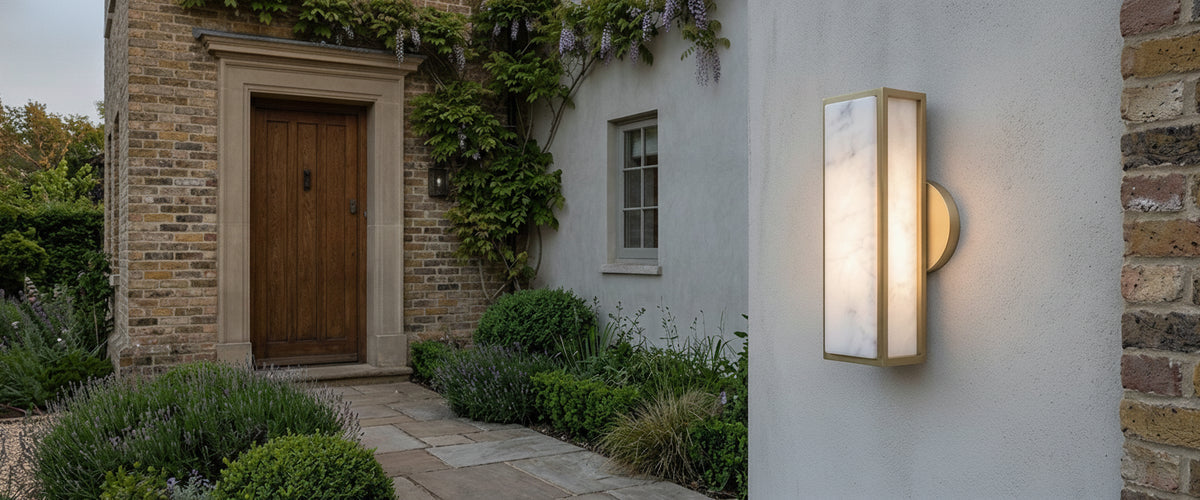

Most people buy a lantern first and measure second. Then the porch door catches the glass, or a tall visitor ducks every time they come in, and the fitting gets swapped within a year. An outdoor flush mount solves that at the source: the fitting sits tight to the ceiling, keeps head height clear, and stops the entrance feeling like an obstacle course. It is the quieter choice, and in low-clearance exteriors it is usually the correct one.
At Niori we work mainly in alabaster and natural stone, which makes us fussy about where fittings go and what conditions they face. Stone is honest material; it tells you very quickly when it has been put somewhere it should not be. That experience shapes the advice below.

Quick Answer: What Matters When Buying an Outdoor Flush Mount
- Clearance first. If a pendant or hanging lantern would sit near head height, or swing in wind, go flush or semi-flush.
- Match the IP rating to the exposure, not to the postcode. A sheltered porch and an open coastal walkway are different problems.
- Finish decides longevity. Marine-grade brass, powder-coated aluminium and stainless steel behave very differently near salt air.
- Warm light for entrances and seating, neutral light for steps, bin stores and workshops.
- Alabaster is an interior material. Use it under genuinely sheltered ceilings, never in wind-driven rain.
- Have the spec sheet in hand before your electrician quotes. IP rating, lamp type, driver location and fixing centres all affect the job.

Why Low-Clearance Exteriors Need a Flush Fitting, Not a Lantern
Porches, covered side returns, garage undercrofts, loggias and boot-room canopies share a common trait: the ceiling is low and the space is busy. People carry shopping through it, prams get folded there, dogs get towelled off there. A hanging lantern in that setting becomes something you avoid rather than something you notice.
flush outdoor ceiling lights change the geometry. Because the body sits against the soffit, light spreads across the ceiling plane and washes down evenly rather than pooling in one hot circle under a shade. That matters at a threshold, where you want faces lit softly and door locks lit clearly. Semi-flush versions drop slightly and throw a little more light upward, which suits a porch with a painted timber ceiling because the reflected bounce softens everything below. On the dry side of the same threshold, a shallow-profile fitting such as the Arion Semi-Flush Ceiling Light, White shows the proportion to aim for: body close to the plane, light spread wide rather than concentrated.
There is a structural argument too. A pendant applies use to its fixing every time the wind gets under it, and exposed canopies see plenty of wind. An outdoor flush mount distributes its load against the ceiling and has no pivot point to work loose, which is why we steer clients on coastal sites toward flush or wall-mounted options.
IP Ratings in Plain Terms: IP44, IP54 and IP65
The IP number describes two things: resistance to solid objects, then resistance to water. For exterior buying decisions the second digit does the heavy lifting.
- IP44 handles splashing water from any direction. Suitable for a fully covered porch with walls on two or three sides, where rain never actually lands on the fitting.
- IP54 adds meaningful dust protection along with splash resistance. A sensible step up for open-sided canopies, carports and garden rooms where wind carries debris.
- IP65 resists low-pressure water jets from any angle. This is the rating for genuinely exposed soffits, coastal properties, and anywhere the fitting may be hosed or hit by driving rain.
British weather rarely arrives politely from above. Rain comes sideways, sits in cold soffit corners, and repeats for weeks. That is why a fitting rated for occasional splashes underperforms in an exposed position even though it never technically gets submerged. The Lighting Industry Association publishes accessible guidance on how ingress protection is tested, worth a read before you drop a rating to save money.
One practical warning: an IP rating only applies when the fitting is installed as designed, with the supplied gaskets intact and the correct cable gland used. We have seen an IP65 outdoor flush mount fail in its first winter because the seal was pinched during installation. The rating is a promise about the product, not about the fitting-out.
Finishes and Materials That Hold Up to Rain, Salt Air and Frost
Metal choice is where an outdoor flush mount quietly succeeds or fails. Powder-coated aluminium is light, does not rust, and copes well inland, though chips in the coating can start corrosion underneath. Marine-grade stainless steel (316 rather than 304) is the safer bet within a few miles of the sea. Solid brass and bronze weather rather than corrode; unlacquered brass patinates to a deep brown, and near salt air it does so fast. Some clients love that. Others expect it to stay golden and are disappointed by spring.
Glass matters as well. Opal and prismatic glass diffuse light without yellowing, while cheaper acrylic diffusers can go cloudy and brittle after a few seasons of UV. If the fitting will sit under a south-facing canopy, ask what the diffuser is actually made from.
Where Alabaster Belongs, and Where It Does Not
Alabaster is a gypsum stone, and gypsum is slightly soluble in water. Conservation departments treat alabaster sculpture as a moisture-sensitive material for exactly this reason, and the Metropolitan Museum of Art keeps its alabaster works in controlled interior conditions rather than open courtyards. That tells you everything about hanging one in the rain.
So we are direct with clients: alabaster belongs indoors, or under a fully enclosed, dry ceiling such as a glazed garden room. We shipped a set of semi-flush alabaster fittings to a converted barn in Suffolk where the owner wanted them in an open cart-lodge entrance; we moved them to the adjoining hallway and specified a sealed, IP-rated fitting for the exposed bay. Two winters on, that was the right call. For stone-toned light outside a sheltered zone, marble and granite handle exposure far better, and a good opal glass diffuser mimics the softness convincingly. Where you want that milky, low-glare quality rather than a hard downlight, the Solana Wall/Semi-Flush Ceiling Light, White Glass Brass is closer to the right design language. Compare the diffusion across our alabaster lighting range, then decide how close the exterior fitting needs to come.
Colour Temperature for Exterior Spaces
Warm light (roughly 2400K to 2700K) suits front doors, porches, verandas and any covered area where people gather. It flatters brick, timber and stone, and reads as welcoming from the street. Alabaster naturally pushes light toward the warm honey end of the spectrum; outdoors, an opal diffuser at 2700K gets you a similar mood.
Neutral light (3000K to 4000K) is smarter where the job is visibility rather than atmosphere: steps, bin stores, side passages, workshop doors. Resist going cooler than 4000K on a residential exterior. It reads institutional after dark and makes planting look flat.
On dimming, check whether the outdoor flush ceiling lights you are considering are integrated LED or lamp-replaceable. Integrated units often need a specific trailing-edge dimmer, and the wrong pairing causes flicker in cold weather. If an outdoor flush mount takes a standard lamp, you keep the option of changing colour temperature later.
What Your Electrician Checks Before Installing an Outdoor Flush Mount
Outdoor electrical work in the UK falls under Part P of the Building Regulations, so this is not a weekend job. Use a registered electrician and make sure the work is notified or certified where required. The official guidance on Approved Document P sets out what counts as notifiable work.
- Circuit protection. Exterior circuits need appropriate RCD protection.
- Cable route and entry. Where does the cable enter the soffit, and is the gland right for the cable diameter?
- Fixing substrate. Timber soffit, plasterboard and masonry all need different fixings; a heavier stone or metal fitting needs a proper anchor.
- Driver location. Some integrated LED fittings house the driver internally; others need a remote driver in a dry, accessible position.
- Zone assessment. Proximity to taps, pools, hot tubs and low walls changes the required rating.
- Access for maintenance. If it needs a scaffold tower to change a lamp, choose a longer-life integrated unit.
How to Read a Spec Sheet Before You Order
Before ordering any outdoor flush mount, work through this list. It takes five minutes and saves returns.
- Confirm the IP rating and check it matches the actual exposure, not the best case.
- Note the drop height and diameter, then hold a template against the ceiling to test clearance and proportion.
- Check the body material and finish, and ask specifically about coastal suitability if you are near the sea.
- Identify lamp type: integrated LED or replaceable lamp, and the maximum wattage.
- Check colour temperature and CRI. For entrances, aim high on CRI so planting and brickwork keep their colour.
- Confirm dimming compatibility and whether a specific driver or dimmer is needed.
- Check the fixing plate and cable entry position against your existing back box.
- Ask whether replacement gaskets and diffusers are available, which tells you how long the maker expects the fitting to last.
Common Buyer Mistakes
Buying one size too small is the most frequent. A fitting that looks generous in a photograph often disappears against a wide porch ceiling; if you are between two sizes, size up. Where the plane is broad and a single small disc would float in the middle of it, a multi-light form such as the Solana 6 Light Wall/Semi-Flush Ceiling Light, White shows the width a fitting needs to cover before it looks deliberate. The second mistake is mixing three finishes across a single elevation, which fragments the frontage after dark. Pick one metal and repeat it across door furniture, ceiling fittings and wall lights.
The third is treating exterior lighting as an afterthought once the interior scheme is signed off. The view through a glazed door at night includes both, and a cool white exterior fitting will fight a warm interior every evening. Plan the transition together, and browse the full lighting range with both sides of the threshold in mind.
Budget for an outdoor flush mount scheme varies with material, scale, ingress rating and installation complexity, so send us the exposure details and ceiling dimensions and ask for a tailored quote. We would rather specify one fitting that lasts a decade than three that look right in July.