
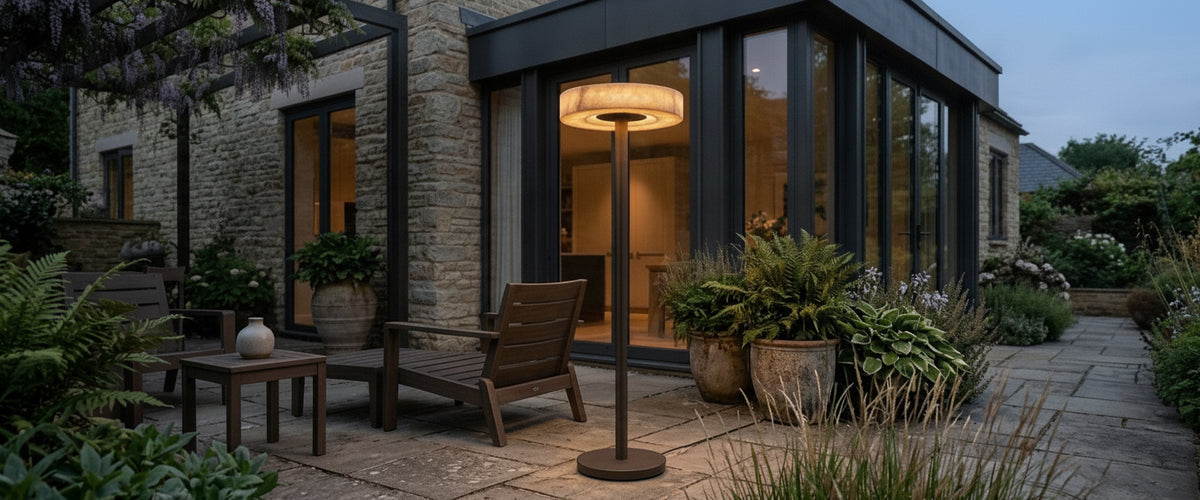

Nine times out of ten, a disappointing outdoor floor lamps is a placement problem wearing a product's clothing. The fitting turns up, gets parked at the end of the terrace because that is where the socket happens to be, and spends the summer shining straight into the eyes of everyone at the dining table. The lamp is fine. The decision about where it stands was made in about four seconds. Get the position, the power source and the weather rating right and even a modest fitting will do more for a garden than three expensive ones scattered at random.

Key Takeaways Before You Buy
- Choose the position before the product. Decide what the light is for (a path, a seating corner, a tree, a doorway) and the shortlist narrows itself.
- IP44 is the realistic minimum for anything standing in the open; IP65 is the sensible choice for exposed sites and coastal gardens.
- "Waterproof" is marketing shorthand. Outdoor floor lamps are water-resistant to a defined level, and that level is the IP number, not the word on the box.
- Warm light wins outdoors. 2700K to 3000K keeps planting and stone looking natural; 4000K makes a garden look like a car park.
- Alabaster and untreated natural stone belong under cover, not out in the rain. Loggias, porches and garden rooms are where they earn their keep.
- Any fixed outdoor circuit needs a qualified electrician and proper RCD protection. Portable rechargeable lamps sidestep that entirely.

Why Garden Floor Lamp Mistakes Happen at the Placement Stage
A floor lamp indoors has help. Walls bounce light back, ceilings hold it in, and a room is small enough that one source fills it. Outside, light leaves and never comes back. Point a lamp into open lawn and most of the output vanishes into the dark, which is why people conclude their new outdoor floor lamp is "not bright enough" when the truth is that nothing was there to catch the beam.
Give the light something to land on. A rendered wall, a yew hedge, a raised bed, the trunk of a multi-stem birch, the underside of a pergola beam. We lit a walled garden near Bath last year where the client had three floor outdoor lamps stranded in the middle of a lawn; moving two of them tight against the boundary wall, roughly 40cm (16 in) out, transformed the whole space without adding a single watt. The wall glowed, the lawn read as depth rather than a void, and the seating area finally felt enclosed.
The second placement error is height versus eye line. Most outdoor floor lamps sit somewhere between 50cm and 110cm (20 to 43 in) tall, which puts the light source directly in the sightline of anyone seated. If you can see the LED from your chair, you will see nothing else. Look for shielded optics, a deep shade, or a diffuser that spreads output rather than firing it sideways.
What Separates a Genuine Outdoor Floor Lamp From an Indoor Fitting
Plenty of handsome lamps get dragged onto a terrace in June and quietly ruined by August. The differences that matter are unglamorous.
- Sealed housings and gaskets. Genuine outdoor fittings use silicone seals at every joint and lens, so condensation does not build inside the head.
- Corrosion behaviour. Powder-coated aluminium, marine-grade stainless and solid brass all cope with British weather. Brass will patinate; that is a finish choice, not a fault. Mild steel with a decorative lacquer will not last.
- Cable and gland quality. Outdoor flex is UV-stable and the entry point is sealed. Indoor fabric flex hardens, cracks and lets water in.
- Ballast and weight. A weighted or ground-spiked base is designed to stay upright in wind. A slim indoor base is not.
- Driver protection. The LED driver is the component that usually fails first, so it should sit inside the sealed body or in a separate rated enclosure.
If a lamp does not state an IP rating anywhere, treat it as an indoor product. Reputable makers publish the figure because they have had the fitting tested.
IP Ratings in Plain Terms: IP44, IP54 and IP65
The two digits after "IP" cover solids then liquids. For garden use, the second digit does the heavy lifting.
- IP44: protected against splashing water from any direction. Fine for covered porches, deep loggias, balconies with an overhang and sheltered courtyard corners. Not the choice for the middle of an open terrace in a Yorkshire winter.
- IP54: dust-protected and splash-resistant. A useful step up for semi-sheltered patios where wind drives rain sideways under a canopy.
- IP65: dust-tight and protected against low-pressure water jets from any angle. This is the specification for open terraces, seaside gardens, poolside seating and anywhere a hosepipe or pressure washer might pass nearby.
Higher is not automatically better, incidentally. Ratings above IP65 involve immersion, which matters for pond and pool fittings but adds cost and bulk that a terrace lamp does not need. What you should never do is assume that outdoor floor lamps described as waterproof are all equal; ask for the rating and the test standard. And if a fitting is being wired into a fixed circuit, that work sits under UK wiring regulations, so use a qualified electrician and make sure the circuit is RCD protected, as Electrical Safety First sets out for garden electrics.
Mains-Wired, Solar or Rechargeable: Picking the Right Power Source
Mains-Wired
Best for permanent schemes where you want consistent output, dimming control and integration with the rest of the garden lighting. An 18W LED outdoor floor lamp on a switched circuit will light a dining terrace properly and do it every night of the year. Where one fitting has to carry a whole eating area, something at that output and height, such as the Luxtra Outdoor LED Floor Lamp 18W 3000K at 55cm, is the right order of scale: low enough to sit under seated eye line, warm enough at 3000K to keep brick and planting looking natural. The trade-off is cost and disruption: trenching, armoured cable, an outdoor-rated junction box and an electrician's time. Worth it if the layout is settled.
Outdoor Solar Floor Lamps
An outdoor solar floor lamp is genuinely useful in one specific role: marking a route or adding a soft point of interest somewhere a cable would be absurd, such as the far end of a long garden. Set expectations honestly, though. British light levels between November and February are low, panels underperform in shade, and lithium cells degrade over a few seasons. Solar is an accent tool. It is not a substitute for the light you cook and eat by.
Rechargeable
The most flexible option and, for most homes, the smartest first purchase. A rechargeable outdoor floor lamp with a small 1.5W LED head puts warm light exactly where the furniture is tonight and somewhere else next weekend, which is the logic behind a fitting like the Veloxis Rechargeable Outdoor LED Floor Lamp 1.5W 3000K. Charge indoors, carry out at dusk, bring in when the forecast turns. We ship a lot of these to clients who move seating around a courtyard through the season, and to hospitality venues that reconfigure terraces for private hire. Look for USB-C charging, a genuine dimming range rather than three fixed steps, and a stated runtime at the brightness you will actually use.
Site Conditions: Surfaces, Wind and Sightlines
Before ordering, walk the space with three questions.
What is underfoot? A weighted base needs a flat, stable surface. Riven slate, cobbles and reclaimed brick all rock a lamp slightly, and a lamp that rocks eventually falls. Gravel and borders suit spiked bases far better than weighted ones. Decking is fine, but check the base will not sit across a gap between boards.
How exposed is it? Roof terraces, coastal gardens and anywhere with a funnel between buildings will take down a tall, top-heavy fitting. A lower, broader lamp is the safer pick, and salt-laden air argues strongly for stainless or brass over coated steel. On a windy roof terrace a compact dark-finished fitting such as the Veloxis Outdoor LED Floor Lamp 1.5W 3000K in black stays put and recedes by daylight, where a slim column lamp would be both a hazard and an eyesore.
What do you see from the kitchen window? Garden lighting is viewed from indoors for most of the year. Stand at the doors in the dark and check that no lamp fires straight back at you through the glass. Bare LEDs reflected in a window kill the view of the garden entirely.
Beam Direction and Depth After Dark
Direction does more for atmosphere than lumens. Three patterns cover most gardens: downward wash for safe circulation, upward grazing against a wall or trunk for drama, and low ambient glow around seating. Mix them and the garden gains layers. Use only one and everything flattens.
A practical rule for outdoor patio floor lamps: keep the brightest thing furthest from where people sit. Light the boundary and the planting hard, keep the table area soft, and eyes adjust to a scene that feels deep rather than staged. Dimming helps enormously here, so choose fittings with real dimming control if you can, and set the terrace level below the level you would use indoors. Our full lighting collection is worth browsing with that layering idea in mind, because the same principle governs how a pendant, a wall light and a floor lamp share a room indoors.
Where Alabaster and Natural Stone Belong Outdoors
Here is the honest position from a studio that works in stone every day. Alabaster is a gypsum mineral, soft and slightly soluble in water, which is exactly why conservators keep historic alabaster monuments indoors or under shelter; Historic England's guidance on building materials is clear about how poorly gypsum stones handle exposure. Rain will dull a polished alabaster surface over a season. Frost inside a hairline vein will do worse.
That does not exclude stone from your garden scheme; it just sets the boundary at the roofline. Covered loggias, deep porches, verandas, orangeries and garden rooms are ideal territory for alabaster, and the warm diffused glow reads beautifully against limestone paving and dark planting seen through the opening. A pair of alabaster table lamps on a covered outdoor kitchen counter, or a stone wall light either side of garden doors, gives a threshold between house and garden far more successfully than a weatherproof fitting ever will. Browse the alabaster lighting range for the sheltered zones and keep IP-rated metal fittings for the open ground.
Buying Checklist for Outdoor Floor Lamps
- Confirm the IP rating in writing: IP44 minimum under cover, IP65 in the open.
- Check the housing material against your exposure, especially within a few miles of the coast.
- Choose 2700K to 3000K colour temperature and confirm the lamp is dimmable if you want flexibility.
- Match the base type to the surface: weighted for paving, spiked for beds and gravel.
- Check the light source is shielded from seated eye level.
- For rechargeables, note runtime at mid brightness and the charging port type.
- For solar, be realistic about winter output and panel orientation.
- For mains fittings, budget for an electrician and RCD-protected outdoor circuit.
- Plan where the lamp overwinters if the finish is delicate.
- Ask the supplier about replacement seals, drivers and spare parts before you commit.
Care Through a Wet Winter
Outdoor fittings fail slowly. A perished gasket lets in a little moisture, condensation forms behind the lens, the driver corrodes, and one damp February evening nothing switches on. Twice a year, wipe seals with a soft damp cloth and check they are still supple; clean lenses with warm water and mild detergent rather than solvent, which clouds polycarbonate. Rinse coastal fittings with fresh water to remove salt. Keep planting trimmed back so leaves do not sit against a warm housing.
Rechargeable lamps prefer to be stored indoors part-charged rather than flat, and it is worth topping them up once mid-winter. Anything in alabaster or marble that has been living in a covered porch should be brought fully inside if temperatures drop hard, and dusted with a dry soft brush rather than a wet cloth. Stone rewards patience, and it will outlive almost everything else in your lighting scheme if you treat it kindly.