
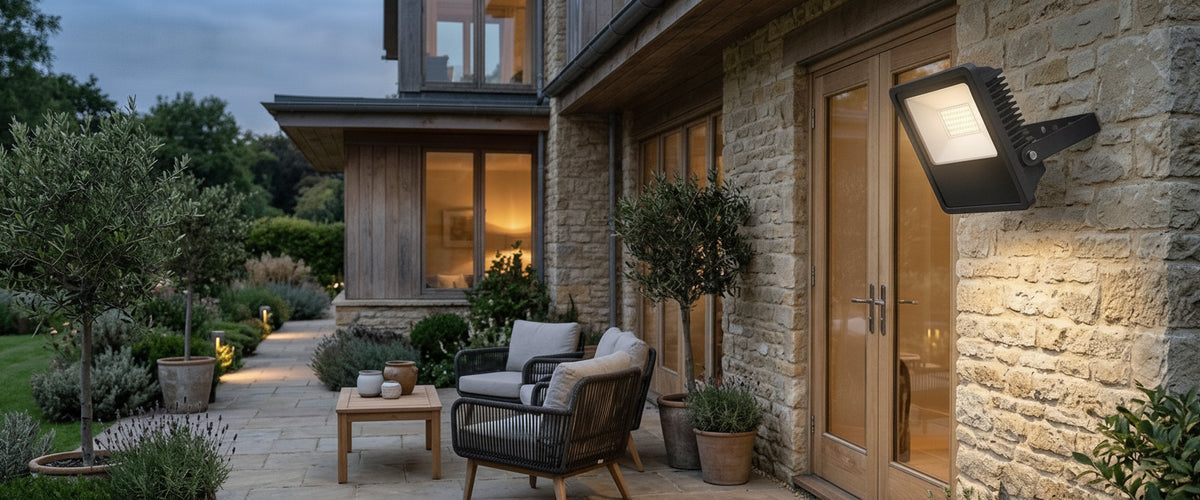

A high-output floodlight bolted above a back door will light the driveway. It will also flatten every texture in the garden, push a hard shadow across a neighbor's bedroom window, and make a handsome house look like a distribution depot after dark. That is the trade-off nobody mentions in the product listing. An industrial floodlight is a working tool, superb at the job it was designed for and completely unforgiving anywhere else. Get the numbers right and an industrial floodlight disappears into the background. Get them wrong and it dominates everything.

Key Takeaways Before You Buy
Buy on lumens and beam angle, not wattage. Wattage tells you the electricity bill, not the light.
IP66 and an IK impact rating matter more than a headline lumen figure if the fitting faces a British winter.
The driver is the part that fails first. Ask who made it and whether it is replaceable.
4000K suits yards, loading areas and workshops. 3000K is kinder anywhere people relax.
Aim low and mount high. Most glare complaints come from a fitting tilted too far towards the horizontal.
An industrial floodlight is for tasks and security. Approaches, terraces and interiors deserve fittings with warmth and material presence.

Where an Industrial Floodlight Is the Right Tool
Industrial floodlights earn their place where the priority is coverage rather than atmosphere: car parks, service yards, loading bays, farm buildings, scaffolded facades during works, tennis courts, and the blind corners of a commercial site where a camera needs usable footage. In those settings a wide flood distribution from a single high mounting point does the work of six decorative fittings and costs less to maintain.
An industrial floodlight is the wrong tool for a front elevation, a courtyard used for dining, a hotel entrance or a garden terrace. We see this often at Niori. A client converting a mill building in West Yorkshire had already fitted two 200W units over an internal courtyard before the glazing went in; every evening the beams bounced off the new glass and washed straight through into the living space, killing the effect of the alabaster pendants above the dining table. The fix cost nothing in new fittings. We dropped the tilt, moved both units behind the parapet line, and added low-level wall lights for the walkway. Same site, completely different mood.
The useful rule: if people will look at the light, choose something with material and warmth. If people will only look at what the light reveals, an industrial floodlight is the honest answer. Our own range sits firmly in the first camp, and you can see how alabaster handles that job across the alabaster lighting collection, where the stone diffuses output instead of firing it in a straight line.
Lumens, Beam Angle and Colour Temperature: The Three Figures Most Buyers Ignore
Wattage is the number printed largest and the least useful. Listings for a 550W floodlight industrial unit sell the wattage as though it guarantees performance, and buyers assume more watts means more light. Efficacy varies enormously between manufacturers. A well-engineered 200W industrial floodlight running at 150 lumens per watt will out-perform an over-driven, badly cooled 550W floodlight industrial LED unit. Ask for the delivered lumen figure at the fitting, not the raw LED chip output, and ask what that figure looks like after 50,000 hours (the L70 or L80 rating).
Beam angle decides whether those lumens land where you need them. A 60 degree symmetric lens gives broad coverage for a yard or forecourt. Narrower asymmetric optics push light forward and downward, which is what you want on a facade or a long access road because they cut back-spill towards windows. Many industrial LED floodlights now take interchangeable lens accessories, so the same body can be refitted with a different optic if the site use changes. Where a yard may later become a parking area or a delivery route, a bolt-on optic such as the FL High Lumen 200W 60° Symmetric Lens Floodlight Accessory lets you change the distribution without changing the fitting. That flexibility is worth paying for on multi-building projects.
Colour temperature sets the character. 4000K neutral white is the working default for industrial floodlighting: it reads as clean and alert, renders color reasonably, and looks appropriate on concrete, steel and tarmac. 5000K and above starts to feel clinical and increases perceived glare at night. For anywhere adjacent to a home, hospitality space or planting, 3000K is the better call. Watch CRI too. Below CRI 70 faces and vehicle paintwork look gray on camera, which defeats the security argument entirely.
IP Ratings and Housing Materials: Why Cheap Units Fail Before Winter Is Out
An industrial floodlight lives outdoors in horizontal rain, freeze-thaw cycles and salt-laden air if you are anywhere near the coast. IP65 covers water jets from any direction and is the practical minimum. IP66 is the sensible specification for exposed elevations and anything mounted on a pole where wind-driven rain hits the gasket line at speed.
The failure point is rarely the LED. It is the seal. Cheap die-cast aluminium bodies with a thin silicone gasket and four undersized screws will hold out for a season, then breathe moisture through every temperature swing until condensation pools inside the lens. Look for a die-cast body with generous heat-sink fins, a toughened glass lens rather than polycarbonate (which yellows under UV), stainless fixings, and a breather valve that lets the housing equalize pressure without drawing water. An IK08 impact rating is worth having wherever there is machinery, ball games or public access. On an exposed yard elevation, that combination is what an industrial floodlight such as the 200W IP66 IK08 LED Floodlight in black die-cast aluminium is built around, and it is the specification to measure cheaper units against.
Finish matters more than people expect. A powder-coated black industrial floodlight body on a south-facing wall reaches serious surface temperatures in summer, and poor coatings chalk and blister. Ask about the pre-treatment process, not just the color.
LED Driver Quality and Dimming Compatibility
If an industrial floodlight dies in year three, the driver is almost always the culprit. Heat, voltage spikes and cheap electrolytic capacitors do the damage. Reputable manufacturers name the driver brand and publish a surge protection rating; look for at least 4kV surge protection on mains-fed exterior fittings and 10kV on exposed pole-top installations, where a nearby lightning strike can travel a long way down a supply cable.
Ask two questions before ordering. Is the driver field-replaceable, or is the fitting sealed and disposable? And is it dimmable, and on what protocol? Many industrial floodlights are non-dimmable as standard. Where a site runs at full output for security but only needs a fraction of that after close of trading, a 1-10V or DALI driver paired with a timeclock cuts running costs and light nuisance at once. Some products also offer CCT-selectable output, useful when you are specifying before the final use of a building is settled.
Everything mains-powered outdoors, an industrial floodlight included, should be installed and certified by a qualified electrician working to BS 7671. That includes bonding, cable routing, RCD protection and the isolation point. It is not a weekend job with a drill and a junction box.
Mounting Height and Aiming Angle: The Small Adjustments That Fix Most Problems
Most dark corners and glare complaints trace back to geometry rather than product choice. Mount the industrial floodlight higher than instinct suggests. A fitting at 5 to 6 meters (roughly 16 to 20 feet) covers far more ground with far less glare than the same unit at 2.5 meters (about 8 feet), because the beam arrives at a steeper angle and the bright source sits outside normal sight lines.
Then aim down. The Institution of Lighting Professionals' guidance on obtrusive light is clear that fittings tilted towards the horizontal are the main source of sky glow and light trespass; their guidance notes on reducing obtrusive light are worth reading before you finalize any exterior scheme. As a working rule, keep the tilt within about 20 degrees of the downward vertical wherever a boundary is in sight, and use an asymmetric optic instead of tipping the fitting up.
Overlap beams rather than butting them together. Two units at moderate output with overlapping edges give even coverage and no black patches; one oversized industrial floodlight gives a hot center and shadows at the perimeter. Scale matters as much as aim: a domestic driveway or a small side return rarely needs anything close to 200W, and a low-output twin head on a bracket such as the 20W Twin LED Security Floodlight with PIR covers the approach on movement without lighting the whole street. Check the aim at night, in the rain, from the neighbor's side of the fence. That last check catches more problems than any calculation.
A Quick Specification Checklist
Confirm delivered lumens, efficacy in lumens per watt, and the L70/L80 lifetime figure.
Choose beam optic by task: wide symmetric for yards, asymmetric for facades and roads.
Set color temperature by neighbor proximity: 4000K for working areas, 3000K near homes.
Specify IP65 minimum, IP66 for exposed positions, IK08 where impact is likely.
Check driver brand, surge protection, replaceability and dimming protocol.
Confirm mounting accessories early: pole clamps, brackets and lens accessories are often separate lines.
Agree mounting height and aiming angle on a plan, then verify on site after dark.
Book a qualified electrician for installation and certification.
Plan the softer layer alongside the industrial floodlight scheme so the site does not read as pure security lighting.
Balancing Industrial Floodlighting With Fittings People Actually See
The best exterior schemes we work on treat floodlighting as one layer among several. High-output industrial floodlights handle the yard, the bin store and the service route. Wall lights mark thresholds. Warm, low-level fittings define the parts of a building people walk through slowly. Inside, the contrast should be sharper still, which is why hospitality clients so often pair perimeter floodlights with alabaster pendants and wall lights in the rooms behind the glazing; the stone glows rather than glares, and the shift from working light to warm light does the psychological work of arriving.
If you are specifying a full property and want the decorative layer to sit properly against a functional one, browse the fixture types across the main lighting collection and think in terms of sight lines. Anything on a wall a guest passes within arm's reach should reward close inspection. An industrial floodlight at 6 meters on a pole only needs to work.
Light pollution is the other reason to keep the two layers distinct. DarkSky International's guidance on the effects of artificial light at night makes a strong case for shielding, warmer color temperatures and switching off when a space is empty. Applied sensibly, that guidance also produces better-looking buildings, because a property lit selectively always reads better than one lit uniformly, and a well-aimed industrial floodlight stops being noticed at all.