
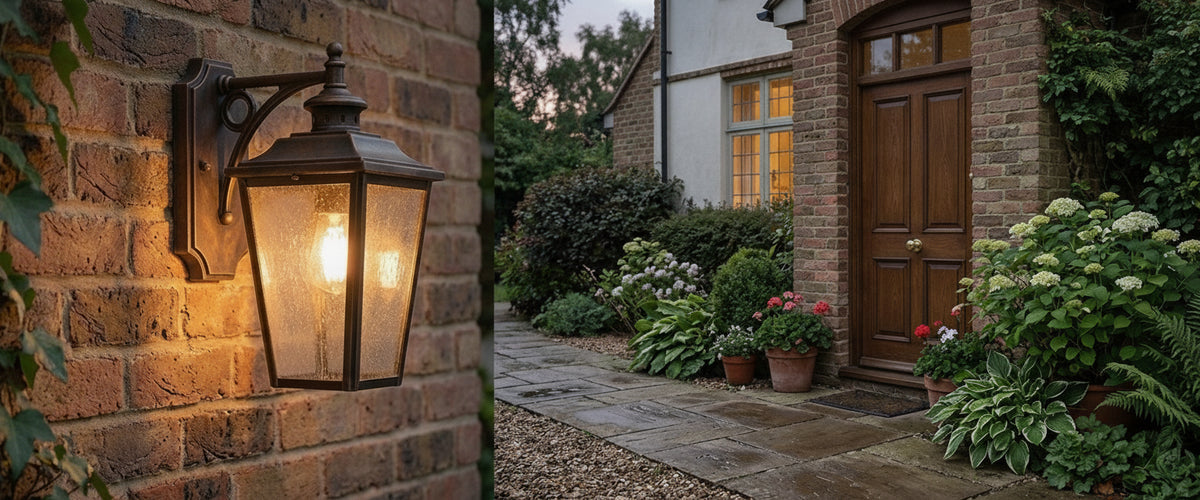

Bronze is the one exterior finish that keeps working on itself long after you have paid for it. Buy a black lantern and it stays black. Buy a bronze outdoor wall lantern and you have bought a surface with a schedule of its own: warm and slightly ruddy on delivery, deeper and browner by the second autumn, softly mottled where rain runs off the roof and where hands touch the glass door. That is either the best thing about it or a slow disappointment, and which one depends almost entirely on decisions you make before the bracket goes on the wall.

Key Takeaways Before You Order
- Colour shifts. A photographed bronze outdoor wall lantern is a lit one. Expect the real thing to read darker and less golden on a north-facing wall.
- Lacquered means stable, then patchy. Unlacquered means unpredictable, then even. Coastal sites accelerate both.
- Scale to the door, not the wall. A fixture roughly a quarter to a third of door height usually sits right.
- Glass decides the light. Clear panels throw sparkle and glare; seeded, reeded or opal panels spread a softer wash across the path.
- IP65 for exposed positions, IP44 under a deep porch, and confirmed cable position before the fixing holes are drilled.
- Budget varies with casting weight, glass type, gasket quality and finishing, so ask for a tailored quote rather than assuming a going rate.

Why a Bronze Outdoor Wall Lantern Is Never the Colour It Was on the Product Page
Product photography is honest about form and generous about tone. A bronze lantern shot under studio lights shows every warm highlight in the casting. Mount the same fixture on a north-facing wall in Yorkshire in February and the highlights vanish; what you see is the mid-tone, which reads closer to dark chocolate or a greenish umber than the amber you had in mind.
Three things drive the difference. The alloy itself, which can lean red with higher copper content or grey with more tin. The applied finish, whether that is a chemical patina, an oil-rubbed treatment or a powder coat imitating bronze. And the wall behind it. Bronze against pale lime render looks lighter and more sculptural. Against London stock brick it almost disappears until it catches low sun, which some clients love and others find flat.
The practical fix is embarrassingly simple and hardly anyone does it: ask for a finish sample or a daylight photograph of the fixture on a comparable wall before you commit to a pair. We keep offcuts and sample plates in the studio for exactly this reason, because a five-minute comparison in real light saves a return.
Lacquered or Unlacquered: What Each Choice Looks Like After Three British Winters
A lacquered bronze outdoor wall lantern arrives sealed. The clear coat holds the factory colour and keeps fingerprints and rain marks off the metal, which is exactly what you want on a sheltered front door where the fixture sits at eye level and gets handled. The catch is that lacquer does not fail evenly. UV, salt and thermal movement break it down first at edges, screw heads and the top plate where water sits. You get a fixture that is glossy in the middle and dull at the corners, and the only honest remedy is to strip and recoat.
Unlacquered, or living, bronze does the opposite. The first six months look inconsistent, sometimes alarmingly so. Then the patina closes up. By the third winter you have a surface with genuine depth, darker in the run-off lines and lighter where wind-driven rain scours it. It suits period properties and rural sites, and it forgives scratches because the metal simply repatinates.
One hard-won lesson from a Norfolk coastal project: we specified a living finish for a pair of lanterns flanking a boathouse door, less than a hundred metres (about 330 feet) from the shore. The patina developed in under a year rather than three, and the client had to accept a much greener cast than the inland version of the same fixture. Salt air is not a modifier, it is an accelerator. If you are within sight of water, assume the timeline halves.
If you want the metal to stay roughly where it started, choose lacquered and inspect it annually. If you want it to look like it has always been there, choose unlacquered and leave it alone. Wiping bronze with household cleaner is the fastest way to ruin either.
Matching Lantern Scale to Door Width, Gate Height and Wall Material
Undersized fittings are the most common exterior lighting mistake, and they are hard to unsee. A useful starting rule for a single bronze outdoor wall lantern beside an entrance door: aim for a fixture around a quarter to a third of the door height, with the centre of the glass roughly 1.6 to 1.7 metres (about 5ft 3in to 5ft 6in) above the threshold, so the light source sits just above eye level rather than glaring into faces.
Flanking pairs can each be slightly smaller than a single lantern would be, because they read as one gesture. Wide double doors or a generous portico will carry more than most people expect. Gate piers are their own problem: a fixture that looks correct on a house wall often looks like a toy on a 1.8 metre (roughly 6 foot) brick pier, because there is no surrounding architecture to give it context. Size up. The reverse is also true along a narrow side return or boundary wall, where a small cylinder such as Atom Black Outdoor Wall Light, 10cm does the job without crowding the brickwork.
Wall material matters for fixing as much as for looks. Soft lime-mortared brick, flint and rendered blockwork all need appropriate anchors and, on historic fabric, fixings placed into mortar joints rather than through the face of a handmade brick. Heavy cast bronze concentrates real weight on two or three points, so tell your installer the fixture mass before they choose plugs.
Glass Panels and What They Do to the Light Reaching Your Path
The glass, not the wattage, decides whether your entrance looks welcoming or interrogated. Clear panels give you a visible filament and crisp shadows, which suits traditional lanterns with a low-output warm lamp inside. Push the output up and clear glass becomes a glare source that leaves the path beyond it darker by contrast.
Seeded or restoration glass breaks the source into a scatter of small highlights and reads well on older buildings. Reeded glass pulls the light into vertical bands and softens the hotspot without losing sparkle. Opal or acid-etched panels give the most even wash and are the safest choice where the fixture lights steps.
This is where our own bias shows. Niori built its range around alabaster and natural stone because of how those materials handle light: the glow comes from within the material rather than bouncing off it, and the veining gives the light a texture that frosted glass cannot fake. Alabaster is gypsum-based and water-soluble, which is precisely why you will never see it used outdoors; the Metropolitan Museum of Art and other conservation collections keep alabaster pieces in controlled interiors for the same reason. Outdoors, opal or etched glass in a bronze frame is the closest honest equivalent, and if you want that diffused warmth to continue past the front door, the alabaster lighting collection is where the interior half of the scheme usually starts.
Period Facade or New-Build Render: Where Bronze Convinces and Where It Jars
Bronze is at its most convincing where there is other metal to talk to. Georgian and Victorian frontages usually have railings, boot scrapers, letter plates and door furniture; a bronze lantern joins that conversation, especially with a scrolled bracket or a tapered ogee top. On a stone farmhouse or a brick coach house, bronze looks inevitable.
Contemporary render, powder-coated aluminium windows and large glazed panels are a different problem. Type outdoor wall lantern bronze into any lighting site and most of the results will be a traditional multi-panel silhouette, which can look like a costume on a modern facade. The fix is usually form, not finish: choose a bronze outdoor wall lantern with clean geometry, a slim frame and a single glass cylinder or a flush up-and-down profile, and the metal stops fighting the architecture. On a rendered or timber-clad elevation where you still want the warmth of bronze without the period outline, a piece like the Utah 1 Light Outdoor Wall Light Up/Down in Sand Brown carries the same earthy metal tone in a form the architecture can absorb. Bronze against smooth white render is a genuinely handsome combination when the shape is disciplined.
Mixed schemes need a rule. Pick one exterior metal and stick to it across lanterns, house numbers, bell push and handle. Two warm metals in slightly different tones look like a mistake even when nobody can say why.
IP Ratings and Wiring Positions: What Your Electrician Needs Before the Bracket Goes Up
IP ratings are the least glamorous part of the decision and the one that determines whether the fixture survives. The second digit is the water figure. IP44 handles splashing and is acceptable under a deep, genuinely sheltered porch. IP65 handles jets from any direction and is the sensible default for any wall exposed to driving rain. Coastal and fully exposed positions also want corrosion-resistant fasteners and stainless internals, not just a good headline rating. Where the wall takes weather from every direction and a decorative bronze outdoor wall lantern would struggle, a sealed up/down fitting such as the Utah Outdoor Wall Light Up/Down E27 IP65 in Graphite is the more honest specification, with the bronze reserved for the sheltered entrance itself.
Give your electrician three pieces of information before installation day: the exact cable entry position on the back plate, the fixture weight, and the lamp type and control method. Retrofitting a dimmer to an outdoor circuit after the fact is far more disruptive than specifying it at first fix. In the UK, most new external circuits fall under Part P of the Building Regulations, so use a qualified electrician and check the current Approved Document P guidance before work starts.
On lamps: 2700K is the warm, slightly amber tone that flatters bronze and brickwork. 3000K reads cleaner and pairs better with pale render and grey stone. Avoid anything above 3000K outdoors unless you want your entrance to look like a car park. Aim for a CRI of 90 or above so the patina on the metal and the colour of your door both read correctly at night, and match the colour temperature to whatever is glowing in the hallway behind the glass. Getting a warm exterior fitting and a cool hall pendant to coexist is impossible; one of them always looks wrong.
The Buying Checklist
- Confirm whether the finish is lacquered, living or a bronze-effect coating, and get that in writing.
- Ask for a daylight photograph or physical sample against a wall colour close to yours.
- Measure door height and width; size the fixture to roughly a quarter to a third of door height.
- Decide mounting height so the glass centre sits just above eye level.
- Choose glass type by function: clear for sparkle, seeded for period character, opal or etched for even light over steps.
- Specify IP65 for exposed walls, IP44 only under real shelter.
- Check fixings against your wall material and tell the installer the fixture weight.
- Set lamp colour temperature at 2700K or 3000K, CRI 90+, and match it to the interior lighting visible from outside.
- Agree the dimming or switching method before first fix.
- Ask for a tailored quote rather than assuming a price; casting weight, glass, gaskets and finishing all move the number.
Keeping the Scheme Coherent From Gate to Hallway
The best exterior schemes we ship are the ones planned inward. A pair of bronze lanterns at the door, a matching bronze detail on the porch ceiling fixture, then something with real softness in the hall. One client in Bath ran that sequence beautifully: living-finish lanterns on a Georgian frontage, then an alabaster pendant just inside the fanlight, so the light you see through the glass from the street is the same warm register as the light outside it. The bronze reads as a frame; the stone does the glowing.
If you are working through a whole-house scheme rather than a single fixture, it helps to browse the full lighting range with the entrance in mind and work backwards, because the front door sets the temperature and the metal for everything behind it. Buy the bronze outdoor wall lantern first, then let the interior follow. Doing it the other way round almost always ends with a compromise on the facade, which is the one fixture your neighbours will judge you on for the next twenty years.