
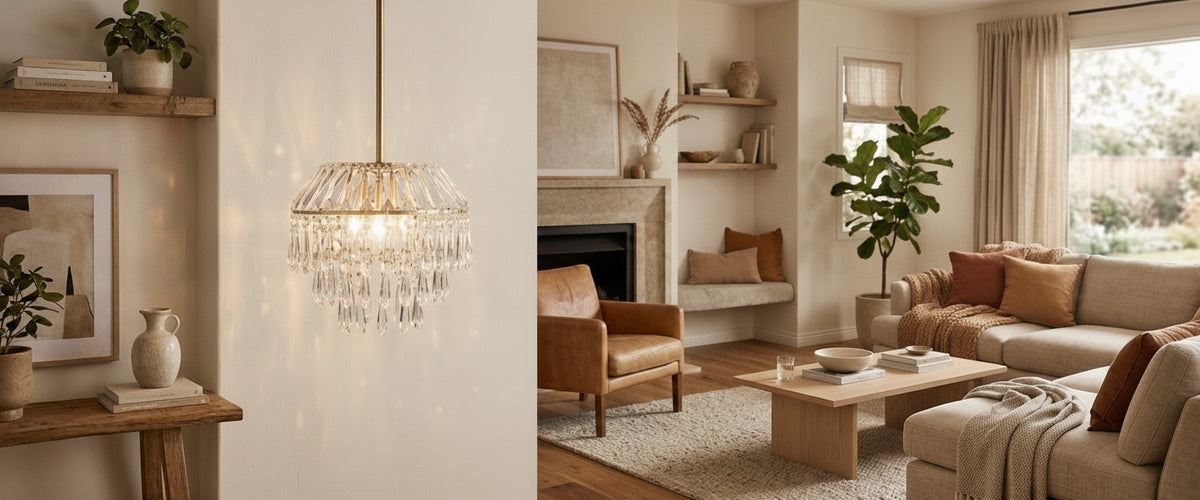

Hang a crystal pendant lights 15cm too high and it stops working as a light. It becomes an ornament on the ceiling, admired from the doorway and invisible from the sofa. Crystal is one of the few materials in lighting that behaves completely differently depending on where your eye sits in relation to it, which is why the same fitting can look extraordinary in one kitchen and oddly cheap in the one next door. The fixture rarely fails. The positioning does.
At Niori we spend most of our days with alabaster and natural stone, materials that soften and diffuse light. Crystal does the opposite: it splits, throws and concentrates. Understanding that difference is the whole game.

Key Takeaways Before You Buy
- Cut matters more than carat talk. A precisely cut facet throws sharp, defined sparkle; a soft moulded edge gives a vague shimmer.
- Drop height is the decision. Over an island or table, aim for roughly 75cm to 90cm (30in to 35in) between the worktop and the lowest point of the fitting.
- 2700K is the default for crystal at home. Warm light reads as candlelight through glass; cooler light reads as a shop display.
- Give it a backdrop. Dark or matt surfaces sharpen the effect. Pale glossy walls swallow it.
- Dimming is not optional. Undimmed crystal at full output is the single biggest cause of glare complaints.
- Match scale to the room, not to the budget. A mini crystal pendant light in a triple-height hall is a lost cause.

How Cut and Quality Change the Light a Crystal Pendant Light Casts
Two crystal pendants can look near identical unlit and behave nothing alike once switched on. The variable is how the material bends light. Lead crystal contains lead oxide, which raises the refractive index and increases dispersion, the property that separates white light into visible colour along the edges of a facet. Ordinary pressed glass has neither the density nor, usually, the precision of cut. The Corning Museum of Glass keeps a good public record of how glass composition shapes optical behaviour, and it is worth ten minutes of reading before you spend anything serious.
In practice, look for three things. Sharp arrises, meaning the ridge where two facets meet should feel crisp under a fingernail rather than rounded. Clarity without a green or grey cast when you hold a drop against white paper. And consistency across the whole fitting, because one dull component in a cluster reads as a fault from across the room.
Crystal pendant lights also asks something of the lamp inside it. A bare, compact, high-brightness source produces the tightest sparkle because the facets have a defined point to refract. Frosted or opal lamps flood the crystal evenly and mute the effect. If you want the fireworks, you need a small, clear, well-positioned source and a way to turn it down.
Drop Height and Sightlines: Where the Money Is Actually Lost
Most disappointing installations we hear about are hung too high, and the reason is understandable. On the ceiling, a suspended fitting looks alarmingly low during the first fix, so somebody shortens the cable. Six weeks later the room feels flat and nobody can say why.
Work from the eye, not the ceiling. Over a dining table, the base of a crystal light pendant should sit around 75cm to 85cm (30in to 33in) above the tabletop, low enough that seated guests see the crystal at close to eye level and catch the refraction. Over a kitchen island where people stand, push that to roughly 80cm to 90cm (31in to 35in). In a stairwell or double-height hall, the rule flips: position the fitting so it is legible from the landing and from the hall floor, and check the view from the first stair tread as well as from the front door.
We shipped a cluster into a Georgian townhouse in Edinburgh last year where the stairwell void ran three floors. The electrician's first drop put the lowest crystal a metre above the first-floor handrail, which looked correct from below and completely wrong from the landing, where it hovered at forehead height. Lowering it by 40cm fixed a problem that had nothing to do with the fitting itself. Always mock the drop with a weighted string before anything is cut. Ten minutes with string saves a rewire.
Why 2700K Matters More Than the Grade of the Crystal
Colour temperature does more for a crystal pendant light than any upgrade in cut quality. At 2700K the refracted light picks up amber and gold along the facet edges and the room reads as warm and settled. At 4000K the same fitting turns clinical, the sparkle takes on a blue edge, and the whole thing looks like a lighting showroom. There are rooms where 3000K works, typically a very white contemporary kitchen with cool stone worktops, but 2700K is the safe default for living rooms, dining rooms, bedrooms and hallways.
Pair that with proper dimming. Crystal at 100% output near seated eye level is genuinely uncomfortable, because facets deliver small, extremely bright points of light straight into the retina. Dropped to 30% or 40%, the same pendant produces the flicker of light people actually want. Check that your driver and dimmer are compatible and that the lamp holds its warmth as it dims rather than going pale and grey. Any hard-wired installation should be completed and certified by a qualified electrician; in the UK you can check that your contractor sits on a government-authorised scheme through the Registered Competent Person Electrical register.
Backdrops That Sharpen the Effect, and Ones That Kill It
Crystal needs contrast. Against a deep clay plaster, a smoked mirror, dark timber panelling or a matt charcoal ceiling, every facet reads. Against high-gloss white, the refraction competes with the reflected bounce off the wall and the fitting loses definition. This is the single easiest fix available to anyone specifying crystal pendant lighting: change the backdrop, not the light.
Texture behaves differently again. Limewash, rough plaster and honed stone absorb scattered light and let the sparkle sit forward, which is why crystal and natural stone work so well together. In a Yorkshire kitchen we supplied last spring, the client paired a slim crystal pendant over the sink with alabaster wall lights either side of the range. The stone gave a warm ambient wash and the crystal supplied the point of glitter, and neither fought the other. If you want to see how that diffusion works before committing, the alabaster lighting collection is the clearest illustration of the softer half of that pairing.
Mini Crystal Pendant Light or Statement Piece?
Scale mistakes are more common than cut mistakes. A mini crystal pendant light is a precision tool: excellent in a run of three over a narrow island, over a bedside table where a lamp would eat surface space, in a cloakroom, above an entry console, or flanking a bath in a well-ventilated bathroom with the correct IP rating. At those sizes, something like the Astro Crystal Pendant Light, 17cm is the right order of magnitude, small enough to repeat in a row without crowding the sightline across a worktop. Used singly in a large room, it disappears.
A statement fitting earns its place where there is volume above head height and a clear focal point below it: a dining table, a stairwell void, the centre of a formal reception room. The test is honest and simple. Stand where people will actually sit or stand and ask whether the fitting has enough visual weight to hold the space. If you are hesitating, go one size up rather than one down; undersized pendants are the more frequent regret by a wide margin, and the step from 17cm to a 20cm version is often the difference between a detail and a focal point over a dining table.
A modern crystal pendant light behaves differently from a traditional tiered design here. Contemporary forms tend to use fewer, larger crystal elements with slim brass or blackened metal frames, so they carry scale with less mass and sit more comfortably in a minimal room. Where the room wants that quieter geometry rather than cut-glass sparkle, a linear blackened form such as the Gemini Black Pendant Light, 61cm is closer to the right design language. Traditional multi-arm designs need ceiling height and a room with some architectural detail to answer them.
Five Placement Errors We See Most Often
- Centring on the room instead of the furniture. A pendant should centre on the table or island. If those are off-centre in the room, the pendant goes off-centre too.
- Hanging in a walkway. Anything below about 2.1m (7ft) in circulation space will be walked into, and crystal is unforgiving.
- No dimmer. Guarantees glare complaints and makes the room unusable in the evening.
- Ignoring the ceiling rose and structure. Heavier crystal fittings need a proper fixing point into a joist or a purpose-made brace, confirmed before you fall in love with a piece.
- Making the pendant the only light. Crystal is a feature layer. Without wall lights, table lamps or discreet task lighting underneath it, the room swings between glare and gloom.
A Buyer's Checklist Before You Order
- Measure ceiling height and note the finished floor level, then decide your drop from the surface below, not from the ceiling.
- Confirm the fixing point and whether a brace is needed.
- Choose 2700K unless you have a specific reason not to, and confirm dimmer compatibility.
- Check the lamp type: clear and compact for maximum sparkle, opal for softer output.
- Assess the backdrop. If the wall or ceiling behind is pale and glossy, plan a change or reconsider the position.
- Ask about cable or rod suspension, adjustability on site, and whether the finish can be matched to other metalwork in the room.
- Plan your secondary layers at the same time, not afterwards.
- For bespoke or larger commissions, request a tailored quote. Cost depends on material, scale, complexity, engineering, installation and finishing, and no honest range exists until those are fixed.
Living With Crystal: Cleaning and Care
Dust is the enemy of refraction. A film you cannot see at arm's length will cut the sparkle noticeably, so plan on a dry microfibre pass every couple of months and a proper clean once or twice a year. Isolate the circuit first, let lamps cool completely, and use a barely damp lint-free cloth with distilled water for spotting. Avoid ammonia-based sprays on anything with plated brass detailing, and never spray directly onto a fitting where liquid can track towards a lamp holder.
Natural stone asks for a different routine. Alabaster and marble are porous and calcite-based, so they want dry dusting and no acidic or general-purpose cleaners at all. If you are mixing materials in one room, keep two cloths and two habits. You can compare how the two families behave across the full niori lighting range, where crystal pendants sit alongside alabaster pendants, chandeliers, wall lights, table lamps and floor lamps.
Get the drop right, keep the light warm, give the crystal something dark to shine against, and a crystal pendant light will do exactly what you bought it for.