
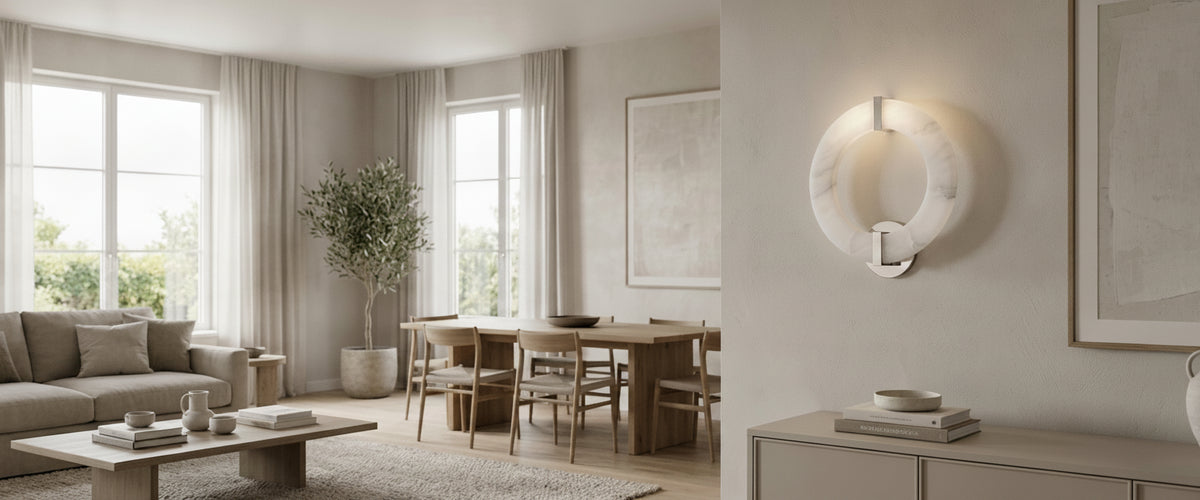

Polished nickel gets mistaken for chrome about nine times out of ten, and that mix-up is why so many hallways end up feeling like a gym locker room. A polished nickel wall lights behaves differently from chrome in a way you can see across a room: the metal carries a faint warm undertone, so it returns light with a softer, slightly golden cast instead of the blue-white snap of chrome. Get the room, the arm length and the bulb right and it reads as quiet money. Get them wrong and you have installed a very handsome mirror at eye level.

Key Takeaways
- Polished nickel is warm-toned silver. Chrome is cool and hard; satin nickel is matte and forgiving; polished nickel sits between them with a slight amber lean.
- High reflectivity is a room decision. A polished nickel wall light rewards dim, deep spaces like stair halls and dining rooms, and punishes bright south-facing walls and mirror-heavy bathrooms.
- Arm length controls the wall wash. A short backplate sconce grazes the wall; a projecting arm throws a wider, softer pool and keeps the hot spot off the paint.
- Warm light flatters the finish. Around 2700K makes nickel look expensive. Anything above 3500K drags it toward hospital-grade steel.
- Pair it with stone, not with more shine. Alabaster, honed marble and painted joinery calm the reflection; glossy tile and polished granite amplify it.

Mirror Versus Satin: What the Polished Surface Actually Does to Light
A polished surface reflects specularly, meaning light bounces off at a predictable angle and arrives at your eye as a bright point. A satin or brushed finish scatters that same light across thousands of tiny abrasions, which is why satin nickel looks like a soft gray cloud from any angle and polished nickel looks like a series of hot highlights that move as you walk.
That difference matters most at the edges. On a curved sconce body, the mirror finish draws a bright ribbon along the curve and a deep shadow beneath it, which sharpens the silhouette and makes the fixture look sculptural. Satin flattens that same curve into something quieter. Neither is better. But a polished nickel wall light asks for a form worth outlining, and it asks for a wall that will not fight it.
The other trade is maintenance honesty. Polished metal shows fingerprints, water spotting and dust in a way brushed finishes never do; in our studio we buff polished pieces with a cotton cloth before every shoot for exactly that reason. If a polished nickel wall light sits within arm's reach of a busy family bathroom sink, satin will look better on a Tuesday morning, and something like the Wales LED Up Down Wall Light in Satin Nickel keeps the silvery tone of the scheme without recording every splash.
The Rooms Where High Reflectivity Works in Your Favor
Dim, deep, circulation-heavy spaces are where a polished nickel wall light earns its place. A windowless stair hall in a Brooklyn brownstone has almost no ambient light to fight with, so every reflected highlight becomes useful. Dining rooms work for the same reason: you run the light low, the room is doing evening work, and the metal picks up candlelight and glassware and gives it back.
Powder rooms are the classic win. Small, dark, and used for two minutes at a time, they carry a level of shine that would exhaust you in a bedroom. Paired with a marble vanity top and an alabaster shade, nickel there reads as jewelry rather than hardware.
Where it turns against you: a bright, south-facing living room wall in Southern California, where midday sun hits the fixture directly and turns it into a glare source before it is switched on. Full-height mirrored bathrooms are the other trap, because you are doubling every highlight. Long corridors with glossy paint above eye level cause a similar problem; you catch the reflection of the lamp in the paint sheen as you walk toward it. Flat or eggshell paint solves most of this quietly.
One honest note from client work. We shipped a pair of alabaster-and-nickel sconces to a Napa guest suite, specified either side of the bed at standard height. The seated sightline put the polished backplate right in the guest's eye line from the pillow. Dropping the fixtures by four inches (10 cm) and rotating the shade slightly downward fixed it in an afternoon. Reflectivity problems are almost always geometry problems.
Arm Length and Shade Direction Shape the Wall Wash
Projection is the single most under-considered spec on a polished nickel wall light. A fixture with a short projection sits tight to the plaster and grazes it, throwing a narrow vertical scallop with a defined hot spot. That grazing effect is beautiful on limewash, textured plaster or fluted paneling, and unkind on flat drywall where every seam and screw pop shows up.
Push the source out on a longer arm and the wash widens and softens. The bright center moves away from the wall surface, the shadow becomes gentler, and the fixture starts lighting the room rather than the paint. Where a corridor needs continuous brightness instead of a row of bright dots, a long linear format such as the Flara Chrome LED Wall Light 30W 3000K in 75cm spreads output across a much wider band of wall, which is worth testing against your corridor length before you commit.
Shade direction sets the mood. Uplight bounces off the ceiling and lifts the whole room, which suits a dining room where you want lift without glare. Downlight puts a focused pool on a console or a stair tread. Up-down fixtures do both and are the most flexible choice for stairwells; a compact double-throw piece like the Marley Up Down Wall Light is the shape to look at when one backplate has to serve the tread and the ceiling. A diffusing shade, particularly one cut from alabaster, removes the point-source problem entirely and lets you run a slightly brighter lamp without discomfort. You can see how that soft, veined diffusion behaves across formats in the alabaster lighting collection.
Pairing Polished Nickel With Stone, Marble and Painted Joinery
Nickel and alabaster work in opposite directions. The metal is specular and bright; alabaster is translucent and scattering, glowing from within rather than bouncing anything back. Put them on one fixture and the shade absorbs the visual heat while the nickel provides the crisp line. That is why so many of our sconces carry stone shades on metal frames rather than metal on metal.
With marble, watch the finish before the color. Honed Calacatta or a soft gray Bardiglio sits comfortably under polished nickel because the stone is matte and the metal is not. Polished marble under polished nickel is two mirrors in conversation, and the result looks busier than anyone intended. Backlit onyx is the exception worth breaking the rule for: it is so dominant in color that the metal becomes a frame rather than a competitor.
Against painted joinery, cool grays and greens flatter nickel's silvery lean, and warm creams make it look faintly cold. Deep inky blues are the safest high-contrast partner. If the room already has unlacquered brass hardware, a polished nickel wall light can still work, but keep the two metals on different planes; nickel on the walls, brass on doors and cabinetry. Mixed metals fail when they are adjacent, not when they are distributed. To hold one scheme together across several rooms, browsing the full lighting range by finish family is faster than sampling one fixture at a time.
Why a Warm Bulb Flatters the Silvery Tone
Nickel's faint amber undertone only shows up under warm light. Run a 2700K lamp in a polished nickel wall light and the metal looks like antique silver: soft, slightly golden, with depth in the shadows. Run 4000K and the same fixture goes flat and slightly blue, which is the fastest way to make an expensive sconce look like a hardware-store fitting.
Color rendering matters just as much. A lamp with a high color rendering index brings out the warmth in both the metal and the veining of an alabaster or marble shade; a low-CRI source flattens stone into dull gray. The Illuminating Engineering Society publishes accessible background on how color rendering is measured and why it varies between sources, and it is worth ten minutes before you buy a case of bulbs.
Dimming is the third lever. The finish looks best at around 40 to 60 percent output in the evening, where highlights stay defined but stop being sharp. Specify a dimmable driver or lamp from the start, and check compatibility between the dimmer module and the LED source rather than assuming it. Warm-dim lamps, which drop toward 2200K as they dim, suit nickel particularly well in dining rooms and bedrooms.
Specification Checklist Before You Commit to a Polished Nickel Wall Light
- Confirm the finish name. Polished nickel, satin nickel and polished chrome are three different products. Ask for a sample or a close-up macro image.
- Check whether the finish is lacquered. Lacquered nickel resists tarnish but can look slightly plasticky; unlacquered develops a softer patina over years.
- Measure projection, not just height and width. Anything on a hallway wall under 40 inches (about 100 cm) wide needs a tight projection so shoulders clear it.
- Set mounting height to the sightline. Seated eye level in a bedroom, standing eye level in a hall, above the top of a mirror in a bathroom.
- Confirm the IP rating for wet zones. Bathrooms and covered outdoor walls need a rating suited to the zone, and a qualified electrician should confirm the installation.
- Ask about the shade material. Natural stone varies piece to piece, so ask whether the veining shown is representative or the actual item.
- Check the backplate against your wall condition. Old lath-and-plaster walls rarely give you a flat surface; a slightly larger backplate hides sins.
- Plan the bulb and dimmer together. Warm color temperature, high CRI, and a dimmer confirmed as compatible with the driver.
- Budget honestly. Cost tracks material, scale, engineering, hand-finishing and installation complexity, so request a tailored quote for the configuration you want.
Keeping the Finish Looking Right
A polished nickel wall light wants a dry microfiber cloth and nothing else in normal use. Skip abrasive creams and anything containing ammonia, which can dull lacquer and etch the surface over time. For fingerprints, breathe on the metal and buff rather than reaching for a spray, because overspray is what damages the stone shade sitting an inch away.
Alabaster and marble shades are a separate discipline. Gypsum alabaster is porous and reacts badly to water, so clean it dry with a soft brush and never with a household cleaner. The Metropolitan Museum of Art's background on alabaster in decorative objects gives a sense of how carefully the stone has been treated historically. Treat your shade the same way and it will outlast the paint behind it.
One last practical point: buy the pair or the run at the same time. Plating varies subtly between production batches, and a replacement sconce ordered two years later rarely matches the original under a warm lamp. If you are working through a whole-house scheme, review the range on Niori in one pass rather than piecing it together over a season.