
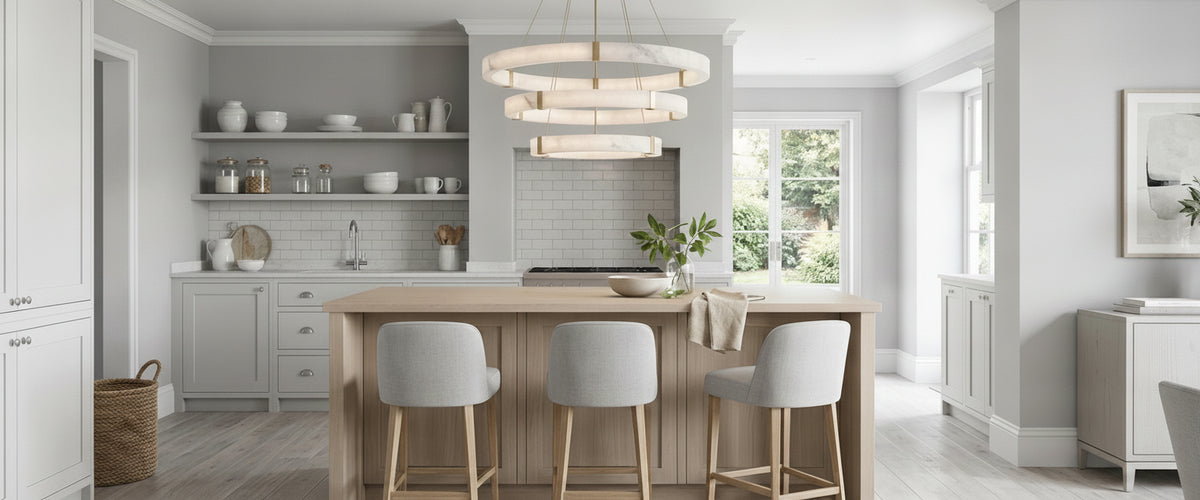

Brass forgives nothing. Hang the wrong one and the room tells on you within a week: the finish fights the taps, the drop is three inches too high, the light goes thin and yellow the moment you touch the dimmer. A beautiful brass chandeliers is one of the few fixtures that can carry an entire room on its own, which is exactly why the decisions behind it deserve more thought than a scroll through a search results page.
At Niori we build most of our chandeliers around alabaster and natural stone, with brass as the structural and decorative partner. That pairing has taught us where the metal flatters and where it exposes a bad plan, and what separates a beautiful brass chandelier from an expensive mistake.

Key Takeaways Before You Shop
- Finish first. Polished, antique, brushed and unlacquered brass age in completely different ways. Choose a beautiful brass chandelier for the ageing behaviour you want to live with, not just the showroom photo.
- Scale is arithmetic, not instinct. Ceiling height and table width set the diameter and the drop. Guessing is how rooms end up looking off-balance.
- Warm light or nothing. Brass reflectors amplify whatever colour temperature you feed them. Cool LEDs turn warm metal flat and slightly green.
- Alabaster softens brass. Stone shades diffuse the glare that bare bulbs create against a reflective metal frame.
- Craft shows in the joints. Solid brass, brazed connections, ceramic sockets and well-matched stone are the signals worth checking before you commit.

Four Brass Finishes, Four Very Different Ceilings
Polished brass is the loudest of the four. Mirror-bright, high contrast, and it throws light back into the room with real punch. It suits formal dining rooms, double-height entrances and any space with enough architectural presence to answer back. In a low-ceilinged room it can look restless.
Antique or aged brass arrives pre-darkened, with the recesses deliberately deeper in tone than the high points. This is the most forgiving finish in older homes, warm-toned kitchens and rooms with reclaimed timber or aged plaster. It also hides fingerprints better than anything else on this list, which matters more in a family kitchen than most people expect.
Brushed or satin brass sits between the two. The fine directional grain kills reflections without going dull, and it pairs beautifully with translucent alabaster because neither material competes for attention. Most of the alabaster fixtures we ship use a brushed frame for exactly this reason; it is the most reliable route to a beautiful brass chandelier that ages quietly. Where the metalwork needs to read as structure rather than ornament, a layered-arm piece such as the Aurelian LED Layered Arms Alabaster Chandelier keeps the frame quiet enough for the stone to lead.
Unlacquered brass is the connoisseur's choice and the one that generates the most customer emails. It has no protective coating, so it oxidises in real time, developing a mottled, deepening patina shaped by humidity, handling and cooking vapours. In a coastal hallway the shift can be obvious inside a single summer, because salt air accelerates everything. If that sounds like character, buy it. If it sounds like a maintenance problem, buy lacquered and never think about it again. Conservation guidance on copper alloys is clear that coatings are the practical barrier between metal and atmosphere, and that removing tarnish repeatedly takes material with it, so choose your side early (Canadian Conservation Institute).
Scale: The Arithmetic That Decides Flattery or Overwhelm
Scale is where a beautiful brass chandelier either flatters a room or bullies it, and two numbers do most of the work. For a fixture floating in a room rather than over furniture, add the room's length and width in feet and treat that sum in inches as a sensible diameter: a 4.3 by 4.9 m room (14 by 16 feet) points toward a fixture around 76 cm (30 inches) across. Over a dining table, ignore the room and look at the table. Aim for roughly half to two-thirds the table's width, leaving clear air on both long edges so nobody feels crowded.
Drop height is where most installations go wrong. Over a dining table, 76 to 91 cm (30 to 36 inches) between the tabletop and the lowest point of the fixture keeps sightlines open across the table while putting the light where it flatters faces. In an open walkway, keep at least 2.1 m (7 feet) of clearance from the floor. For ceilings above 2.4 m, add roughly 7 cm to the fixture height, or lengthen the chain, for every additional 30 cm.
Vaulted spaces need a different conversation entirely. In a dining room with a steeply pitched ceiling, the first instinct is usually a compact fixture; the better answer is a longer, linear alabaster and brushed brass chandelier along the lines of the Aurevia 14 Light LED Linear Alabaster Chandelier, which fills the vertical volume instead of hovering apologetically inside it. Height of the room, not floor area, sets that call. It also raises a practical point: confirm the fixture's weight in kilograms against the ceiling box and joist support before anything is ordered, and have a qualified electrician verify the mounting and wiring.
Backdrop Decisions That Let Brass Age Gracefully
Brass photographs well against almost anything. It lives well against far fewer backdrops. Cool grey-blues and stark whites push warm metal toward orange, which reads cheap even when the fixture is anything but. Warm off-whites, clay, deep olive, plaster pinks and mushroom tones let brass sit down and behave.
Texture matters as much as colour. Limewash, polished plaster and lightly troweled finishes scatter the reflected light and make the metal look richer over the years, particularly as an unlacquered finish darkens. Flat modern emulsion on smooth board gives you nothing to bounce against.
Think about what happens in five years, not on installation day. Antique brass changes very little. Unlacquered brass will be visibly different, and a wall colour chosen to match today's bright metal can look mismatched once the fixture has deepened. Pick a backdrop that works with both ends of the range, so a beautiful brass chandelier still looks deliberate in year five.
Where a Beautiful Brass Chandelier Reads as Intention, Not Afterthought
Dining rooms are the natural home. The table gives the fixture a job, the seated eye level gives it a correct height, and the ceiling gives it a frame. This is where a beautiful brass chandelier with alabaster shades earns its keep every evening.
Entrance halls and stairwells reward vertical fixtures. A tiered brass frame seen from both the ground floor and the landing does two jobs at once. Check the swing clearance from the stair edge.
Principal bedrooms want restraint. A smaller-scale fixture centred over the foot of the bed, dimmed low, beats a downlight grid every night of the week. A three-light form such as the Arco 3 Light Chandelier in Brass is closer to the right scale here than anything with a wide arm span, and alabaster shades matter because you will occasionally look straight up at it from the pillow.
Kitchens and islands suit linear multi-light fixtures rather than round ones. Aged or brushed brass copes far better with cooking atmosphere than a mirror polish.
Where it becomes an afterthought: hallways too narrow to see it properly, corridors where the fixture only ever appears at an angle, and rooms where a ceiling fan already owns the centre point. If the fixture cannot be seen from a seated position in the room's main gathering spot, spend the budget on wall lights and a floor lamp instead. Our wider lighting collection covers those supporting layers, and getting them right is often what makes the centrepiece look expensive.
Bulb Warmth and Dimming: Brass Amplifies Your Choices
A beautiful brass chandelier is partly a reflector. Every surface bounces the source colour back into the room, so the bulb decision has more consequence here than it does in a matte fixture. Stay between 2400K and 2700K. At 3000K and above, warm metal starts to look drained, and any alabaster in the fixture loses the honeyed quality that makes stone worth using in the first place.
Ask for a colour rendering index of 90 or higher. Brass has a narrow, specific hue, and a low-CRI lamp flattens it. Dim-to-warm LEDs are worth the premium in dining rooms because they mimic the way incandescent light drops toward candlelight as it dims, which is precisely the effect a chandelier over a dinner table is supposed to produce.
Dimming compatibility is the detail most buyers skip. LED drivers and dimmer modules have to be matched, and a mismatch shows up as flicker, buzz or a dead zone at the bottom of the dial. Confirm which dimmer type the fixture's driver expects, and have your electrician install accordingly rather than reusing whatever was already on the wall. The US Department of Energy publishes plain-language guidance on LED performance and controls if you want the technical background.
Craft Signals Worth Scrutinising Before You Commit
Two fixtures can look identical online and behave nothing alike overhead. These are the details worth pressing a supplier on before you commit to a beautiful brass chandelier.
- Solid brass versus brass plating. Plated steel will eventually chip or wear at contact points and cannot be refinished. Solid brass can be polished, re-lacquered or left to patina.
- Joints. Brazed or threaded connections at the arms, not adhesive. Look at where an arm meets the central body; that is where corners get cut.
- Weight in the hand. Spun and cast components have heft. Thin stamped parts ring hollow.
- Stone quality. On alabaster fixtures, check that shades are cut to a consistent thickness. Thin patches glow hot and uneven; well-selected stone lights evenly and shows its veining as a soft internal drift rather than a blotch.
- Vein matching. Multi-shade fixtures should look like they came from related blocks. Random matching is the fastest way to make natural stone look accidental.
- Sockets and internals. Ceramic or high-grade sockets, properly sleeved wiring, and a canopy finished to the same standard as the visible body.
- Serviceability. Ask whether shades, drivers and sockets can be replaced individually. A centrepiece fixture should be repairable, not disposable.
A Short Pre-Purchase Checklist
- Measure table width and ceiling height, then calculate diameter and drop before you look at a single photo.
- Decide your finish based on ageing behaviour, cleaning tolerance and local humidity.
- Hold the finish against your actual wall colour and cabinetry hardware, in evening light.
- Confirm fixture weight and mounting requirements with a qualified electrician.
- Specify bulbs at 2400K to 2700K with CRI 90+, and match the dimmer to the driver.
- Ask the supplier about stone selection, vein matching and replacement parts.
- Plan the supporting layers: wall lights, table lamps, floor lamps.
Care is simple once a beautiful brass chandelier is installed. Dust the metal with a dry, soft cloth. Skip ammonia-based cleaners and never wet-clean alabaster, which is a soft, water-sensitive stone that will mark if treated like glass. If you have chosen an unlacquered finish, resist the urge to polish it back; the patina is the point.
Budget and Specification
What a beautiful brass chandelier costs depends on material grade, overall scale, the complexity of the metalwork, how the stone is selected and finished, the engineering behind the suspension, and installation. A hand-finished solid brass frame with matched alabaster sits in a different bracket from a plated fixture with acrylic diffusers, and the difference shows in the first hour of use. For a project-specific piece or a custom drop length, ask for a tailored quote rather than working from a general figure.
If brass and stone together is the direction, browse the alabaster lighting collection to see how brushed and burnished frames behave against different stone tones. Take note of which combinations read warm and which read crisp; that single observation usually settles the decision faster than any spec sheet.