
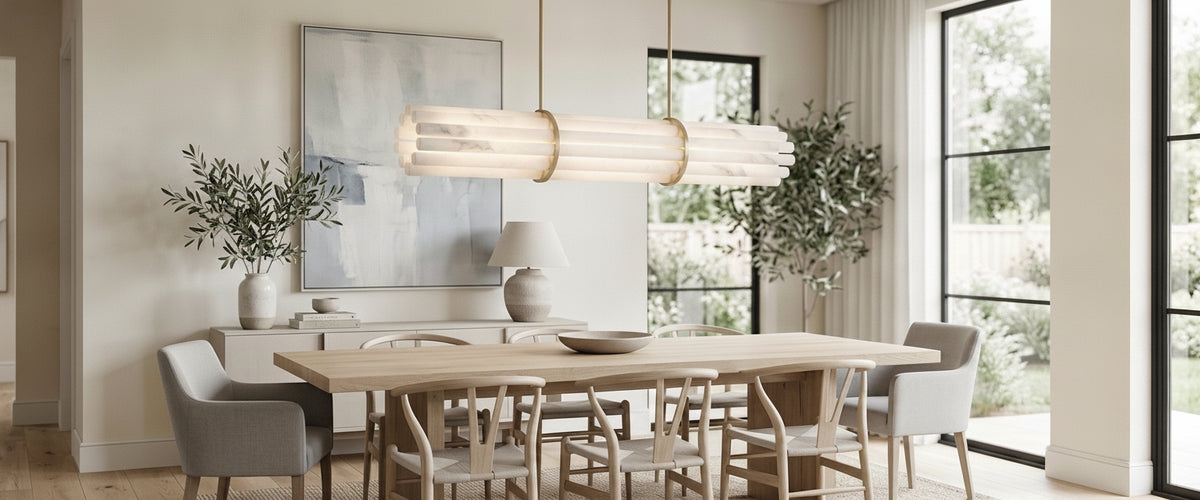

A single round chandelier hung over a three-metre dining table is a compromise, and everyone sitting at the far ends knows it. The centre of the table glows, the seats at each end sit in a slow fade, and the fixture itself looks like it was chosen for a different room. An alabaster linear chandeliers solves the geometry problem and, if the stone is specified properly, does something a glass or metal bar fixture cannot: it turns the light source itself into a long, softly lit plane of natural material that reads warm from every seat.
Getting there is a matter of detail. Slab length, joint placement, suspension spacing and lamp positioning all sit behind the finished piece, and they are the things buyers ask about last when they should be asking first.

Key Takeaways Before You Specify
- An alabaster linear chandelier should be roughly half to two-thirds the length of the table, and at least 30cm (12in) narrower overall.
- Ask whether the alabaster panels are cut sequentially from one block. Veining continuity across joints is the difference between a crafted piece and an assembled one.
- Linear fixtures need two or more ceiling fixings. Find out where your joists run before you order, not on installation day.
- Hot spots along the lamp run are a design failure, not a bulb problem. Diffusion distance and lamp spacing fix them.
- Specify 2700K, CRI 90+ and a trailing-edge dimmer. Alabaster rewards warm, dimmable light and punishes cold, flat light.

Why the Linear Form Changes How Stone Reads
Alabaster is translucent in a way most people underestimate until they see a slab backlit for the first time. Light does not bounce off it; it travels a short distance into the gypsum, scatters against the crystal structure, and comes back out softened and slightly warmed. The V&A and other collections hold medieval English alabaster carvings precisely because the stone takes fine detail while staying luminous, and the Metropolitan Museum of Art holds comparable pieces that show how long makers have exploited that quality.
In a round or drum fixture, you see that glow as a single point of interest. Stretch the same material into a bar 1.2m or 1.8m long and the effect changes character entirely. You are now reading the stone as a horizon line rather than an object. Veining runs sideways across your field of view and the eye follows it. That is why an alabaster linear chandelier asks more of the material than a compact pendant does: any inconsistency in colour, thickness or vein direction is laid out end to end for inspection.
It is worth being honest about when stone is the wrong answer. If the brief is sparkle and refraction rather than a continuous plane of glow, a linear format built from discrete glass or crystal elements, such as the Bolero 6 Light Linear Square Drop Glass Bubble Chandelier, is speaking a different design language: light broken into points rather than spread across a surface. Both suit long tables; they do very different things to the room after dark.
The stone also changes the light on the table. A long emitting surface throws a broad, even wash down the length of the table rather than a pool at the centre, which is exactly what you want for a dinner for ten. Faces are lit softly from above and slightly to the side, glassware picks up warmth, and there is no harsh cut-off two seats from the head of the table.
Slab Length, Joints, and Why Veining Continuity Matters
Alabaster comes out of the ground in blocks, and usable translucent stone of consistent colour has limits. Beyond a certain length, an alabaster linear chandelier will be made from more than one panel. That is normal. What separates good work from careless work is where the joints fall and what happens to the veining across them.
When panels are sliced sequentially from a single block, the veining carries on across each joint like a continuous drawing. When panels are pulled from whatever stock is on the shelf, you get three unrelated pieces of stone in a row, and once the fixture is lit that mismatch is obvious from across the room. Backlighting exaggerates everything. A vein that looks like a faint shadow in daylight becomes a dark ribbon at night.
Questions worth putting to any supplier before you commit:
- Are all panels cut from the same block, and cut sequentially?
- Where do the joints sit relative to the lamp positions? A joint directly over a lamp will glow along its edge.
- Can I see the actual slabs backlit before assembly, not a stock photo of a different piece?
- Is the stone thickness consistent panel to panel?
We photograph slabs on a lightbox at the studio before anything is cut, and it is genuinely surprising how often two pieces that look near-identical dry will read as completely different stones once lit. One recent commission for a barn conversion in Oxfordshire went through three block selections before the veining behaved across a 1.6m span. That is the part of the process nobody sees, and it decides whether the finished piece looks inevitable or improvised.
Sizing an Alabaster Linear Chandelier to the Table
Size an alabaster linear chandelier to the table rather than to the room, and the ratio that holds up in real UK dining rooms is straightforward: roughly half to two-thirds the length of the table. Shorter than half and it looks apologetic; longer than two-thirds and it starts competing with the table rather than serving it. On a 2.4m table, something in the 1.2m to 1.6m range sits comfortably.
The same arithmetic works downwards. Over a 1.6m to 1.8m table, a 90cm run like the Astro 4 Light Linear Crystal Chandelier sits neatly inside that half-to-two-thirds band, where the same length hung over a three-metre table would look stranded. Measure the table before you fall for a fixture, not afterwards.
Width matters just as much and gets ignored. Leave at least 15cm (6in) of clear table on each side of the fixture when viewed from above, so nobody reaching for a serving dish meets stone. For hanging height, 75cm to 90cm (30in to 35in) between the tabletop and the underside works for a standard 2.4m ceiling. Add roughly 7cm for every additional 30cm of ceiling height, and check sightlines by sitting down. The test is simple: can two people opposite each other see each other's faces without leaning?
Period properties complicate this. Low beamed ceilings, sloping soffits and off-centre ceiling roses are common, and a linear form is more forgiving here than a wide drum because it occupies length rather than depth. If you are weighing a linear piece against other formats, look across the full alabaster lighting range first and see how the same stone behaves in pendants, wall lights and floor lamps before settling on the dining fixture.
Suspension Points: The Detail Buyers Overlook
Round chandeliers hang from one point. An alabaster linear chandelier rarely does. Most span their weight across two or three suspension cables or rods, and stone is substantially heavier than glass or acrylic of the same size. That means the fixing positions are decided by your ceiling structure, not by preference.
The longer the run, the less negotiable this becomes. A 1.8m fixture along the lines of the Sparx White Linear Pendant Light 30W 3000K carries its weight on two widely spaced drops, and those drops have to answer to the joists rather than to the table centreline. In stone, with the extra mass involved, that constraint tightens further.
UK joists typically run at 400mm centres, and there is no guarantee your suspension points will land on them. If they do not, you need noggins fitted between joists to carry the load, which means access from above or a small area of ceiling opened and made good. On a plasterboard ceiling with no timber behind the fixing point, no proprietary anchor is an acceptable substitute for solid timber.
Establish three things early: where the joists run, whether the existing rose position aligns with your intended table centreline, and whether the ceiling void can be accessed. Installation should be carried out by a qualified electrician working to BS 7671, and Electrical Safety First is a sensible reference point on what competent work looks like. Stone fixtures also want a canopy and cable system rated properly for the load; ask the question rather than assuming.
Avoiding Hot Spots Along the Lamp Run
The most common fault in a poorly engineered alabaster linear chandelier is scalloping: a row of visible bright patches where each lamp sits, with dimmer bands between them. It ruins the effect, because the whole point of the stone is a continuous, even glow.
Three factors control it. Lamp spacing relative to the diffusion distance is the main one; the further the light source sits from the back of the stone, the more the beams overlap before they reach it. Panel thickness is the second, and it is a balancing act, since thicker stone diffuses better but transmits less light. A secondary opal diffuser between the lamps and the stone is the third, and it is the mark of a fixture that has been engineered rather than assembled.
For lamps, use frosted or opal rather than clear, and keep colour temperature at 2700K. Alabaster has warm honey and cream undertones that turn slightly grey under 4000K light. Specify CRI 90 or above so food and skin tones read properly, and pair the circuit with a trailing-edge dimmer suited to LED loads. Dim-to-warm drivers are worth the extra outlay in a dining room, because the stone drops into an amber glow at 20 per cent that no fixed-temperature source reproduces.
How the Fixture Talks to the Rest of the Room
A linear chandelier draws a strong horizontal line, and that line has to agree with something else in the room. Align it to the table centreline first, then check it against the window run, a long sideboard, or a kitchen island in open-plan spaces. Where those axes disagree, the eye picks up the conflict immediately even if nobody can name it.
Night-time reflections are the other consideration. In rooms with large glazed doors, the fixture appears twice: once in the room, once in the glass. A warm linear glow reflected across a dark window is a genuine asset, but only if the piece reads cleanly from behind as well as below. Ask what the top face looks like.
alabaster dining room chandeliers also work harder when they are not the only stone in the scheme. A pair of alabaster wall lights on the flanking wall, or a table lamp on the sideboard in the same stone family, gives the room three warm anchor points at different heights instead of one bright bar. Layered like that, an alabaster chandelier in the dining room stops being a fixture and starts being the lighting scheme. Browsing the wider lighting collection alongside your chandelier choice makes those pairings easier to plan.
Pre-Order Checklist
- Measure table length and width, then confirm the alabaster linear chandelier at half to two-thirds of table length.
- Confirm at least 15cm (6in) of clear table each side of the fixture.
- Set hanging height at 75cm to 90cm (30in to 35in) above the tabletop and adjust for ceiling height.
- Ask for backlit photographs of the actual slabs and confirm sequential cutting from one block.
- Locate joists and confirm suspension point positions before ordering.
- Check the fixture uses a secondary diffuser or engineered lamp spacing to prevent hot spots.
- Specify 2700K, CRI 90+, frosted lamps and a trailing-edge or dim-to-warm dimmer.
- Confirm installation by a qualified electrician and agree who makes good any ceiling access.
Living With Stone Overhead
Alabaster is soft. It sits around 2 on the Mohs scale, which is roughly fingernail hardness, and gypsum alabaster is sensitive to water. Dust panels with a dry, soft brush or a clean microfibre cloth; a soft artist's brush gets into carved edges without pressure. Skip ammonia, vinegar, glass cleaner and anything described as a multi-surface spray, all of which can etch or dull the surface permanently.
Keep the fixture away from steam. A dining room is fine; an open-plan layout where the piece sits directly above a hob or within reach of a steam oven is worth reconsidering. LED lamps run cool enough that heat is rarely an issue, which is one reason a modern alabaster linear chandelier is far more practical than its historic equivalents ever were.
On budget, there is no honest single figure. Cost tracks block selection, slab length and how many joints are involved, frame material and finishing, engineering of the diffusion layer, and installation complexity in your particular ceiling. A short two-panel fixture in standard stone and a long sequentially matched piece in brass are different propositions entirely. Send through your table dimensions, ceiling height and a photograph of the space, and ask for a tailored quote rather than working from a guess.
Do the specification work up front and an alabaster linear chandelier will outlast every trend the dining room passes through. Skip it, and you will spend years looking at a joint in the wrong place.