
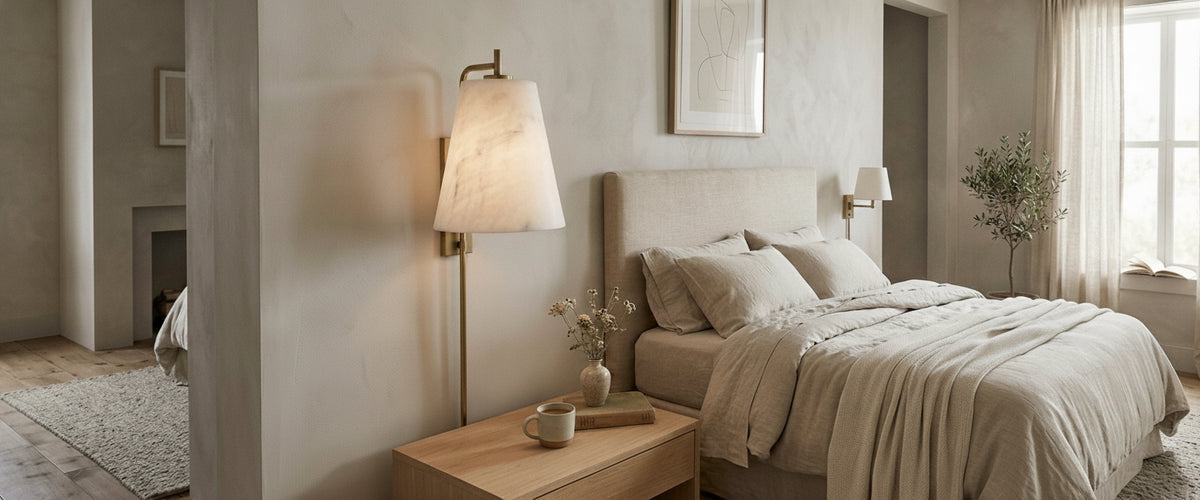

A bedside lamp is a compromise dressed up as a solution. It lights the tabletop, the wall behind it, a good deal of the ceiling, and only incidentally the book in your hands. Anyone who reads for more than twenty minutes at night knows the symptom: you tilt the page toward the shade, your neck stiffens, and by chapter three you have given up. The wall reading lights bedroom readers reach for night after night solve that geometry problem at source, because they put the light above and slightly behind your shoulder where it belongs, and they clear the nightstand of clutter while they are at it.
At Niori we specify a lot of these. Alabaster and natural stone give a particular quality of glow that flatters a bedroom, but stone also behaves differently to glass or fabric when you ask it to do a directional job. Most wall reading lights bedroom projects come down to that balance, and getting it right is the bulk of the work.

At a Glance: What Makes a Wall Reading Light Work
Height: center the light roughly 55 to 70cm (22 to 28in) above the top of the mattress, not a fixed height off the floor.
Position: the source wants to sit behind and outboard of your shoulder, not in front of your eyeline.
Aperture: a defined downward opening beats an all-over glow if you actually want to read.
Control: a switch on the fitting itself, plus dimming. Reaching for the door at 11pm defeats the point.
Color: 2700K for the bedroom. Daylight-white lamps belong in a workshop.
Wiring: settle cable positions before plastering, and use a qualified electrician.

Why a Wall Light Outperforms a Bedside Lamp for Real Readers
Three things go wrong with table lamps at bed height. The shade sits at roughly eye level when you are propped up on pillows, so you get glare straight into the field of view. The bulb is too low to clear your shoulder, so your own body casts a shadow across the lower half of the page. And the light is symmetrical, which means half of its output goes into the room and wakes whoever is trying to sleep beside you.
A wall-mounted fitting fixes all of that with position alone. Raise the source, push it behind the shoulder line, and the page is lit evenly with no shadow and no glare. Choosing reading lights for bedroom use is one of the few cases in domestic lighting where the mounting geometry matters more than the fitting itself. Get the height wrong and even a beautifully made light will underperform.
There is a secondary benefit that wall reading lights bedroom clients mention more than we expect: the nightstand becomes usable again. A carafe, a stack of books, a phone charger and a small alabaster accent piece all fit where a lamp base used to squat. In smaller UK bedrooms, particularly in period conversions with narrow alcoves flanking a chimney breast, that recovered surface area is worth as much as the light.
Mounting Height and Arm Reach: The Numbers That Decide Everything
Measure from the mattress, never from the floor. Bed heights vary enormously once you factor in divan bases, deep mattresses and toppers, so a rule based on finished floor level will fail on half of installations. Sit up in the bed as you actually read, and have someone measure from the top of the mattress to your shoulder. In most cases that lands somewhere around 50 to 60cm (20 to 24in). When wall reading lights bedroom installations disappoint, the mounting height is almost always the reason rather than the fitting.
Measure to the shoulder from the mattress top, then mount the light just above that line.
The light source should sit a little above that shoulder measurement, which usually puts the center of the fitting 55 to 70cm (22 to 28in) above the mattress top, or roughly 110 to 130cm (43 to 51in) above the floor for a standard bed. Horizontally, set it outboard of your body rather than directly overhead. Aligning the fitting with the outer edge of the pillow, often 40 to 55cm (16 to 22in) from the centerline of the bed, keeps the beam off your partner's face. Height and offset together do most of the work in any wall reading lights bedroom scheme.
Arm reach or projection matters just as much. A fitting that sits tight to the wall throws its light down the wall surface, not onto the book. You generally want the light-emitting part to project far enough to clear the headboard and the pillow stack. Deep buttoned headboards need more projection than a slim upholstered panel. In an alcove or beside a narrow nightstand where a wide fitting would crowd the pillow, something compact like the Bora Matt Black Oval LED Wall Light 6W 2700K, 13.5cm holds its position without dominating the wall. Before anything is drilled for a wall reading lights bedroom install, tape a paper template of the fitting's footprint to the wall, get into the bed with a book, and check the sightlines. We have talked more than one client out of a mounting height they were certain about, and the paper test is what changed their mind.
Shade Aperture and Material: Shaping the Beam onto the Book
This is where alabaster needs an honest conversation. Alabaster is a gypsum stone with genuine translucency, and light passing through it comes out warm, soft and full of the veining that makes each piece different. That is exactly what you want for atmosphere. It is not, on its own, a task beam. A fully enclosed alabaster shade radiates in every direction and produces a lovely halo rather than a defined pool of light.
An open lower aperture lets the stone glow while a controlled cone lands on the page.
The workable answer is a fitting that does both jobs. A stone shade with an open lower aperture lets the body glow while the opening pushes a controlled cone downward onto the page. A carved alabaster back plate paired with a directional arm and a narrower shade works the same way. Onyx behaves similarly with more dramatic banding, and marble, being largely opaque, is better used as a base, back plate or arm detail than as the diffusing element. If you want to compare how different stones handle transmitted light before committing, it is worth browsing the alabaster lighting collection with this distinction in mind.
Aperture width sets the spread, and in a pair of wall reading lights bedroom side it also decides who else in the room stays asleep. Narrow openings give a tight, well-defined pool that is excellent for a single reader and slightly clinical if you also want the light to soften the room. Wider apertures spread further and read as more generous, but push the beam edge closer to the other side of the bed. Where a bedroom needs a soft diffused wash rather than a hard downlight, a broader diffusing body such as the Lystra White LED Wall Light 12W 3000K, 45cm is closer to the right design language. Where couples keep different hours, we usually recommend the narrower option on both sides and a separate low-level source for ambient warmth.
Switching and Dimming: The Detail That Matters at Eleven at Night
Specify the switch position before you specify the finish. This is where wall reading lights bedroom specifications quietly fall apart. A wall reading light that can only be turned off at the door is a design failure, however good it looks by day. Options worth discussing with your electrician include an integral rocker or toggle on the backplate, a discreet pull cord, a switched socket behind the headboard, or a two-way circuit with a plate at the bedside.
Dimming is the second half of the equation. Reading wants a decent output; the ten minutes before sleep wants almost nothing. Most integrated LED wall lights need a trailing-edge dimmer rather than an older leading-edge type, and the dimmer has to be compatible with the specific driver, otherwise you get flicker or a dead band at the bottom of the range. Ask for the driver specification in writing and hand it to your electrician. Warm-dim drivers, which shift towards a lower color temperature as they dim, suit bedrooms particularly well because the light softens as the evening does.
On color temperature: 2700K is the bedroom standard, and 3000K is about as cool as you should go. Daylight-white lamps at 5000K and above are rich in short-wavelength light, which research summarised by Harvard Health links to suppressed melatonin and delayed sleep onset. Chase a high color rendering index instead. A CRI of 90 or above makes print crisper and skin tones better, and it does far more for reading comfort than raw brightness.
Fixed Versus Adjustable Arms: What Each Type Gives Up
Fixed fittings win on form. A carved stone wall light with no visible pivot reads as architecture, sits flush and quiet against the wall, and has nothing to loosen over a decade of use. A linear fitting like the Egeo Black Linear LED Wall Light 14W 2700K, 41cm shows how that logic plays out at bed height: the length does the work of spreading light along the pillow line, so nothing needs to swivel. The trade is precision: you must get the mounting position right first time, because the beam cannot be redirected later. Fixed is the right call for wall reading lights bedroom schemes where the bed position is permanent, the headboard depth is known, and one person reads in a consistent posture.
Adjustable arms, whether swing, articulated or simply rotating at the shade, buy tolerance. They cope with a partner who reads sitting bolt upright and one who slumps, they adapt when the bed shifts 15cm (6in) during a redecoration, and they let you push light onto a laptop or a crossword. What they give up is visual calm and, over time, mechanical friction. Joints in stone-detailed fittings need decent engineering; cheap knuckles sag within a year. Ask how the pivot is damped and whether tension is adjustable.
Wired Installation: Questions to Resolve Before the Plasterer Leaves
Hardwired wall reading lights bedroom installations are a first-fix decision, not a decorating one. Once the plaster is on, moving a cable means chasing walls again. Settle these points early:
Exact cable exit heights, measured from finished floor level and cross-checked against the final mattress height, not the current one.
Backplate coverage. Confirm the fitting's backplate will conceal the back box or cable exit. Stone backplates are less forgiving than metal ones if the position drifts.
Fixing substrate. Stone fittings carry real weight. Stud walls need noggins installed behind the plasterboard at the right height; solid masonry needs appropriate anchors.
Driver location. Some integrated LED fittings house the driver remotely. Decide whether it sits in the void with access, or inside the fitting.
Switching route. Two-way wiring or a bedside plate must be planned now.
Certification. All fixed wiring should be carried out and signed off by a qualified, registered electrician.
One recent job stays with us. A client refurbishing a converted mill house in Somerset had specified a beautiful pair of alabaster wall lights under a sloping eaves ceiling, and the electrician had run cables at the height the drawings showed. Nobody had accounted for a headboard that projected 12cm (5in) further than the one in the mood board. We caught it because the client sent a photo of the taped template before second fix. The cables moved; the reading light works. Templates are cheap and re-plastering is not.
Wall Reading Lights Bedroom Checklist: Before You Drill
Measure shoulder height from the mattress with the reader in position.
Tape a paper template and test sightlines from the bed before drilling.
Check the fitting projects far enough to clear your headboard depth.
Choose a defined lower aperture if reading is the priority, a fuller stone glow if atmosphere is.
Confirm 2700K to 3000K and CRI 90 or above.
Get the driver spec and match a compatible trailing-edge dimmer.
Specify a switch you can reach lying down.
Plan noggins, back boxes and driver access before plastering.
Book a registered electrician for the install and certification.
Living With Stone Fittings
Alabaster is soft, water-soluble gypsum, which is why conservators handle it so carefully. The Victoria and Albert Museum's guidance on caring for sculpture is a useful reference point: dry dusting with a soft brush, no soaking, and no household cleaners. In practice that means a soft, dry cloth or a clean make-up brush every few weeks, and nothing containing ammonia, vinegar or bleach anywhere near the stone. Bedroom fittings live an easy life compared with kitchen ones, so this is a five-minute job, occasionally.
Marble and onyx tolerate slightly more, though sealed surfaces still dislike acids. Brass details will patinate unless lacquered, which most people come to like. If you are weighing up finishes across a whole scheme rather than a single pair of bedside fittings, working through the wider lighting range in one sitting tends to produce a more coherent result than choosing room by room.
Specify the geometry first, the material second, and the finish last. Do it in that order and a pair of wall reading lights for the bedroom will be the fittings you notice least and use most.