
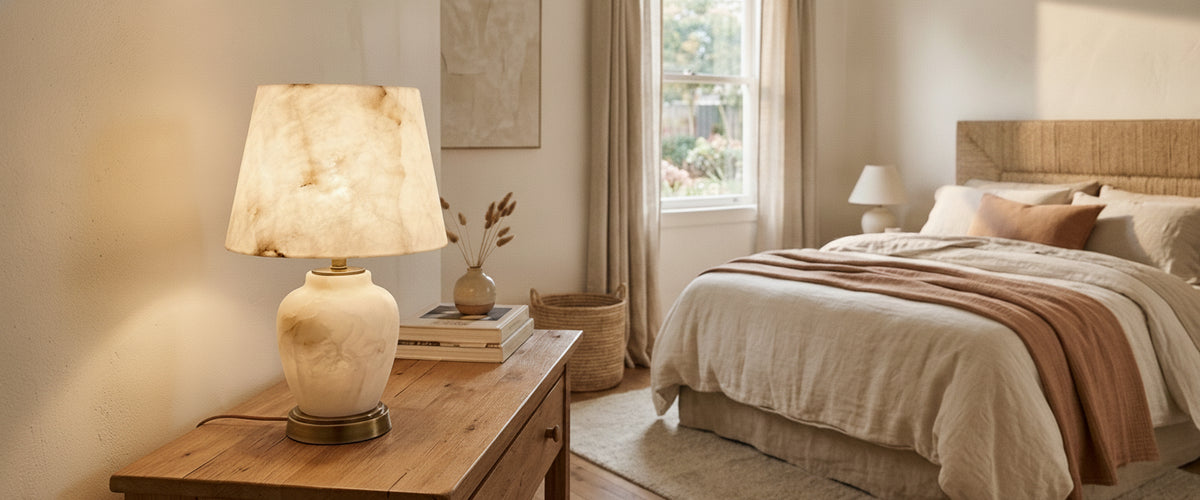

A bedside lamp is the most physically handled light in the house. You grope for it half asleep, knock the shade with a paperback, and on a hot night someone drapes a shirt over it. That daily contact is exactly why a vintage table lamps bedroom scheme works so well, and it is also why so many of these lamps look wrong once they land: a lovely 1940s base bought on instinct, stranded on a nightstand three inches too low, wearing a shade that fights it. Type vintage table lamps bedroom into a search bar and you get thousands of results with no sense of scale, which is the one thing that settles the outcome. This vintage table lamps bedroom guide sets out what actually earns a period lamp its place beside a bed: shade height measured from the mattress, shade diameter, bulb color temperature, which materials age well and which give themselves away as fakes, and what to do when a room refuses to hand you a matched pair.
Character is easy to buy with vintage bedroom table lamps. Proportion is the part most vintage table lamps bedroom projects get wrong, and it is usually why a good base still looks marooned.

Key Takeaways
Height rules everything in a vintage table lamps bedroom setup: the bottom of the shade should sit near eye level when you are propped up in bed, usually around 20 to 24 inches (50 to 60 cm) above the mattress top.
Shade diameter is the fastest fix for vintage bedroom table lamps that look marooned; too small is a far more common error than too large.
Warm-dimming LEDs at roughly 2200K to 2700K flatter aged brass, hand-blown glass and translucent stone. Anything cooler makes vintage finishes look gray.
A genuine period base paired with a freshly made shade almost always beats a full-vintage set with a tired, yellowed original.
Pair one vintage bedroom table lamp with a quieter contemporary partner rather than forcing a matched antique pair you do not love.
Alabaster and natural stone sit easily in a vintage table lamps bedroom scheme, because the material itself has been lit from within for centuries.

Why Vintage Table Lamps Suit the Bedroom More Than Any Other Room
Hallways and living rooms are performance spaces. They get looked at from a distance, often by other people, and they tolerate a certain amount of showmanship. A bedroom is read from about three feet away, lying down, in low light. Detail matters more; scale matters more; glare matters enormously.
That intimacy is what makes a vintage table lamps bedroom choice such a strong buy. A hand-turned wood base, a slightly irregular blown-glass body, the soft pitting on a cast brass column: these are qualities you notice at close range and stop noticing across a room. Age also solves a problem that new lighting struggles with. A bedroom full of freshly bought objects can feel like a hotel suite. One older piece with visible wear gives the whole scheme a spine.
There is a practical argument too. Bedside lamps rarely need to do heavy lifting on lumens. They light a book, a glass of water, a face. That low output requirement means you can choose a lamp for its material and silhouette rather than its efficiency spec, which is precisely where vintage bedroom table lamps and natural materials win.
Height and Shade Proportion: The Measurements That Stop a Lamp Looking Marooned
Start with the mattress, not the nightstand. Sit up in bed as you would to read, then find the height of your eye line. The bottom edge of the shade wants to land near that line, typically 20 to 24 inches (50 to 60 cm) above the mattress surface. Sit the shade lower and you stare into the bulb. Sit it higher and light spills across the pillow rather than onto the page. That one measurement does more for a vintage table lamps bedroom scheme than any styling decision you make afterwards.
Work backwards from there. A tall nightstand needs a shorter lamp; a low platform bed with a slim side table needs more lamp than most people expect. Overall height in a vintage table lamps bedroom setup usually falls somewhere between 24 and 32 inches (61 to 81 cm), but the number that matters is the relationship, not the absolute. This is why some designs are worth buying by size rather than by looks alone: on a high chest-style nightstand the Astro 3 Light Crystal Table Lamp, 20cm keeps the light below eye level, while the same design at 30cm is the version you want beside a low platform bed.
Shade proportion is where vintage bedroom table lamps most often fail. Older bases were frequently rewired and reshaded over decades, and each replacement tends to shrink. A useful working rule: the shade should be roughly two-thirds the height of the base, and its widest diameter should be close to the base's height. It should also cover the socket and harp completely when viewed from a seated position. Then check the nightstand itself. Leave a few inches of clear surface on each side of the shade, otherwise the lamp reads as furniture rather than lighting.
One more test worth running before you commit to a vintage table lamps bedroom shortlist: stand at the doorway and look at both sides of the bed at once. If one lamp visually outweighs the other by more than a small margin, the room will always feel slightly off-kilter, even when the lights are off.
Pairing a Period Base with a Contemporary Shade
Most vintage bedroom table lamps arrive with a shade that has either yellowed, gone brittle, or was replaced badly in 1988. Replacing it rarely feels like a compromise. It is usually the single decision that makes the lamp look intentional.
Keep the base's era visible and let the shade be quiet. A heavily decorated ceramic base from the fifties calms down under a plain linen or parchment drum. A slender brass column can carry a slightly tapered empire shade without looking costume. Where people go wrong with a vintage table lamps bedroom pairing is matching period to period too literally: a fringed shade on a fringe-era base tips the whole thing into set dressing.
Material contrast helps as well, especially when you own a single vintage bedroom table lamp and no twin exists. Say you have inherited a 1930s patinated bronze base. Rather than spend a year hunting a match, put the bronze lamp on one side, an alabaster lamp on the other, and fit identical off-white shades to both. The shades do the reconciling, and the two bases read as a deliberate pair rather than an unfinished one.
Bulbs and Dimming: How Warm LEDs Behave on Glass, Ceramic, Brass and Stone
Color temperature is the difference between vintage bedroom table lamps that glow and ones that look slightly dead. Aged brass, painted ceramic glazes and hand-blown glass were all designed under incandescent light at roughly 2700K, and older filament sources dropped warmer still as they dimmed. Modern LEDs hold their color temperature as they dim unless they are specifically warm-dim, which is why a perfectly good antique base can look chilly and gray on a standard bulb.
For bedside use, look for 2200K to 2700K, a color rendering index of 90 or above, and a warm-dim or dim-to-warm driver if the budget allows. The Illuminating Engineering Society publishes accessible guidance on how color temperature and rendering affect perceived quality of light, and it is worth a read before you buy a six-pack of bulbs you will end up returning.
Materials respond differently, and that matters more in a vintage table lamps bedroom than in a hallway. Hand-blown glass shows every flaw the bulb reveals, so a frosted or opal envelope is usually kinder than a clear filament. Where the aim is an even, ambient glow rather than a directed reading beam, an enclosed form such as the Estro Globe Glass Table Lamp, 21cm handles the bulb for you, since the glass itself does the diffusing and there is no exposed filament to catch your eye from the pillow. Painted ceramic reflects color rather than transmitting it, so warmth in the bulb matters more than diffusion. Aged brass simply drinks cool light and gives nothing back. Alabaster and onyx behave differently again: the light passes through the stone and picks up the veining, which means a warm source produces that honey-toned interior glow the material is known for, while a cool source flattens the veining into something closer to gray plastic. If you are combining a vintage base with newer stone pieces, put the same bulb temperature in both or the mismatch will be obvious.
Any rewiring of older vintage bedroom table lamps should be done by a qualified electrician. Old cloth flex, unearthed metal bodies and perished insulation are common in genuinely old pieces, and a rewire is straightforward for a professional and genuinely risky as a weekend project.
Materials That Age Gracefully, and Materials That Announce Themselves as Fakes
Some materials get better with handling, and that is half the appeal of a vintage table lamps bedroom scheme. Solid brass develops an uneven patina around the switch and the base rim, which is exactly where hands go. Hand-blown glass carries small bubbles and a slightly uneven wall thickness that catches light unpredictably. Turned hardwood dulls and softens at the edges. Alabaster develops a subtle warmth in tone over years, and because every block is different, no two lamps carry the same veining.
Alabaster deserves a caveat, because it is a soft gypsum stone and behaves nothing like granite. It scratches, it dislikes standing water, and it should never meet a household cleaner. Conservation guidance, including material published by the American Institute for Conservation, treats gypsum-based stone as far more porous and water-sensitive than harder decorative stones. In practice this means a dry microfiber cloth, a coaster under the water glass, and no perfume sprayed near the shade.
The materials that give themselves away on cheap vintage bedroom table lamps are easier to spot than you think. Plenty of the low-cost listings that surface when you search vintage table lamps bedroom fail the same tests. Brass-effect plating wears through to a whitish base metal at the touch points rather than deepening in color. Resin cast to imitate stone has veining that repeats, and it feels warm to the touch instead of cool. Printed "marble" film shows a visible seam where the pattern wraps. Hold the lamp up to a window: real translucent stone transmits light unevenly, with denser and thinner regions. Faux material glows with suspicious consistency.
If you want the period feel of a vintage table lamps bedroom without the risks of buying blind at auction, contemporary pieces made in traditional materials sit comfortably between the two. Blown glass is the easiest bridge: a piece like the Icaro 1 Light Glass Table Lamp carries the slight irregularity and depth that reads as handmade at close range, which is the distance a bedside lamp is actually judged from. The alabaster lighting collection at niori is built around the same idea: stone shades and brass detailing that suit a nightstand alongside genuinely old furniture, with none of the rewiring anxiety.
Scheme Conflicts Vintage Bedroom Table Lamps Create
The most common conflict in a vintage table lamps bedroom is metal. A vintage bedroom table lamp brings its own brass or bronze tone, and that tone rarely matches the door hardware, the picture frames or the ceiling fixture. You do not need everything to match, but you do need a hierarchy. Pick the dominant metal in the room and let the lamp be the deliberate outlier rather than one of four competing golds.
The second conflict is light level. Vintage bedroom table lamps tend to be dim by design, and if your ceiling light is bright and cool, switching between the two feels jarring. Fix it at the ceiling, not the bedside. A softly diffused stone pendant or a low-output flush fixture bridges the gap far better than a bright downlight ever will. Browsing the wider niori lighting range alongside your bedside choice is worth doing before you commit, because the ceiling decision constrains everything below it.
The third is symmetry. Many buyers assume a vintage table lamps bedroom needs a matched pair. Unless you have found two lamps you genuinely love, a considered mismatch reads better than a compromised pair. Keep the shades identical and the visual weight similar, and the eye will accept it.
The Bedside Lamp Checklist
Run through this before any vintage table lamps bedroom purchase, whether the lamp is a hundred years old or made last month.
Measure from the mattress, not the floor or the nightstand top.
Check the shade covers the bulb from a seated reading position, not a standing one.
Leave clear surface on both sides of the shade on the nightstand.
Test the switch position. Rotary switches under a shade are awkward in the dark; inline or base switches are kinder.
Confirm dimming compatibility between the lamp, the bulb and any wall dimmer before you buy.
Buy bulbs at 2200K to 2700K with CRI 90 or higher, and buy both sides of the bed at once.
Have genuinely old pieces rewired by a qualified electrician before use.
Plan care by material: dry cloth for stone, no solvents on painted ceramic, no polish on intentionally patinated brass.
What It Costs, and What Drives the Number
Budget for vintage bedroom table lamps and their contemporary stone equivalents swings widely, and honest guidance is more useful than a number. Cost is driven by the material itself (block stone is quarried, cut and matched by hand, and yield is unpredictable), the scale of the piece, metalwork complexity, the electrical components, and the level of hand-finishing on the surface. Custom sizing and matched pairs add to it. If you are specifying a vintage table lamps bedroom scheme across several rooms, whether that is a boutique property or a whole-floor renovation, request a tailored quote rather than working from a headline figure. You can start from the Niori homepage to see how the range is organized before you get specific.
A vintage table lamps bedroom purchase is one of the few where the emotional reason and the practical reason line up. You want the object because it has a history. You need it because it lights a page at 11pm without waking the person beside you. Get the height, shade and bulb right on your vintage bedroom table lamps, and both jobs are done at once.