
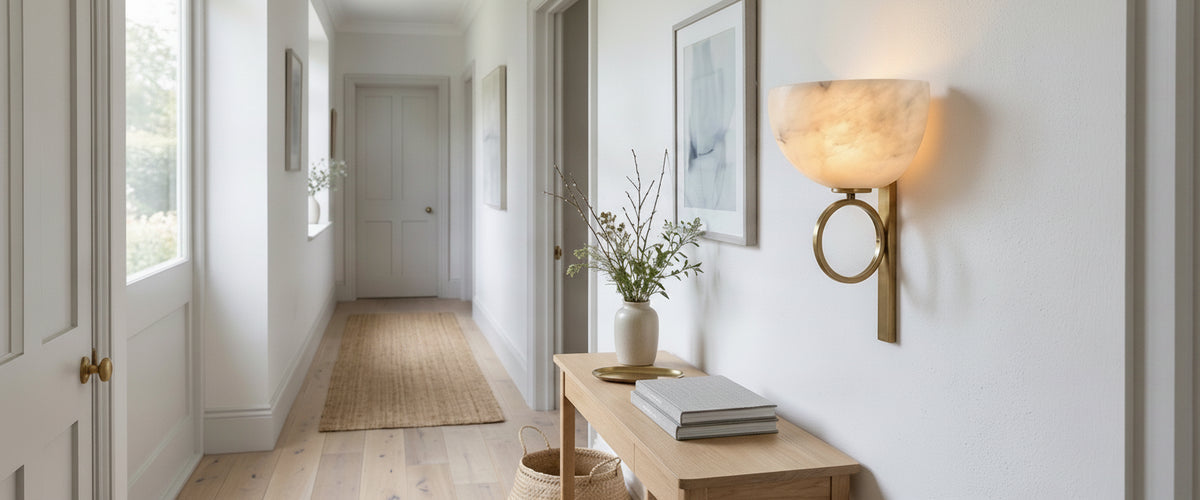

A vintage hallway lighting wall scheme comes down to four numbers: mount at 1.6 to 1.7m to the centre of the fitting, keep the projection shallow in any corridor under 1.2m wide, space fittings 1.8 to 2.5m apart, and lamp at 2200K to 2700K on a dimmer. Get those right and the period character looks inevitable rather than staged. Most hallways in Britain are lit by one ceiling fitting hung dead centre, and it does the space no favours at all. Light falls straight down, faces go grey, coat hooks throw hard shadows and the far end of the corridor disappears. Wall-mounted light solves the geometry problem before it solves the style one: thrown sideways along a wall, it lengthens a narrow space, picks up plaster texture, and gives you something to walk towards. That geometry is the real argument for a vintage hallway lighting wall layout. The period detail is the reward, not the reason.
The catch is that "vintage" is a broad and often lazy label. A reproduction gas-style bracket in a 1930s semi reads as costume. A well-proportioned aged brass vintage hallway wall light with an alabaster shade in the same corridor reads as though it has always been there. The difference is proportion, finish and restraint, and every vintage hallway lighting wall decision below follows from those three things.

At a Glance: Vintage Hallway Lighting Wall Decisions
Height: mount to roughly 1.6 to 1.7m (63 to 67 inches) at the centre of the fitting, so the light source sits just above eye level for most adults.
Projection: in a corridor under 1.2m (4ft) wide, keep the wall light's reach off the wall shallow so shoulders and suitcases clear it.
Spacing: 1.8 to 2.5m (6 to 8ft) apart for a run, and never split the difference by adding one extra fitting to "fill a gap".
Finish: aged brass warms narrow light; verdigris needs daylight to read properly; ceramic and alabaster diffuse rather than reflect.
Bulb: 2200K to 2700K, dimmable, and always check whether the shade is open, frosted or stone before choosing.
Fewer, better: on a vintage hallway lighting wall run, one generous fitting usually outperforms three timid ones.

What "Vintage" Actually Signals in a Corridor
A hallway is the only room in a house that everyone passes through and nobody sits in. That makes it a signalling space. Whatever you hang on the wall there sets the register for everything behind the doors, which is why a vintage hallway lighting wall plan is worth more thought than its square footage suggests.
Period reference works when it agrees with the building's bones. If the house has deep skirtings, a dado rail, an original arch over the hall or encaustic floor tiles, a vintage form has something to answer to. Historic England's guidance on Victorian and Edwardian interiors is a useful sanity check on what those homes actually contained, and it is more restrained than most reproduction catalogues suggest (Historic England, advice for homeowners). Where the fabric is plain, a vintage hallway wall light has to carry the whole story alone, and that is when it tips into nostalgia.
The reliable trick is to choose a fitting with an older silhouette and a quieter material palette. A swan-neck or scroll-arm bracket in unlacquered brass, holding a shade of translucent alabaster rather than moulded pressed glass, borrows the form without the pastiche. That is the honest version of vintage hallway lighting wall design. The stone reads as old because stone is old. It does not need to imitate anything.
Victorian, Edwardian and Mid-Century Forms Against UK Hallway Proportions
British hallways are narrow. A typical Victorian terrace corridor runs somewhere around 0.9 to 1.2m (3 to 4ft) wide with a ceiling well over 2.7m (9ft). A 1960s or 1970s hallway is often wider but much lower. Those two conditions want completely different vintage hallway lighting wall solutions.
Victorian and Edwardian Brackets
Gas-derived forms sit high and project outward, because they were designed to lift a naked flame away from wallpaper. That projection is the problem. In a 1m-wide corridor, a bracket reaching far off the wall becomes a shin-height hazard for anyone carrying a laundry basket. Look for shorter arms, uplit shades, or wall lanterns that hug the plaster. High ceilings will happily take a taller vintage hallway wall light, so buy height rather than depth.
Edwardian Half-Shades and Plate Lights
Flatter backplates with a half-round shade are the most forgiving vintage hallway lighting wall option for tight corridors. They wash the wall above and below, they keep the walkway clear, and they suit alabaster beautifully because the stone is doing all the visual work while the metalwork stays slim. Where a corridor is genuinely tight and every centimetre of projection counts, a shallow, small-format fitting such as the Bora Matt Black Oval LED Wall Light 6W 3000K, 13.5cm shows the kind of footprint to aim for: enough presence to register, not enough depth to catch a shoulder.
Mid-Century Forms
Lower ceilings and wider halls suit horizontal, up-down forms with a cleaner line. Mid-century fittings tend to have less ornament and more geometry, so they cope better with modern plasterboard walls that have no mouldings to relate to. A slim horizontal bar in a warm material, along the lines of the Brad LED Up Down Bar Wall Light, Wood, is closer to the right design language for a 1960s hall than any scroll-arm bracket. If the hall is under about 2.4m (8ft) high, avoid any vintage hallway lighting wall fitting with a deep downward-hanging shade; it will crowd the head height and make the ceiling feel lower still.
Spacing a Vintage Hallway Lighting Wall Run Without the Corridor-Hotel Effect
Evenly spaced identical fittings marching down both sides of a corridor is the single fastest way to make a home feel like a chain hotel. Two habits cause it: spacing that is too tight, and spacing that is too regular.
Space vintage hallway wall lights 1.8 to 2.5m (6 to 8ft) apart and stagger them if the hall is wide enough to take fittings on both walls. In a narrow hall, keep everything on one side, ideally the wall without doors, and let the pools of light overlap gently rather than form separate discs. Overlap is what makes a corridor feel continuous.
Good vintage hallway lighting wall spacing follows architecture rather than a tape measure. Centre a fitting on the arch, or on the wall between two doors, or above the console table where keys land. When a light has a reason to be where it is, the eye stops counting fittings. We had a client in a Bristol townhouse who wanted five vintage hallway wall lights down a 6m hall. We shipped three, positioned against the arch, the stair return and the console. She emailed later to say the hall finally looked like part of the house instead of a route through it.
Aged Brass, Verdigris and Ceramic in the Narrow Light a Hallway Offers
Hallways rarely have windows, so the finish on a vintage hallway lighting wall fitting is judged almost entirely under artificial light at close range. That changes how materials behave.
Aged and antique brass is the safest choice for corridors. It has enough warmth to stop a windowless space feeling cold, and its slight unevenness catches light in a way that polished metal cannot. Unlacquered brass will continue to darken with handling, which suits a hallway where sleeves brush past.
Verdigris is a harder sell indoors. That blue-green patina relies on daylight to read as intended; under warm bulbs at night it can flatten to a muddy grey. If you love it, use it where a hall has a fanlight or a glazed front door, and keep the bulb warmer to compensate.
Ceramic fittings suit cottage and utilitarian schemes and are pleasingly matt, but they bounce very little light. Pair them with a stronger lumen output than you think you need.
Alabaster and natural stone behave differently again, and this is where our range earns its keep. Alabaster is translucent, so the shade itself becomes the light source rather than a container for it. The veining glows, the output is soft, and glare essentially disappears at eye level. In a narrow corridor that matters enormously, because you walk directly past the fitting rather than viewing it from across a room. Marble and onyx do the same thing with more drama and more colour, onyx especially, which throws amber and honey tones into the space. If you are weighing stone against metal-and-glass vintage hallway lighting wall options, the alabaster lighting collection is the clearest place to see how translucency changes a wall light's character.
One care note specific to stone: alabaster is a gypsum mineral and it is water-soluble. Never take a damp cloth to it. Dust with a dry, soft brush, keep it away from radiators directly beneath, and it will outlast every other component in the fitting.
Filament or LED in a Vintage Fitting?
The bulb decision is where a good vintage hallway lighting wall scheme is most often undone.
If the shade is open or clear glass, the bulb is part of the design. A visible filament, whether genuine tungsten or a good LED replica, flatters that form. Look for a squirrel-cage or globe shape and keep the colour temperature at 2200K to 2400K so the filament glows amber rather than white. Anything above 3000K will make a clear-glass vintage hallway wall light look like a shop display.
If the shade is alabaster, onyx, opal or ceramic, the bulb should disappear. Here a compact LED at 2700K is the better tool: no hot spot burning through the thinnest part of the stone, no visible coil, and far less heat sitting inside a closed shade. Stone shades are unforgiving about badly centred lamps, so check the lamp holder position before you buy.
Dimming is non-negotiable in a hallway. You want enough light to find a coat at 8am and a low glow at midnight. Match a trailing-edge dimmer to dimmable LED lamps, and test the combination before the electrician boards the wall back up. Any vintage hallway lighting wall fitting is fixed wiring, which in the UK falls under BS 7671, so this is a job for a qualified electrician rather than a weekend project (IET Wiring Matters).
Why One Good Wall Lantern Beats Three Modest Ones
Budget instinct says spread the money across several fittings so the hall is evenly lit. In practice that produces three unremarkable objects and a corridor with no focal point.
A single generous wall lantern, positioned where it does the most work, gives the hallway a subject. Put it opposite the front door, or at the turn of the stairs, or above a console where a mirror can double its glow. Then let a low-level plinth light or a discreet downlight handle pure function at the far end. That split, one piece of character plus quiet supporting light, is how most designers we work with approach vintage hallway lighting wall design.
Scale up rather than out. A larger alabaster vintage hallway wall light with real presence will hold a 6m hall on its own, and it gives the stone enough surface area to actually show its veining. Small shades never do. If you want a sense of the jump in scale involved, something like the Bora Matt White Oval LED Wall Light 16W 2700K, 27cm is roughly the size and warmth a single anchoring fitting needs to work at, rather than the small brackets people usually order three of.
Buyer's Checklist for a Vintage Hallway Lighting Wall
Measure corridor width first, then set a maximum projection off the wall.
Confirm mounting height at 1.6 to 1.7m (63 to 67 inches) to fitting centre, adjusting up in tall Victorian halls.
Check what the fitting relates to: an arch, a door pair, a console, a stair return.
Decide one wall or two before ordering quantities. Narrow halls: one wall.
Choose finish under artificial light, not daylight photos.
Match the bulb to the shade: visible filament for clear glass, hidden LED for stone and opal.
Specify dimmable lamps and a compatible trailing-edge dimmer.
Ask about lamp holder centring if the shade is alabaster, marble or onyx.
Book a qualified electrician for fixed wiring and confirm back box requirements early.
Plan care: dry dusting only for stone, and accept that unlacquered brass will patinate.
Niori works almost entirely in alabaster and natural stone, which means our take on vintage hallway lighting wall design leans on material rather than ornament. The forms stay restrained; the stone does the talking. If you are still deciding between vintage hallway wall lights, a pendant over the stairwell or a table lamp on the hall console, browsing the wider lighting range is a quick way to see how the same stone behaves across different fixture types before you commit to a wiring plan.
Get the geometry right, keep the count low, and let the light source glow rather than glare. A vintage hallway lighting wall handled that way is the best first impression a house can make.