
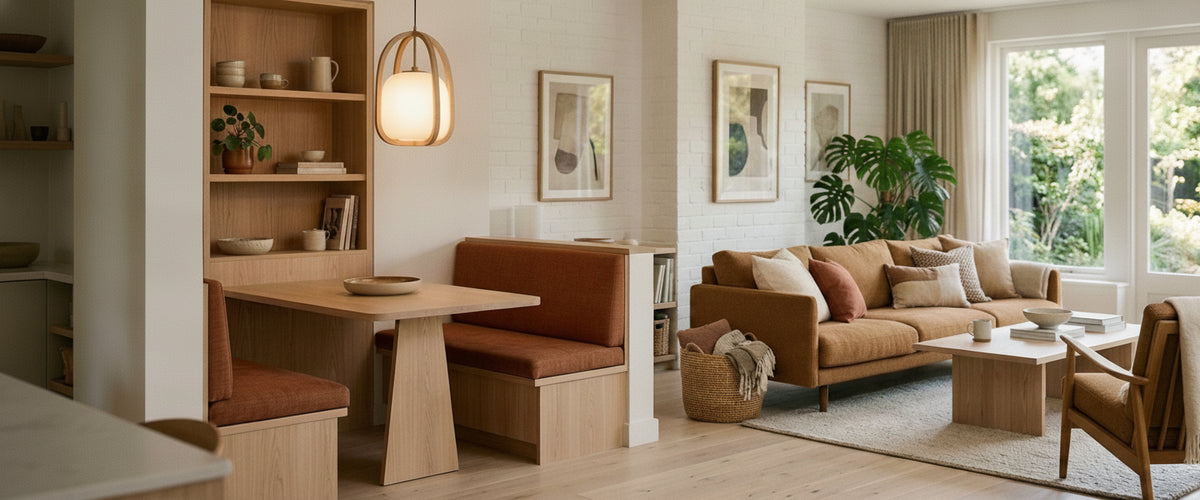

Buy a frosted glass pendant lights for the look and you will get one of two outcomes. Either the glass does its job, spreading a soft, even wash that flatters faces and stone worktops, or it fogs a perfectly good lamp into a dull grey blob that lights nothing in particular. The difference rarely comes down to price or brand. It comes down to how heavily the glass is frosted, what shape it is wrapped around, and what you put inside it.

Quick Answer: What to Check Before You Buy
Six things decide whether a frosted glass pendant light earns its place in your room:
- Depth of frosting. A light surface etch still shows the filament. A deep etch or opal casing hides it completely and cuts perceived brightness.
- Seated eye level. Over a dining table, glare is judged from a chair, not from standing height. Check what you can see of the bulb from 1.2m (about 4ft) off the floor.
- Shape drives the beam. Cylinders throw down, globes throw everywhere, domes push light sideways onto walls.
- Bulb choice matters more than wattage. Use frosted or opal LED lamps behind frosted glass unless the design is meant to show a filament.
- Dimming. Specify a dimmable driver and a compatible dimmer, and have a qualified electrician confirm the circuit.
- Alternative worth weighing. Alabaster and natural stone diffuse light with visible depth and veining rather than a flat white face.

What Frosting Actually Does to the Light Cone
Clear glass barely interferes with light. You see the source, sharp shadows, and a hard bright point that the eye keeps returning to. Frosting scatters that light at the surface, so the glass itself becomes the visible source rather than the bulb inside it. The cone widens, edges soften, and the shadow under a chair leg turns from a hard line into a gradient. That is the entire point of a frosted glass pendant light: the shade, not the lamp, is what you look at.
Frosting is usually achieved by acid etching or sandblasting the surface, both long-established glass finishing techniques. The Corning Museum of Glass documents how surface treatments like these change the way glass transmits and reflects light. Opal glass works differently again: the diffusing material is inside the glass body, not just on the skin, which is why opal reads as a milky solid even when it is switched off.
The practical takeaway is that frosting trades intensity for comfort. A frosted glass lighting pendant will not push as much light onto a worktop as a clear one with the same lamp inside, but nobody squints at it. On a long kitchen island where you need task light, that trade needs planning. Over a bath, a reading corner or a hallway, it is exactly what you want.
How the Degree of Frosting Controls Glare
Not all frosting is equal, and the differences are easy to feel and hard to photograph. Hold a lightly etched shade up to a bare LED and you will still see a hot spot ghosting through the surface. Move to a heavier etch and the hot spot dissolves into an even glow. Full opal removes it entirely.
Glare is a question of luminance: brightness per unit of surface, and one of the main comfort criteria in any interior scheme. The Illuminating Engineering Society publishes work on discomfort glare that explains why a small, intensely bright source is far harder on the eye than a large, gently lit one. That principle is the whole argument for a frosted glass pendant light: spread the same lumens across a bigger surface and comfort rises even though the light output has not changed.
The failure we see most often involves reflection rather than the fitting itself. Put clear glass pendants in a barn conversion or a garden-room extension with a wall of black glazing, and after dark every bare filament is mirrored in the window, doubling the number of bright points in the room. Frosted glass pendant lights with a deeper etch remove the hot spot and the reflection of it at the same time.
Cylinder, Globe, and Dome: Same Glass, Different Light
The same frosting behaves completely differently depending on the form it is blown into, which is why pendant lighting frosted glass comparisons only make sense within a shape category.
Cylinders
A cylindrical frosted glass pendant light is directional. Light escapes down the open base as a defined pool while the walls glow gently. Good over kitchen islands, console tables and stairwells where you want a column of light with a legible edge. Hang several in a row and the vertical rhythm does a lot of the design work. Where an island needs that soft wash but still has to earn its keep as a work surface, a fitting that combines both glasses, such as the Vision 3 Light Island Pendant in gold with frosted and clear glass, keeps the downward punch while taking the hard edge off the source.
Globes
A frosted globe is the most forgiving shape in a room. Light leaves in every direction, so ceilings lift, walls warm up and shadows soften across the whole space. The cost is contrast. Fill a room with globes and everything flattens. Use them where atmosphere beats task performance: bedrooms, dining rooms, cloakrooms, corridors. For a single point of soft light over a bedside table or a small hallway, a true opal body like the Volanne Glass Pendant Light in opal white hides the lamp more completely than a surface etch ever will.
Domes and Cones
A dome pushes light down and outward at an angle. On a dining table, a domed frosted glass pendant light is the safest choice for seated diners because the shade blocks the direct view of the lamp while still washing light across the table surface and the faces around it. It also throws a soft halo on the wall behind, which stops the fitting from reading as an isolated bright object.
Where Frosted Diffusion Earns Its Place, and Where It Kills Contrast
Kitchens. A frosted glass pendant light works over an island as long as it is supported. Pair a run of them with directional downlights or under-cabinet strips for chopping and reading recipes. Diffuse light alone will leave you working in your own shadow.
Dining rooms. The strongest use case. Long dwell times, seated sightlines and faces to flatter. A frosted glass pendant light over a table on a dimmer is one of the few decisions in a scheme that almost never gets regretted.
Bedrooms. Frosted globes either side of a bed give a soft ambient layer, but add a directed reading source too. Nobody reads well by diffusion alone.
Hallways and stairwells. Excellent. A frosted glass pendant light hides the lamp from the awkward upward sightlines you get on a landing, and a cylinder can carry a tall void without looking mean.
Bathrooms. Diffused light near a mirror reduces the hard under-eye shadows that spotlights create. Wet-area fittings need the correct IP rating for the zone, and installation is a job for a qualified electrician, not a weekend project.
Where it fails. Galleries, display shelving, kitchen prep zones and anywhere you want texture to read. Frosting removes the shadow that gives a stone wall, a painting or a plaster ceiling its depth. If you are lighting a piece of art, you need a narrower beam and a harder edge. Browse the wider niori lighting collection if you need directional wall lights and table lamps to sit alongside diffuse pendants; layering the two is usually the answer.
Bulbs, Wattage, and Colour Temperature Behind Frosted Glass
Frosted glass does not fully hide a clear filament lamp. It softens the edges, but the bright coil still shows as a shape through the surface, and with two or three pendants in a row that ghosting looks accidental rather than deliberate. Most frosted glass pendant lights look their best with the source completely invisible, so use frosted or opal LED lamps unless the design explicitly celebrates the filament.
On colour temperature, stay warm. Anything at or below 2700K keeps frosted glass looking creamy; go cooler and the glass reads clinical, closer to a bathroom cabinet than a dining room. Look for a high colour rendering index, ideally CRI 90 or above, because diffusion already softens contrast and poor colour rendering compounds the flatness.
Because frosting absorbs some output, resist the urge to compensate with a much higher wattage lamp. Check the maximum rating for the fitting, stay within it, and gain your flexibility from dimming instead. Warm-dim LEDs, which drop towards a candle-like tone as they fade, work beautifully behind frosted glass because the whole shade shifts colour together rather than showing a hot centre.
Drop Height and Diameter: The Limits of Diffusion
Two geometry rules save most projects. Over a dining table or island, hang the base of the shade roughly 75cm to 90cm (30in to 35in) above the surface. Higher and the pool of light spreads thin; lower and a frosted glass pendant light sitting at seated eye level becomes the brightest object in the room. In a stairwell or double-height hall, keep the lowest point well clear of head height on the upper landing and check sightlines from both floors.
Diameter is where frosted glass has a hard limit. As a shade grows, the same lamp has to light more surface, and beyond a certain point the glass looks unevenly lit rather than uniformly glowing. Large diameters generally need multiple lamps, a deeper opal body, or a different material altogether. Splitting the light across several small globes is the usual fix, which is the logic behind a multi-lamp cluster such as the Vosanne 11 Light Pendant with opal glass globes: each shade stays small enough to glow evenly while the group still fills a wide table or a double-height void. That same scale problem is one reason we so often steer larger single-shade installations towards stone.
Frosted Glass or Alabaster: Two Ways to Soften Light
Both diffuse. They do not look the same doing it. Frosted glass gives a clean, even white face with no internal detail, which suits minimal and contemporary rooms. Alabaster transmits light through crystalline structure, so the veining, honey tones and mineral cloudiness all become visible when lit. The glow has depth and movement; it changes as you walk past it.
Alabaster is also more forgiving at scale. A large stone shade never looks starved of light in the way an oversized frosted globe can, because the material's own pattern reads as intentional variation. If you like what a frosted glass pendant light does but want more warmth and character, the alabaster lighting range is the natural next step, particularly for dining rooms, hotel lobbies and stairwell installations where the fitting is on show at close range.
The practical trade-off: stone is heavier and needs a suitable ceiling fixing, and it is not for a steamy wet room. Glass is lighter, easier to clean and better where humidity swings.
Buyer's Checklist
- Sit down at the table or island and check the sightline to the lamp before you commit to a shape.
- Ask whether the diffusion is surface-etched or true opal, and how the glass looks unlit as well as lit.
- Confirm the lamp base, maximum wattage and whether the fitting is dimmable.
- Match colour temperature across all diffuse fittings in the same room; mismatched whites are painfully visible through frosted glass.
- Plan a second, directional layer for task areas.
- Check the drop is adjustable and specify the ceiling height when you order.
- For heavier stone or multi-arm fittings, confirm the ceiling structure and use a qualified electrician for installation.
- Ask for a tailored quote rather than assuming a figure. Cost tracks material, scale, number of lamps, metalwork and finishing far more than it tracks style.
How to Clean Frosted Glass Pendant Lights
Frosted surfaces hold onto fingerprints and kitchen grease more stubbornly than clear glass because the etched texture gives dirt somewhere to sit. Switch the power off at the wall and let the fitting cool completely. Dust first with a dry microfibre cloth, then wipe with a cloth barely dampened with warm water and a drop of mild washing-up liquid. Rinse the cloth, wipe again, and dry immediately so you do not leave water marks in the texture.
Avoid ammonia-based sprays and abrasive pads. Ammonia can attack lacquered brass fittings on the surround, and abrasives will polish the frosting unevenly, leaving shiny patches that show badly once lit. In a kitchen, a light clean every couple of months prevents the slow yellowing that greasy air causes. Never soak an electrified fitting; where a glass shade unclips safely, remove it and wash it separately.
Alabaster and marble shades follow a different rule. They are porous and should be dusted dry, never wet-cleaned with detergent, and kept away from acidic products entirely. If you are mixing materials across a house, keep two cloths and remember which is which.
Getting It Right First Time
A frosted glass pendant light is a comfort decision as much as an aesthetic one. Get the depth of frosting, the shape and the drop right, and the fitting disappears into the evening as a soft, easy source of light that people sit under for hours without noticing why it feels good. Get them wrong and you will spend two years squinting at it. If you are weighing frosted glass against stone for a particular room, our studio is happy to talk through the sightlines before you order; browsing the full Niori range of alabaster and natural-stone lighting alongside glass options is the fastest way to see which one suits the space.