
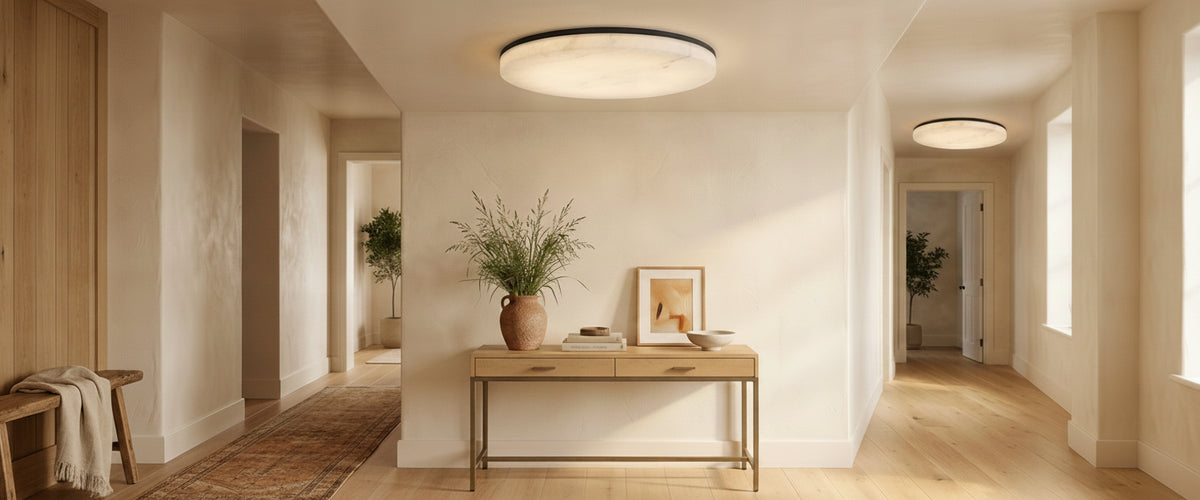

Most hallways are lit by whatever the developer left behind: a shallow plastic disc, a cool white bulb, and two pools of shadow where the corridor meets the doors. A flush mount hallway fitting gets walked under a hundred times a day and chosen in about ninety seconds, which is exactly why so many of them look wrong. Get the ceiling height, the diffuser material and the spacing right and a hallway flush mount stops a corridor feeling like a transit route and starts reading as a proper room with a job to do.

At a Glance
Under 2.4m (about 8ft): flush mount hallway fittings only. Anything that drops will be felt before it is seen.
2.4m to 2.7m (8ft to 9ft): flush or slim semi-flush, keeping at least 2.1m (7ft) of clear head height beneath.
Diffuser matters more than wattage: alabaster and honed stone soften output; frosted acrylic flattens it.
Spacing beats brightness: plan fittings roughly every 2m to 2.5m (6ft 6in to 8ft) rather than one big fitting fighting a long run.
Warm and dimmable: 2700K to 3000K, CRI 90+, on a dimmer that is confirmed compatible with the driver.
Always use a qualified electrician to check ceiling fixing, joist positions and loop-in wiring before any hallway flush mount is committed to plasterboard.

Why a Flush Mount Hallway Fitting Deserves Real Thought
Hallways are the only spaces in a house you experience almost entirely in motion. You see the ceiling from below at walking pace, at an angle, usually with a door frame or a stair rail cropping the view. That makes the underside of a fitting the most important surface on it. A cheap hallway flush mount shows you its bulb, its screws and its dust; a well-made one shows you a lit surface.
There is a second reason to take the decision seriously. Hallways set the tone for every room that opens off them. If the corridor is lit at 4000K and the sitting room is at 2700K, the eye adjusts every time you cross the threshold, and the warmer room reads slightly dingy for a few seconds. Your flush mount hallway lighting and the lamps in the rooms beyond should share a color temperature; consistency across circulation space is one of the quiet things that makes a house feel resolved.
Alabaster answers the hallway problem well because the material does the diffusing itself. English alabaster is a fine-grained form of gypsum, quarried across the Midlands for centuries and mapped by the British Geological Survey, and it has been worked for lighting because light passes into the stone rather than bouncing off it. In a flush mount hallway fitting, that translucency means the glow comes from the whole disc, not a hot spot in the center.
The Ceiling Height Numbers That Decide Flush Mount vs Pendant
The usual advice about hanging heights collapses in a corridor because the constraint is not aesthetic, it is physical. Nobody wants a shade brushing a shoulder as they carry a suitcase to the stairs.
Work to a minimum of 2.1m (7ft) of clear space beneath the lowest point of the fitting, and more if the hallway carries traffic with luggage, prams or ladders. On a standard 2.4m (8ft) ceiling, a flush mount hallway fitting is the only sensible answer; the fitting itself will eat 8cm to 15cm and you are already close to the limit. Where every centimeter of head height counts, a shallow-profile piece such as the Oracle White Slim Flush Ceiling Light 2700K, 50cm sits closer to the plaster than most semi-flush shapes while still covering a decent span of ceiling. At 2.6m to 2.7m (roughly 8ft 6in to 9ft), a slim semi-flush becomes possible and adds a little depth and shadow line to the ceiling.
Above about 2.9m (9ft 6in), in a Victorian or Georgian entrance hall, a pendant or small chandelier starts to earn its place, though even then a flush mount hallway fitting can be the better choice further along the corridor where the ceiling drops. Split-level halls in period houses often have two different ceiling heights within six paces of each other. Match the fixture type to each section rather than forcing one solution down the whole run.
Alabaster, Glass and Frosted Acrylic: What Each Does to a Narrow Corridor
Diffuser material changes the character of a corridor more than lumen output does, and it is the first thing to settle once you know a flush mount hallway format is right for the ceiling height.
Alabaster and Honed Natural Stone
Light entering alabaster scatters inside the stone before it leaves, so the surface glows unevenly in a way that reads as depth. Veining shifts as you walk under it. In a narrow hallway this is genuinely useful: a corridor with a plain ceiling and a single interesting lit object above has somewhere for the eye to rest. Warm-toned stone also flatters emulsion paint, timber floors and skin tones near the mirror by the front door. That is the whole argument for a stone hallway flush mount over anything backlit and plastic. Our own alabaster lighting collection leans on this, and the flush and semi-flush shapes tend to be the pieces designers specify for circulation space rather than the statement chandeliers.
Opal and Ribbed Glass
Glass gives a cleaner, more even wash and suits corridors where the architecture is already busy. Ribbed and reeded glass throws faint vertical striations onto the ceiling that can be attractive at night. What it will not do is give you the density and warmth of stone; glass looks lit, stone looks luminous. A glass hallway flush mount is also easier to keep looking new behind a front door that opens onto a road.
Frosted Acrylic
Acrylic is light, inexpensive to produce and consistent, which is why so much builder-grade product uses it. Two problems in a corridor. It yellows over years of continuous LED heat, and it reads as flat white in daylight, which makes the ceiling look punctuated by blank discs. If budget is pushing you toward acrylic, consider fewer, better flush mount hallway fittings and supplementary wall lights instead.
Finish and Form Against White Ceilings, Bold Colour and Period Cornicing
On a plain white ceiling, a pale alabaster disc with a slim brass or bronze rim gives you contrast without shouting. The metal edge is what stops it disappearing; a white flush mount hallway fitting on a white ceiling in daylight is invisible in the wrong way, and the space looks unfinished.
Against a saturated hallway color, a deep green, an inky blue, a warm clay, the calculus changes. Stone reads much brighter, and an aged brass or blackened finish anchors it. A warm metal edge like the one on the Oracle Brass Slim Flush Ceiling Light 3000K, 50cm is the kind of detail that holds its own against a dark ceiling instead of dissolving into it. If you are painting the ceiling in the same color as the walls, which is a good move in a low corridor, choose a flush mount hallway piece with some physical depth so it casts a shadow and defines itself.
Period cornicing is where people make mistakes. A heavily molded Victorian cornice and a ceiling rose expect a fitting with a defined circular backplate; a square or rectangular hallway flush mount fights the geometry. Keep the fitting concentric with the rose where one exists, and if the rose is off-center because a wall was moved decades ago, be honest about it and either center to the corridor width or restore the plasterwork. Photograph the ceiling detail on your phone before you browse the wider lighting range; it is far easier to judge a backplate against a real cornice than against a mental image.
Scale Mistakes: Why a Fitting Sized for a Room Looks Wrong in a Corridor
The single most common error we see is a fitting bought for a bedroom and then pressed into service as a flush mount hallway light. In a square room, a 50cm disc sits in open ceiling and looks proportionate. Put the same disc in a 1m wide corridor and it spans half the width, and because the sight lines run along the hall rather than across it, the ceiling reads crowded rather than generous.
A more useful rule for hallway ceiling lights fixtures: relate diameter to corridor length as well as width. In a short hall of 2m to 3m, one fitting at around 40cm to 50cm carries the space, assuming the corridor is not unusually narrow. In a long run, use smaller flush mount hallway fittings repeated at regular intervals; three well-spaced 35cm discs look considered, while one oversized fitting at the midpoint leaves both ends gloomy and the middle glaring. For that repeated approach, a modest warm-toned disc such as the Twilight White LED Flush Ceiling Light 12W 3000K, 35cm is the more sensible unit to multiply than a single wide fitting stretched over the whole corridor.
A client in a converted Edwardian terrace came to us last year with a plan for one large fitting in a 9m hall that turned a corner halfway along. That single fitting would have lit the turn and abandoned the front door. Four smaller alabaster flush mounts, evenly spaced on one dimmed circuit, gave a rhythm you notice as you walk. That rhythm is the point of a flush mount hallway scheme.
Bulbs, Colour Temperature and Dimming
Specify 2700K for warm plaster and timber, 3000K where the stone itself is cooler or the walls are gray. Choose lamps or integrated LEDs at CRI 90 or above; below that, natural stone veining goes muddy and paint colors shift. Avoid 4000K in a domestic hallway entirely, however tempting the brightness looks in a showroom.
Dimming is worth the effort. A hallway wants to run at perhaps 30 percent late at night and full output when you are looking for keys in a coat pocket. Confirm that the dimmer module is compatible with the specific driver, and where several flush mount hallway fittings share a circuit, check the combined minimum load; low-wattage LED fittings frequently sit below a dimmer's threshold and flicker as a result.
What a Qualified Electrician Should Confirm Before Anything Goes Up
A stone hallway flush mount weighs more than the acrylic disc you are replacing. That single fact drives most of this checklist.
Fixing substrate: is there a joist, a noggin or only plasterboard at the mounting point? Stone and glass need mechanical fixing into timber or a rated plasterboard anchor.
Weight allowance: confirm the fitting's mass against the fixing method, especially in lath and plaster ceilings.
Existing wiring condition: older rubber or fabric-insulated cable at the ceiling rose should be replaced, not reused.
Loop-in versus junction box: flush mount hallway backplates offer little void for a crowded loop-in terminal; ask whether a junction box above the ceiling is the tidier answer.
Heat clearance: insulation packed against a driver shortens its life. Check the void above.
Circuit and switching: two-way or intermediate switching at both ends of a long corridor and at the top of the stairs.
Certification: work should comply with BS 7671, the UK wiring regulations published by the IET, and be signed off appropriately.
Never treat mains work as a DIY job. Positioning, however, is yours to decide, and it is worth marking centers on the ceiling with low-tack tape and living with them for a day before drilling.
Keeping Stone Flush Mounts Looking Right
Hallways collect dust from the front door faster than any other space. Dry-dust an alabaster or marble hallway flush mount with a soft microfiber cloth every few weeks; the stone is porous and mildly reactive, so skip vinegar, citrus and any general-purpose spray. A barely damp cloth followed by a dry one handles marks. Brass rims can be left to patinate or kept bright with a proprietary polish applied to the cloth rather than the fitting.
As for budget, cost tracks the material, the size of block the piece is cut from, the metalwork and the driver quality, so it is worth asking us for a quote against your actual corridor dimensions and fitting count. If you want a starting point, look at how the shapes behave in situ across the Niori range, then narrow by ceiling height first and finish last. A flush mount hallway scheme rewards that order every time.